U.S. Politics · Congress · National Security
House Blocks Hegseth Impeachment Vote, Refers Resolution to Committee
The 211-204 vote stopped an immediate decision on eight impeachment articles against Defense Secretary Pete Hegseth. It did not acquit him, remove him or resolve the underlying disputes over war powers and military policy.
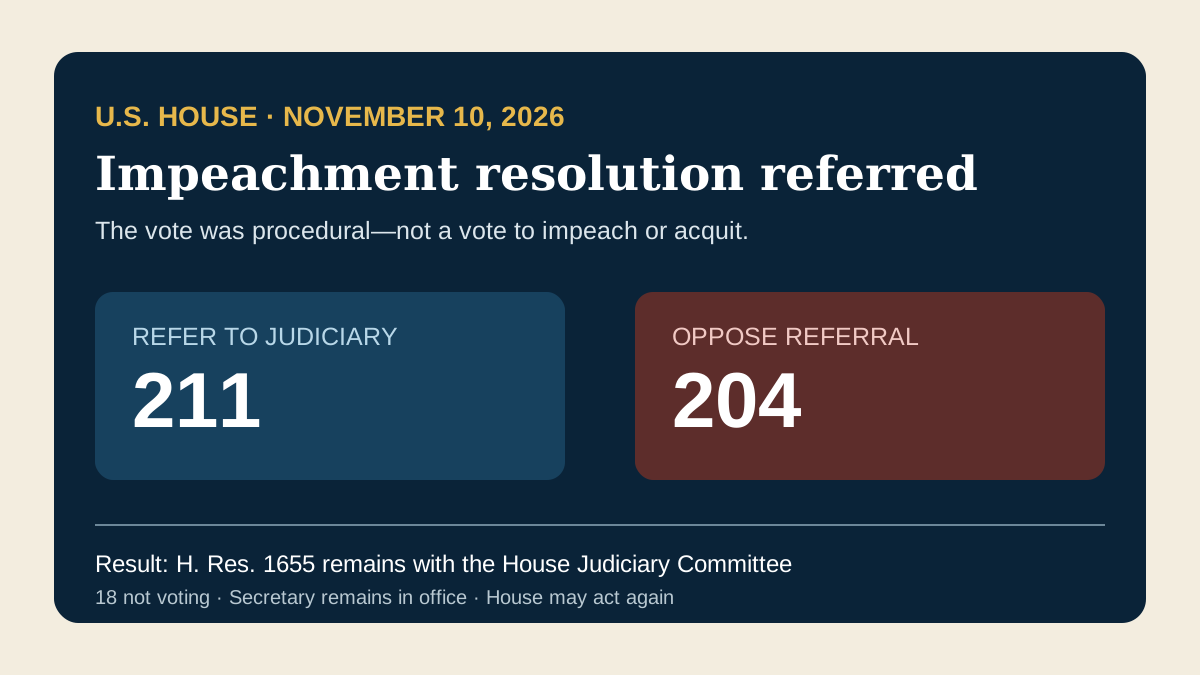
Verified baseline: the House voted on referral, not impeachment
The House voted Tuesday evening to send H. Res. 1655 to the Judiciary Committee. The official House Clerk record shows the motion passed 211-204, with 18 members not voting. Republicans voted 210-1 for referral; Democrats voted 203-0 against it; the chamber’s independent member voted for referral.
That distinction matters. Members did not vote to adopt or reject the eight articles of impeachment. Referral interrupted the immediate floor path and put the resolution in committee, where it can be considered, amended, reported or left without further action.
Hegseth remains defense secretary. The vote changed neither military orders nor the legal status of current operations. It also did not make a factual finding about any allegation in the resolution.
What the resolution alleges—and what is not established
Representative Thomas Massie, a Kentucky Republican, introduced the resolution. The published text of the eight articles accuses Hegseth of directing unauthorized military operations, disregarding congressional war-powers measures, participating in the capture of Venezuelan President Nicolás Maduro, retaliating against critics and other abuses of office.
Those are congressional accusations, not criminal charges or judicial findings. The resolution cites the War Powers Resolution and constitutional limits on executive power, but the House referral did not decide whether Hegseth violated either. The White House opposed the resolution, arguing that military decisions were lawful exercises of presidential authority and that impeachment would undermine national security.
The core dispute is partly legal and partly political: how much authority the executive branch may exercise in sustained hostilities without a new, specific authorization from Congress, and whether the secretary’s conduct rises to the constitutional standard for impeachment. The vote settled neither question.
Why the procedural vote matters
Referral protects Hegseth from an immediate impeachment vote during the current Republican-controlled House. It also gives the Judiciary Committee control over whether the resolution receives hearings or advances before the present Congress ends.
The result is not permanent immunity. Democrats are set to control the House in January, and a new Congress can investigate the same conduct or introduce new articles. Reuters reported that Democratic leader Hakeem Jeffries said he would consult members about whether to pursue another effort.
Even if a future House approved articles by a simple majority, removal would not be automatic. The Senate’s official impeachment guide explains that the Senate conducts the trial and conviction requires two-thirds of senators present. The House acts as accuser; the Senate decides whether to convict.
Practical implications for the public
- No leadership change: Hegseth continues to run the Defense Department, and the vote itself does not change deployments, command authority or military benefits.
- Oversight continues: Congress may still hold hearings, seek documents, pass funding restrictions or pursue separate war-powers legislation without impeaching anyone.
- No verdict on military policy: support for or opposition to a referral motion should not be read as a legal ruling on every military operation named in the articles.
- Another vote remains possible: the committee could act, or lawmakers could start a new effort in the next Congress.
Health Politics Daily previously examined Congress’s debate over the costs and authorization of the Iran war and what incoming Democratic control changes in January. Those questions remain live regardless of Tuesday’s referral.
Fact, analysis, forecast and opinion
Verified fact: the House voted 211-204 to refer H. Res. 1655 to the Judiciary Committee. Analysis: referral prevented an immediate up-or-down impeachment vote while preserving the resolution as a committee matter. Forecast: the incoming House majority may revisit Hegseth’s conduct, but whether it will impeach him—and whether two-thirds of the Senate would convict—cannot be known now. Opinion: Health Politics Daily takes no position on Hegseth’s tenure or the merits of impeachment.
What remains uncertain
It is unclear whether the Judiciary Committee will schedule hearings before January, whether Democratic leaders will introduce a new resolution and whether any future investigation will produce evidence beyond the allegations already published. It is also uncertain how Congress and the courts will address the underlying war-powers disputes.
The close vote should not be converted into a hypothetical impeachment tally. Eighteen members did not vote, and members can vote differently on a procedural referral than on impeachment itself.
Bias Lens: accountability, procedure or partisan defense?
Verified baseline: the House voted 211-204 to refer—not adopt or reject—eight impeachment articles against Hegseth. The referral stopped an immediate floor decision and left the resolution with the Judiciary Committee.
Left-leaning — The Guardian: emphasized frustration among Democrats over absences and the narrow margin, presenting the result through the prospects for renewed accountability. Center — Reuters: centered the procedural outcome, vote count, allegations and statements from both Hegseth and Democratic leaders. Right-leaning — Fox News Digital: described the referral as GOP leaders blocking a renegade Republican’s push and stressed the political defeat of the resolution.
The differences are primarily about emphasis: missed opportunities for accountability, the institutional mechanics, or Republican unity. None of those frames changes the official record, and none turns a referral vote into a merits judgment.
Principal sources
- Office of the Clerk, U.S. House — Roll Call 317
- H. Res. 1655 — text of the eight articles
- White House — statement opposing the resolution
- U.S. Senate — official impeachment procedure
- Reuters — vote and political response
No directly relevant official or publisher-authorized video with clear persistent embedding permission was available at publication, so no video was embedded.
No comments yet.