International Politics · Rwanda · Democratic Republic of the Congo
U.S. Sanctions Rwanda’s Defense Ministry and Zigama Over Alleged M23 Support
The targeted designations block covered property and transactions; Rwanda disputes Washington’s account of the Congo conflict.
By Health Politics Daily News Desk · October 28, 2026 at 6:00 p.m. ET

Watch in this article
Pumpjack operating at the Kern River Oil Field
A short CC0 field video provides visual context for reporting on oil production and fuel supply.
Thomas Farley / Wikimedia Commons · CC0 1.0 · License and source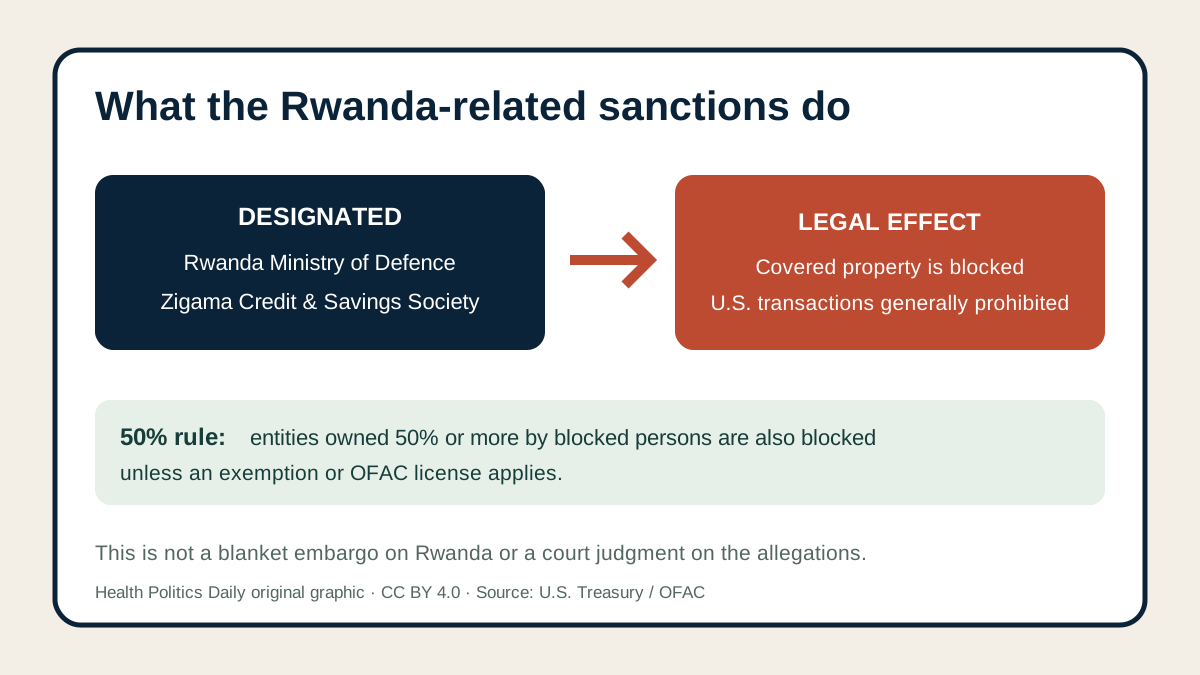
Verified baseline
The U.S. Treasury’s Office of Foreign Assets Control on Wednesday designated Rwanda’s Ministry of Defence and Zigama Credit and Savings Society under the executive order governing Democratic Republic of the Congo-related sanctions. Treasury says both materially supported Rwanda’s armed forces and the M23 movement in eastern Congo.
The designation is a government enforcement action, not a judicial finding. Rwanda denies supporting M23. Its government says it remains prepared to implement the 2025 Washington Accords if Congo fulfills commitments concerning the Democratic Forces for the Liberation of Rwanda and the mediator holds all parties accountable.
What the sanctions legally change
Property and interests in property belonging to the two designated entities that are in the United States or controlled by U.S. persons are blocked and must be reported to OFAC. U.S. persons generally may not transact with them unless a license or exemption applies. Under OFAC’s 50% rule, entities owned at least 50% by blocked persons are also blocked.
The action does not impose a general trade embargo on Rwanda, automatically freeze every Rwandan government entity or authorize seizure of all Rwandan assets. Companies must evaluate the parties, ownership and transaction involved rather than infer that all Rwanda-related business is prohibited.
Treasury’s allegations
Treasury says the defense ministry directed thousands of Rwanda Defense Force troops deployed in North and South Kivu, where U.S. officials allege they operated alongside M23 and supplied equipment, logistics and training. The State Department’s statement also alleges that surface-to-air missiles and jamming equipment created risks for civilian aviation.
Treasury alleges Zigama facilitated payments abroad for weapons and military equipment, handled Rwanda Defense Force travel and training costs, and enabled gold from M23-controlled territory to move to Kigali. Those are U.S. government allegations supporting the designation; the public material reviewed does not include a court-tested evidentiary record.
Why the action matters
M23 and its political allies control substantial territory in eastern Congo after capturing major cities and mining areas. The United States and U.N. experts say Rwanda supports the movement; Kigali disputes that account and points to security threats from the FDLR, a militia with roots in perpetrators of the 1994 genocide.
The sanctions also test Washington’s mediation. Rwanda and Congo signed the U.S.-brokered Washington Accords in December 2025, but fighting has continued. Congo welcomed Wednesday’s sanctions and called for Rwandan withdrawal; Rwanda says implementation must be reciprocal.
Practical implications
- Financial institutions: screen the named entities, ownership links and payment chains against current OFAC data and licenses.
- Mineral buyers: strengthen traceability for gold and coltan originating in or moving through eastern Congo and Rwanda; the designation does not prove the source of any individual shipment.
- Aid organizations: targeted sanctions do not end humanitarian work, but banks may apply added compliance checks. Organizations should review applicable exemptions and licenses.
- Travelers: the action does not itself close borders or change visa rules; current government travel advisories remain controlling.
This is general reporting, not legal or financial advice.
Fact, analysis, forecast and opinion
Verified fact: OFAC designated the defense ministry and Zigama, producing immediate blocking and transaction restrictions. Analysis: Washington is escalating pressure after diplomacy failed to stop fighting. Forecast: the measures could constrain financing or prompt negotiations, but their battlefield and diplomatic effects are unknown. Opinion: Health Politics Daily takes no position on the sanctions or the parties’ competing security claims.
For related sanctions mechanics, see our reports on the October 21 Iran-related designations and the U.S. designation of the International Criminal Court. Those actions use different authorities and licenses; they do not establish the scope of this Congo-related action.
Bias Lens: enforcement, conflict context and Rwanda’s response
Verified baseline: OFAC designated two Rwandan entities; Rwanda disputes the premise that it supports M23, while Congo welcomed the action.
A left-center-right comparison is not forced here because the first wave of coverage has not produced a meaningful, well-sourced partisan split. Center-oriented Reuters foregrounded the sanctions, continuing combat and all three governments’ positions. The Associated Press placed greater emphasis on mineral-rich territory, humanitarian consequences and the limited effect of the peace deal. Rwanda-based Rwanda Dispatch highlighted Kigali’s denial and the unmet FDLR issue. These differences reflect sourcing and regional perspective more than a clean U.S. ideological divide; Treasury’s notice remains the baseline for the legal action.
What remains uncertain
It is unclear whether Rwanda will retaliate, whether OFAC will issue additional licenses or guidance, or whether the designations will alter troop deployments, mineral flows or peace talks. Zigama had not issued a public response at publication.
Principal sources
- U.S. Treasury / OFAC designation announcement
- OFAC recent-action record
- U.S. State Department statement
- Reuters, including Rwandan and Congolese responses
- Associated Press report
No suitable directly relevant official or publisher-authorized video with clear embedding permission was available, so no video was embedded.
No comments yet.