U.S. Politics · Justice Department · Federal Courts
Grand Jury Declines to Indict Cassidy Hutchinson Over Jan. 6 Testimony
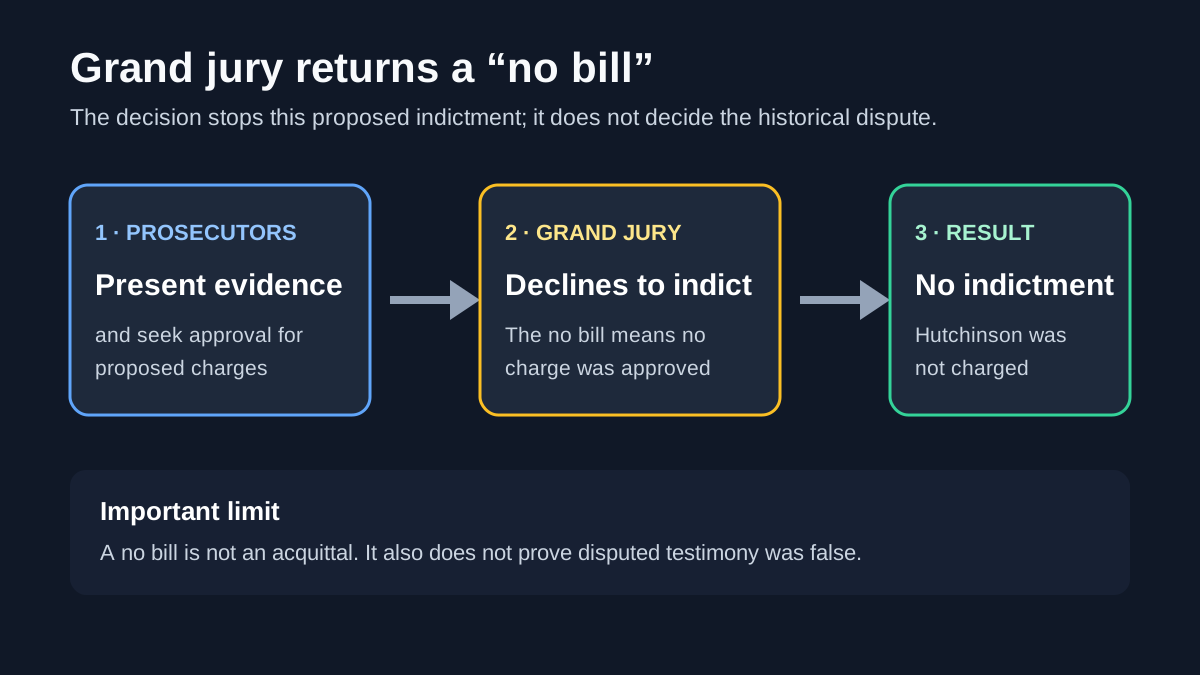
The Washington grand jury’s “no bill” means former White House aide Cassidy Hutchinson was not charged. It is not a trial verdict on her testimony, and the Justice Department has not disclosed the proposed charges or evidence.
By Health Politics Daily News Desk · October 28, 2026 at 12:00 a.m. ET
Verified baseline
A federal grand jury in Washington declined to approve an indictment of Cassidy Hutchinson, a former aide to White House chief of staff Mark Meadows who became a prominent witness before the House committee investigating the January 6, 2021, Capitol attack. Reuters, the Associated Press, CBS News, NBC News and Fox News independently reported the result on October 27.
A Justice Department prosecutor told U.S. Magistrate Judge Zia Faruqui in open court that a Washington grand jury had not concurred in a proposed indictment, Reuters and The Washington Post reported. The prosecutor did not name the proposed defendant or charges; news organizations identified the matter as Hutchinson’s through officials or sources familiar with the proceedings.
What the no bill means
A grand jury decides whether prosecutors have shown probable cause to bring a criminal charge. Its refusal to return an indictment—often called a “no bill”—means Hutchinson was not charged through that presentation. It is legally significant because the government did not clear the threshold needed to start the proposed prosecution.
The result is not an acquittal: there was no criminal trial, adversarial presentation or jury verdict. It also does not establish that every statement Hutchinson made was true, or that disputed statements were false. Prosecutors can sometimes present a matter again if they obtain additional evidence, but the Justice Department had not announced whether it would do so.
What was under scrutiny
News organizations reported that the investigation concerned whether Hutchinson made false statements to Congress during the January 6 inquiry. Republican lawmakers had urged the Justice Department to examine her testimony, particularly an account she said had been relayed to her about President Donald Trump’s actions inside the presidential vehicle after his Ellipse speech.
Hutchinson testified in 2022 that then-White House deputy chief of staff Tony Ornato told her Trump tried to grab the steering wheel and lunged toward a Secret Service agent when told he could not go to the Capitol. She did not claim to have witnessed that episode. A driver later told congressional investigators that Trump wanted to go to the Capitol but that he did not see Trump grab the wheel or lunge into the front seat. Hutchinson has maintained that her testimony was truthful.
The public reporting does not establish which specific statement prosecutors put before the grand jury, what statute they proposed using or what evidence was presented. Those gaps matter: a dispute over an account is not by itself proof of a knowingly false statement, and intent is normally central to a false-statements case.
Why it matters
The decision is consequential because a grand jury rejected a politically sensitive prosecution involving testimony about a sitting president. It also arrives amid broader disputes over whether the Justice Department is applying criminal law neutrally or pursuing the president’s critics. Those institutional questions are legitimate subjects for oversight, but the no bill alone does not prove a political motive by prosecutors.
For Hutchinson, the immediate result is that no indictment issued. For Congress, the episode underscores the difference between conflicting testimony, a criminal referral and a provable federal offense. For the public, it is a reminder to distinguish a source-described investigation from charges filed in court.
Fact, analysis, forecast and opinion
Verified fact: a Washington grand jury declined to approve a proposed indictment, and multiple news organizations identified the matter as the Hutchinson investigation. Analysis: the no bill is a meaningful check on prosecutorial power, but incomplete public records limit conclusions about why jurors rejected the request. Forecast: prosecutors could close the inquiry or attempt another presentation if new evidence emerges; no public announcement establishes either path. Opinion: Health Politics Daily favors transparent, evenhanded enforcement and precise language that neither treats an investigation as guilt nor a no bill as a historical verdict.
Practical implications
- No pending charge from this presentation: Hutchinson does not face an indictment arising from the grand jury decision reported Tuesday.
- No finding on the testimony: the no bill is not proof that Hutchinson’s account was fully validated or disproved.
- Records may remain limited: federal grand jury proceedings are secret, so the proposed charging document and evidence may not become public.
Related context includes our coverage of the federal indictment of Virginia Sen. Louise Lucas, the Justice Department’s California voter-registration lawsuit and the Supreme Court dispute over federal records.
Bias Lens: legal outcome or political rebuke?
Verified baseline: the grand jury declined to indict Hutchinson; the proposed charges and evidence remain undisclosed; the decision does not determine whether every disputed statement was true.
Left-leaning — The Washington Post: foregrounds the decision as a rebuke to a Justice Department effort involving a perceived Trump adversary and emphasizes the unusual Civil Rights Division role. Center — Associated Press and Reuters: lead with the failed indictment, then balance Hutchinson’s testimony, the later contradiction and political context. Right-leaning — Fox News: emphasizes the allegation that Hutchinson lied and the disputed parts of her account while explicitly noting that the no bill proves neither truth nor falsity. The frames differ in their weight on institutional motive versus disputed testimony; all agree on the no-indictment result.
What remains uncertain
The Justice Department has not publicly released the proposed charges, explained which testimony it viewed as false, or said whether the investigation is over. The public also does not know the evidence grand jurors reviewed or their reasons for declining to indict. Because grand jury deliberations are secret, a complete account may never be available.
Principal sources
- Reuters: court confirmation and source reporting
- Associated Press: grand jury result and testimony context
- CBS News: corroborating reporting
- U.S. House January 6 committee final report
No suitable directly relevant official or publisher-authorized video with clear embedding permission was available, so none was embedded.
No comments yet.