U.S. Politics · 2026 Elections · Congress
Democrats Win House and Senate, Setting Up Divided Government
Race calls show Democrats capturing both chambers after gains across traditionally Republican territory. The result gives the party congressional control in January, while President Donald Trump retains the veto and broad executive authority.
By Health Politics Daily News Desk · November 4, 2026 at 4:00 a.m. ET

Watch in this article
Pumpjack operating at the Kern River Oil Field
A short CC0 field video provides visual context for reporting on oil production and fuel supply.
Thomas Farley / Wikimedia Commons · CC0 1.0 · License and source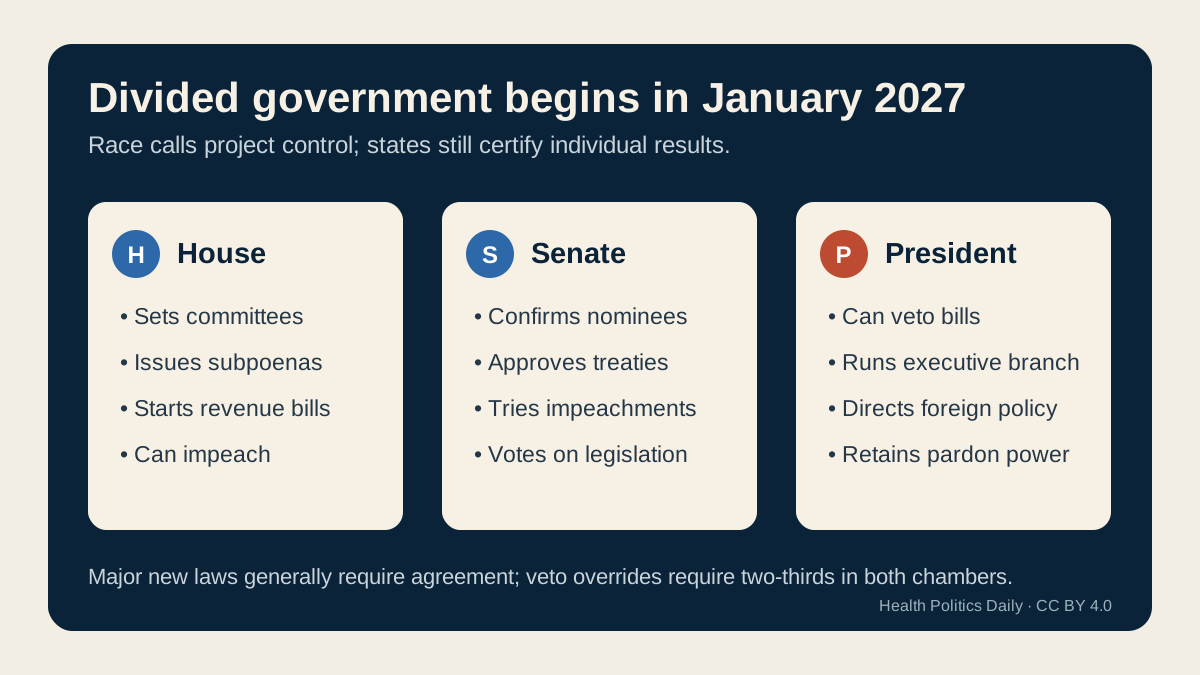
Verified baseline
The Associated Press, Reuters and other major election desks projected early Wednesday that Democrats had won enough races to control both the U.S. House and Senate. Democrats flipped at least seven Senate seats and gained more than two dozen House districts, including victories in states and districts President Trump carried in 2024.
These are race calls based on reported vote and outstanding-ballot analysis. They are not state certifications. State and local election officials continue counting eligible ballots under state law, and each state certifies its own results. The Federal Election Commission explains that it does not certify federal election results.
What changes when the new Congress takes office
Democratic majorities will choose committee leaders, control hearing agendas and decide which bills receive votes. The House can conduct investigations, issue subpoenas through its committees and initiate impeachment proceedings. The Senate can slow or reject presidential nominees, including judges and Cabinet officials, and must consent to treaties.
Congress also controls appropriations. Because both chambers must pass the same spending legislation, the new majorities can demand negotiations over agency budgets and policy conditions. That leverage is real, but failure to compromise can also produce funding lapses.
What does not automatically change
President Trump remains in office through January 2029. He can veto legislation, direct executive agencies within existing law, conduct diplomacy, exercise commander-in-chief authorities and issue pardons for federal offenses. Congress can override a veto only with two-thirds majorities in both chambers—far more than current projections show Democrats winning.
A Democratic Congress therefore cannot enact its entire campaign agenda alone. It can block legislation, refuse nominations, investigate and negotiate, but major new laws generally require presidential agreement or a veto-proof coalition. The courts will continue to decide legal challenges independently.
Why voters moved
AP VoteCast and current reporting point to dissatisfaction with living costs, the Iran war and perceived government corruption. Democrats also won in several places that had appeared structurally difficult, including Senate races in Texas, Kansas and South Carolina.
Analysis: national conditions clearly mattered, but no single issue explains every race. Candidate quality, fundraising, turnout, redistricting and state-specific concerns varied. A vote for a congressional candidate cannot be assumed to express a view on every presidential policy.
Practical implications
- Federal benefits and taxes: existing laws do not change because election desks called a majority. Any revisions still require legislation and, ordinarily, the president's signature.
- Agency rules: Congress may use hearings, appropriations and the Congressional Review Act, but executive agencies remain operational unless law or funding changes.
- Nominations: pending nominees face a different Senate after the new Congress convenes; the current Senate remains in office during the lame-duck session.
- Election results: voters should use state election websites for official counts and certification dates, especially in uncalled or close races.
Fact, analysis, forecast and opinion
Verified fact: major election desks project Democratic control of both chambers. Analysis: the result creates divided government and strengthens congressional oversight. Forecast: more investigations and budget conflict are likely, but their scope and outcomes are not settled. Opinion: Health Politics Daily supports transparent certification and clear separation between projected winners, official results and political interpretation.
Bias Lens: mandate, backlash or ordinary midterm correction?
Verified baseline: Democrats have been projected to win both chambers; the exact seat totals are incomplete, and states have not yet certified all results.
Left-leaning — The Guardian: frames the Senate result as voters rejecting Trump's agenda and emphasizes an unexpectedly broad reversal. Center — Associated Press: leads with the institutional change and a mix of economic, war and governance concerns. Right-leaning — Fox News Elections Center: foregrounds individual race calls and Republican losses, while its opinion coverage focuses on party strategy and candidate failures.
Those frames differ mainly over how much the result should be read as a personal verdict on Trump versus a broader midterm response. The seat calls are independently checkable; claims about a national mandate are interpretations.
What remains uncertain
Final margins, the exact size of each majority and several individual races remain unsettled. Party leadership elections, committee assignments and the lame-duck agenda will determine how quickly the institutional shift becomes visible. It is also too early to know whether the two branches will bargain on budgets and foreign policy or rely mainly on vetoes, subpoenas and confrontation.
Principal sources
- Associated Press — congressional control and nationwide race calls
- Reuters — results, battlegrounds and divided-government implications
- Federal Election Commission — state responsibility for official results
- U.S. Senate — constitutional powers and procedures
- USAGov — legislation and presidential vetoes
No suitable directly relevant official or publisher-authorized video with clear persistent embedding permission was available.
No comments yet.