U.S. politics · 2026 midterms · Polling
Democrats Lead Republicans in New Midterm Poll as Cost-of-Living Concerns Persist
A new national survey shows Democrats ahead on the congressional ballot and voters dissatisfied with household costs. The findings measure the political environment—not the outcome of hundreds of separate House and Senate races.
By Health Politics Daily News Desk · October 26, 2026 at 6:01 p.m. ET

Verified baseline
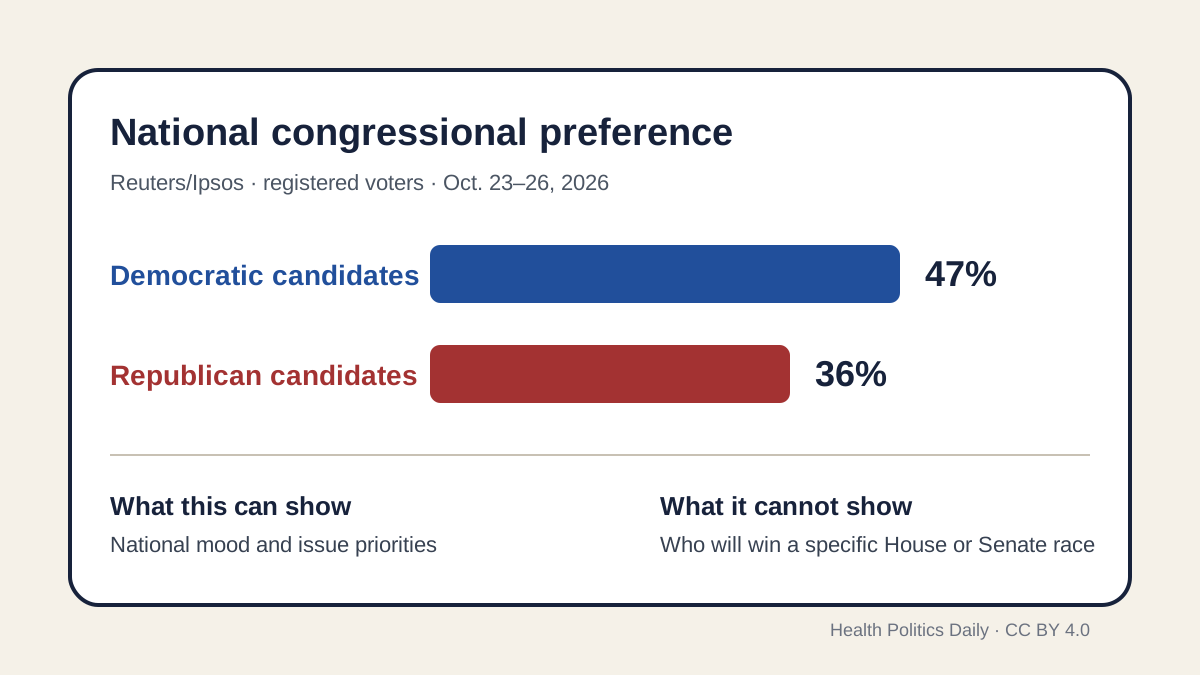
A Reuters/Ipsos poll released October 26 found 47% of registered voters preferred a Democratic congressional candidate and 36% preferred a Republican. When undecided voters who leaned toward a party were included, the split was 50% to 41%.
President Donald Trump’s overall approval was 32%, up one percentage point from the prior week and within the poll’s margin of error. Among all adults, 73% said the cost of living was moving in the wrong direction; 25% approved of Trump’s handling of the economy and 20% approved of his handling of living costs.
How the poll was conducted
Ipsos surveyed 1,679 U.S. adults online from October 23 through October 26 using its probability-based KnowledgePanel, including 1,280 registered voters. The margin of sampling error was about two percentage points for all adults and three points for registered voters. Weighting can make a sample nationally representative, but every poll still carries sampling and non-sampling uncertainty.
Why it matters
Control of Congress will shape taxes, spending, oversight, judicial confirmations and the administration’s ability to enact legislation during the final two years of Trump’s term. The poll suggests the national political environment favors Democrats and that affordability remains a major vulnerability for Republicans.
That does not translate mechanically into seats. House outcomes depend on district boundaries and local candidates; Senate control depends on the particular states voting this year. Turnout, late campaign events and polling error could produce a result different from the national preference.
What voters can take from the numbers
The clearest signal is not the one-point movement in presidential approval, which is statistically indistinguishable from no change. The stronger signals are the persistent Democratic ballot advantage, higher reported Democratic enthusiasm and widespread economic dissatisfaction.
People comparing campaign claims should look for district- or state-level evidence, survey dates, sample definitions and margins of error. A national poll is useful context, not proof that either party will win Congress.
Fact, analysis, forecast and opinion
Verified fact: Democrats led the national congressional ballot in this survey, while Trump’s approval stood at 32%. Analysis: the results indicate a difficult national environment for Republicans, especially on affordability. Forecast: Democrats appear better positioned in the House than Republicans, but the poll alone cannot establish who will control either chamber. Opinion: Health Politics Daily favors transparent polling methods and careful uncertainty language, not any party or candidate.
Bias Lens: wave warning, economic referendum or uncertain race?
Verified baseline: Reuters/Ipsos measured a Democratic national-ballot advantage and low approval for Trump’s economic performance. It did not forecast seat totals or declare a winner.
Left-leaning coverage: The Guardian emphasizes voter frustration, Republican vulnerability and Democratic opportunities in normally conservative states. Center coverage: Reuters leads with the measured approval and ballot numbers while stressing House–Senate differences. Right-leaning coverage: Fox News, reporting its own earlier poll, similarly highlights cost-of-living concerns but gives more attention to issue-level Republican strengths and voter-group changes.
The outlets use different surveys and news frames, so their percentages should not be treated as a single combined measure. The common thread is economic dissatisfaction; the difference is whether coverage foregrounds a Democratic opportunity, neutral polling signals or remaining Republican advantages.
What remains uncertain
Early voting is underway, but final turnout is unknown. The generic ballot cannot capture candidate quality, state-specific coalitions, district boundaries or post-survey events. A small approval shift inside the margin of error should not be described as a meaningful rebound.
Principal sources
- Ipsos — findings, sample and methodology
- Reuters — results and congressional context
- Associated Press — campaign and competitive-race context
- Reuters — election mechanics and chamber control
No suitable official or publisher-authorized video with clear downstream embedding permission was available, so no video was embedded.