International politics · Israel · Elections
Israel Heads to Polls in First National Election Since October 7 Attack
Voters will choose party lists for the 120-seat Knesset on Tuesday. The ballot will test Prime Minister Benjamin Netanyahu's governing coalition, but election night may not establish who can assemble the next government.
By Health Politics Daily News Desk · October 27, 2026 at 12:03 a.m. ET

Watch in this article
Pumpjack operating at the Kern River Oil Field
A short CC0 field video provides visual context for reporting on oil production and fuel supply.
Thomas Farley / Wikimedia Commons · CC0 1.0 · License and source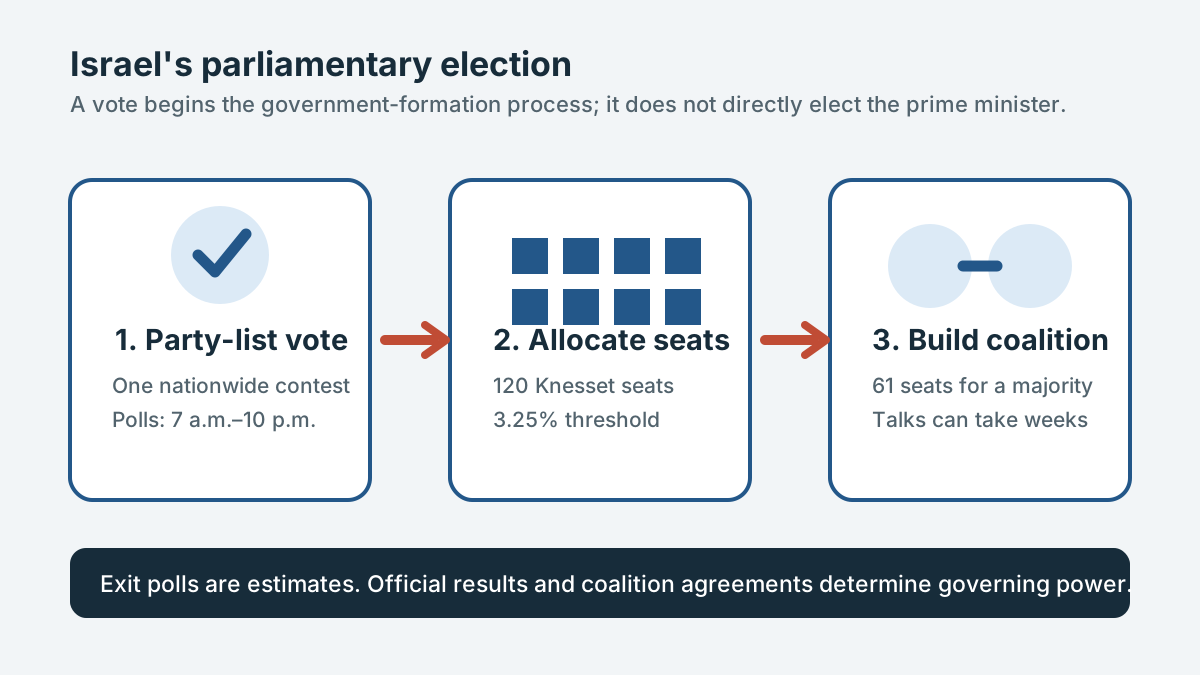
Verified baseline
Israel holds its election for the 26th Knesset on October 27, according to the government's official election notice. Polling stations are scheduled to open at 7 a.m. and close at 10 p.m. local time. The official voter-information service provides polling-place and accessibility details.
This is Israel's first national election since the Hamas-led attack of October 7, 2023 and the wars that followed. It is a parliamentary election: voters choose party lists, not a prime minister directly.
What the ballot decides
All 120 Knesset seats are allocated through nationwide proportional representation. A party generally must receive at least 3.25% of valid votes to enter parliament. A governing majority normally requires support from at least 61 lawmakers, so smaller parties can determine whether either major bloc can form a coalition.
Television exit polls are expected after voting closes. They are estimates, not certified results. Reuters reports that a final tally is expected by October 30 and official results on November 4. Counting schedules can change, and close races near the electoral threshold can shift seat projections.
The central political choice
Netanyahu is seeking another mandate after nearly two decades of cumulative service as prime minister. His campaign emphasizes wartime leadership, security and his relationship with the United States. Former military chief Gadi Eisenkot leads the main centrist challenge and argues that the country needs accountability for the October 7 security failures and political reconstruction.
The choice extends beyond two leaders. Former prime minister Naftali Bennett, opposition leader Yair Lapid, nationalist and ultra-Orthodox parties, and Arab-led parties could all influence the governing arithmetic. A party can win the largest number of seats without being able to form a government.
Issues with practical consequences
Security and accountability: voters are weighing the government's handling of the October 7 attack, the Gaza war and wider regional conflict. Debate includes whether to establish an independent state commission of inquiry.
Military service: exemptions for many ultra-Orthodox men have become more contentious after extended reserve duty and wartime mobilization. Coalition agreements could affect legislation on conscription and public funding.
Courts and governance: the earlier judicial-overhaul fight remains a dividing line over the balance between elected officials and legal institutions. The next coalition may revive, revise or block those proposals.
Household costs and public services: housing, food prices, taxes and war-related spending affect voters regardless of their position on security. Campaign promises will still require budgets and coalition agreement before becoming policy.
What happens after the count
After official results, President Isaac Herzog is expected to consult the elected parties and ask the lawmaker considered most likely to form a government to try. That nominee can receive up to 42 days, including an extension, to assemble a coalition. If the effort fails, another lawmaker may receive an opportunity; continued deadlock can lead to another election while the existing government serves in a caretaker capacity.
For the public, this means three different moments should not be confused: exit-poll projections, certified seat totals and a signed coalition agreement. Only the last stage establishes a durable parliamentary majority.
Fact, analysis, forecast and opinion
Verified fact: Israelis are electing a 120-seat parliament under proportional rules, with 61 seats normally needed for a majority. Analysis: parties near the threshold and disagreements over cooperation with Arab-led parties could matter as much as which large party finishes first. Forecast: surveys and reporting indicate a close contest, but neither polls nor exit polls can establish the final coalition. Opinion: Health Politics Daily favors transparent counting, equal access to voting and clear coalition disclosures without endorsing any party or candidate.
Bias Lens: leadership referendum, democratic crossroads or security mandate?
Verified baseline: Israel is electing the Knesset, not directly choosing a prime minister. Netanyahu's future is central to the campaign, but the decisive legal question is which coalition can command at least 61 seats.
Left-leaning coverage: The Guardian stresses democratic institutions, the far right, Palestinian consequences and accountability after October 7. Center wire coverage: Reuters foregrounds Netanyahu's political survival, the security record and coalition arithmetic. Right-leaning coverage: Fox News emphasizes Netanyahu's legacy, wartime leadership and the prospect of deadlock.
These are differences in emphasis, not proof that one set of facts is exclusive to a political camp. The baseline mechanics come from official election information; claims about leadership and national direction remain campaign arguments until voters and coalition negotiations produce an outcome.
What remains uncertain
Turnout—especially among Arab citizens and disaffected voters—could change the seat distribution. Parties near 3.25% may enter or miss the Knesset, magnifying small changes in the vote. It is also unknown whether opposition parties would cooperate with Arab-led parties, whether a unity government is possible, or whether prolonged deadlock would leave Netanyahu as caretaker prime minister.
Principal sources
- Government of Israel — election date and official information
- Knesset — election and parliamentary information
- Reuters — counting and government-formation timeline
- Associated Press — voter priorities and October 7 context
No suitable official or publisher-authorized video with clear downstream embedding permission was available, so no video was embedded.