U.S. foreign policy · Israel · Elections
Trump Endorses Netanyahu Ahead of Israel’s October 27 Election
The U.S. president’s October 18 endorsement is a campaign intervention, not an election result or a new binding security commitment.
By Health Politics Daily News Desk · October 18, 2026 at 3:58 p.m. ET
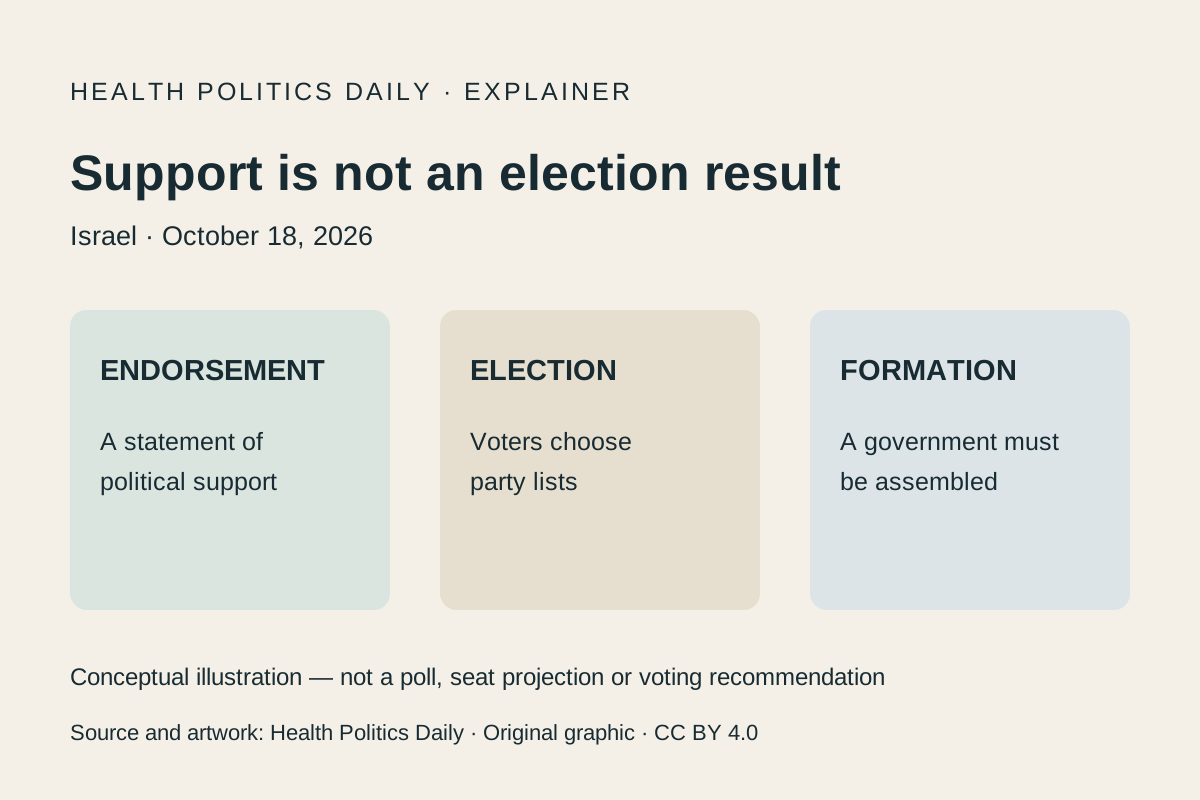
President Donald Trump endorsed Israeli Prime Minister Benjamin Netanyahu on Sunday, October 18, nine days before Israel’s parliamentary election. The announcement gives Netanyahu a public statement of support from Washington’s most prominent political figure. Whether it changes votes or the balance of power in the next parliament remains unknown.
What happened
Trump issued the endorsement on Truth Social. Linda Feldmann’s contemporaneous White House travel-pool report, preserved by an independent archive, flags that exact post. Reuters and The Associated Press corroborate the endorsement. Direct retrieval of the post was unavailable; its substance here is drawn from that corroborated reporting, not an independently captured social-media transcript.
AP reports that Trump praised Netanyahu’s partnership against Iran, and that Netanyahu thanked him publicly. These are the leaders’ political positions. Descriptions of military success or promises of peace in campaign messaging should not be treated as this publication’s assessment.
Why the election mechanics matter
Israel’s official Ministry of Interior voter-information service lists October 27, 2026, as the date for the 26th Knesset election. The Knesset’s explanation of candidate lists describes voters supporting party lists, with seats allocated proportionally. Its government-formation reference explains that the Israeli president assigns the task of forming a government to a member of parliament after results are published.
Analysis: Calling this Netanyahu’s reelection campaign is convenient shorthand, but it is not a separate nationwide ballot directly choosing a prime minister. Campaign attention, parliamentary seats and the ability to assemble a government are distinct stages. A foreign endorsement cannot substitute for any of them.
What it changes—and what it does not
Reuters describes a close contest and cautions that an electoral boost is not assured. AP places the announcement after months in which Trump had withheld an endorsement amid differences between the leaders. Neither account establishes how many voters, if any, will change their choice because of Sunday’s statement.
Analysis: The endorsement changes the public campaign record: Netanyahu can point to explicit support rather than leave voters to infer it from past cooperation. It does not itself enact an aid package, publish a new military agreement or guarantee the policy of a future Israeli government. Those developments would require their own evidence.
For people concerned about regional security, the useful distinction is between political alignment and verified operational decisions. Our reporting on Rubio’s call for action against West Bank settler violence covers a separate diplomatic issue; this endorsement does not resolve those investigations. The Egypt–Saudi defence-support announcement is another regional development where a pledge should not be confused with a confirmed deployment.
Practical information and uncertainties
Eligible voters can use the linked official polling-station locator for eligibility and location information. Enter personal details only on the official government service, not in this article’s comments. An endorsement does not change registration requirements or tell a voter where to cast a ballot.
Forecast limits: The endorsement’s electoral effect, final seat distribution and outcome of government-formation efforts remain unresolved. This article does not convert opinion polls into results, assign a probability of victory or recommend a candidate.
Bias Lens: campaign support, political pressure and Iran
Verified baseline: Trump endorsed Netanyahu on October 18; Israel’s official voter service lists an October 27 parliamentary vote.
Left-leaning—The Forward: Its October 18 report emphasizes the late-campaign boost and uncertain majority.
Center—Reuters: Its report foregrounds the endorsement and uncertainty over its impact.
Right-leaning—Fox News: Its October 18 report foregrounds Trump’s Iran-related warning. That framing is not proof of a new operational commitment.
These differences concern the linked reports, not every journalist at those publications. Campaign arguments, reporters’ interpretations and independently established outcomes are different kinds of information; none should be silently substituted for another.
Sources and media
Primary references include the linked presidential post, its contemporaneous pool-report pointer, and Israeli election and parliamentary information. Reuters and AP corroborate the announcement; direct access to some primary pages was limited. The original explanatory graphic is licensed CC BY 4.0. No directly relevant authorized video with sufficiently clear rights was verified, so none is embedded.