U.S. foreign policy · Middle East
Rubio Urges Israel to Crack Down on West Bank Settler Violence
The secretary of state’s call follows an assault on a journalist and a separate incident involving European diplomats. Investigations, not announced new U.S. penalties, are the immediate test.
By Health Politics Daily News Desk · October 18, 2026 at 12:06 a.m. ET
Secretary of State Marco Rubio said on October 17 that Washington wants Israeli authorities to curb settler violence in the West Bank, describing disturbing images after an attack that injured Washington Post photographer Heidi Levine. His comments put a fresh U.S. diplomatic response alongside Israeli investigations and European demands for accountability.
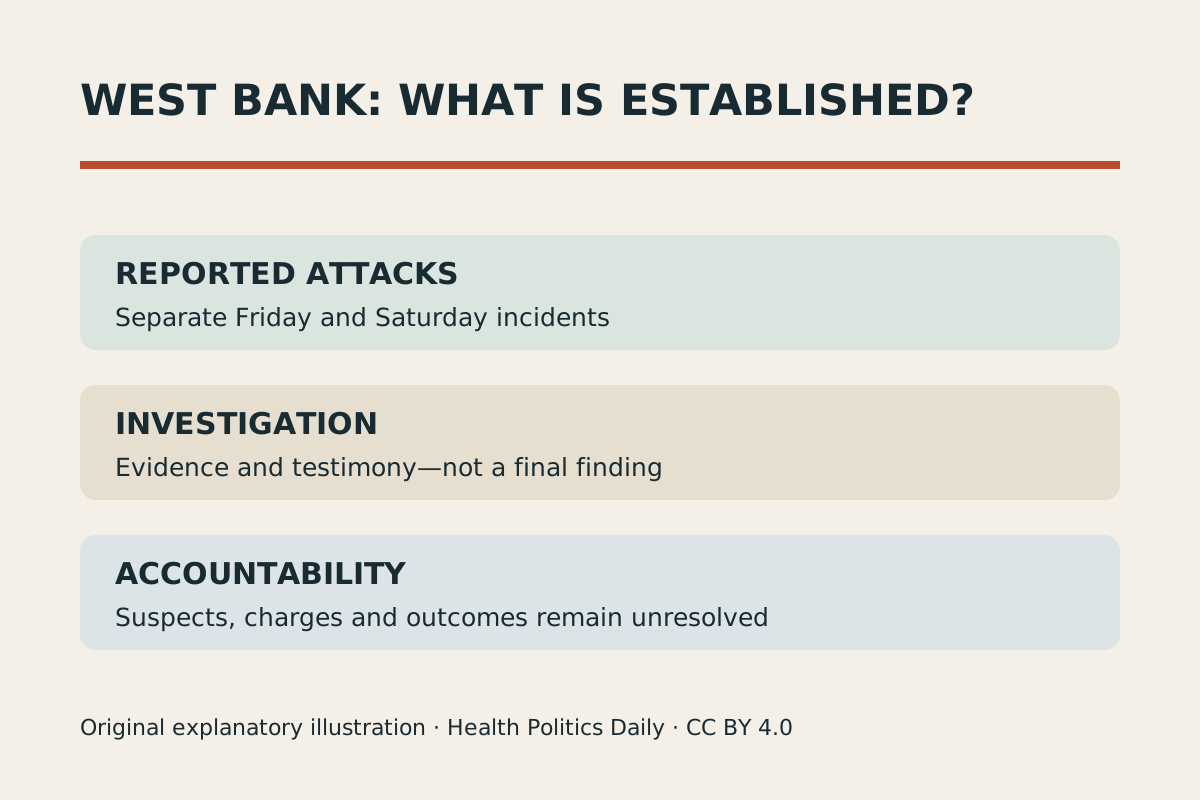
Two incidents must be kept separate: the Friday, October 16 assault involving Levine, and a Saturday, October 17 attack near Taybeh involving Palestinians and European diplomatic representatives. Reports of the latter added an international diplomatic dimension to concerns around the Palestinian olive harvest.
What Rubio said—and did not announce
In State Department remarks reproduced by the Forth press-release archive, Rubio said the United States had repeatedly asked Israel to crack down on the violence. He said President Donald Trump did not want a West Bank crisis to become another source of regional conflict.
Rubio also qualified his account: he did not yet have all the details and was relying on media reports while the embassy sought information. That distinction matters. His condemnation was a diplomatic position, not a completed American investigation identifying responsibility for each attack. Reuters separately reported his comments and his expectation of further embassy reporting.
Asked about the earlier lifting of sanctions on settlers, Rubio said that decision did not endorse violence. The remarks did not announce restored sanctions, new aid conditions or another specific U.S. enforcement measure.
A separate attack involving diplomats
Belgian Foreign Minister Maxime Prévot condemned Saturday’s attack and said Belgium’s team was safe. His public statement, also reproduced by The Times of Israel, described a damaged Belgian vehicle and an incident involving French and Polish representatives and others. He said Belgium would continue pressing for sanctions; that was a policy demand, not confirmation of newly enacted EU restrictions.
The Associated Press reported the diplomats incident and Israeli police’s investigation. Police said they were seeking testimony and identifying suspects. The Israeli military condemned the violence and said its preliminary inquiry found no soldiers at the scene. It also said the diplomatic visit had not been coordinated with it. That operational account does not settle the question of criminal responsibility or excuse an assault.
Why it matters for people on the ground
Analysis: Protection during the olive harvest is about whether Palestinians can reach and work their land, as well as whether journalists and diplomatic observers can document conditions safely. Attacks on those observers can also make independently establishing what happened harder. A condemnation therefore addresses only part of the problem: investigation, protection and prosecution are separate steps.
For readers following U.S. policy, the practical distinction is between requesting action from an ally and changing American policy instruments. Neither Rubio’s words nor Belgium’s call alone establishes that sanctions will follow. For the affected communities, the more immediate question is whether authorities can prevent further assaults and produce an evidence-based account of these incidents.
What remains uncertain
The reviewed material does not establish a final list of suspects, charges or judicial findings. Nor does it resolve whether Washington will change sanctions policy after receiving more information. No forecast of either outcome is warranted from the remarks alone. This report does not combine the two attacks into a single event or treat preliminary official accounts as final findings.
Bias Lens: diplomacy, protection and accountability
Verified baseline: Rubio requested an Israeli crackdown; Belgium condemned the diplomats incident; Israeli police opened an investigation. An investigation is not a conviction.
Left-leaning coverage: The Guardian foregrounds harvest access and accountability.
Center coverage: Reuters leads with the U.S. diplomatic response and Rubio’s request for further information.
Right-leaning/center-right coverage: The Jerusalem Post prominently includes Israeli police and military statements and the investigation’s operational details.
These are differences in the emphasis of these specific reports, not claims that every item from a publisher takes the same position. They do not create competing facts about whether violence is acceptable, and none substitutes for the investigation’s outcome.
Sources and video
The source trail begins with Rubio’s departmental remarks and Prévot’s statement, then independent reporting and published Israeli official responses linked above. The departmental transcript is accessed through an archive reproduction, not a separately retrieved State Department page.
The Jerusalem Post’s publisher-hosted video and report on the Taybeh incident provide a relevant viewing option. Footage may be distressing. We link to the publisher’s page; no protected footage has been copied, rehosted or embedded.
Related Coverage
For broader U.S. foreign-policy context—not reports about these attacks: