U.S. FOREIGN POLICY — RUSSIA — ENERGY
Trump Waives New Russia Sanctions and Tariffs Under Graham Act
The October 16 order blocks major new penalties before the October 18 deadline. It does not repeal the law or remove existing Russia sanctions wholesale.
By Health Politics Daily News Desk · October 17, 2026 at 6:05 a.m. ET
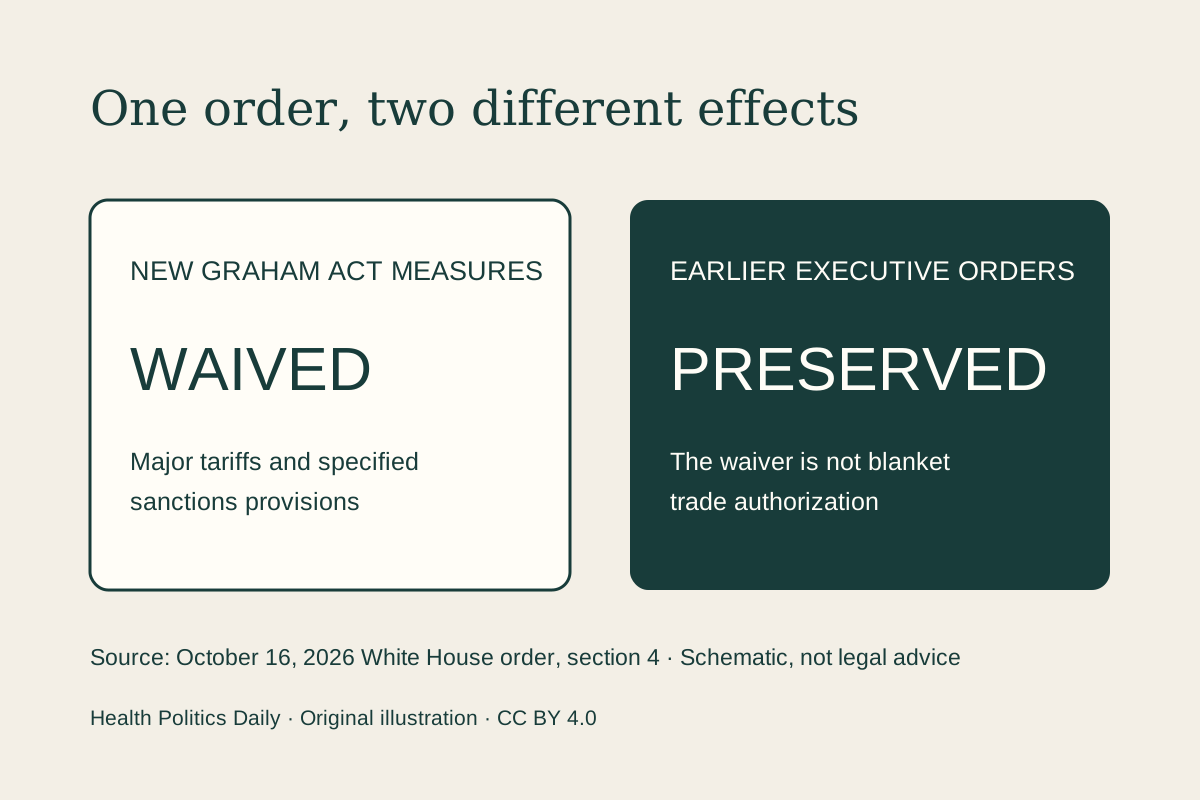
What changed
Verified fact: President Donald Trump signed an October 16 executive order waiving major sanctions, restrictions and tariffs under the Lindsey O. Graham Sanctioning Russia and Iran Act of 2026. He invoked the law’s waiver authority and said he had submitted a national-interest certification and explanatory report to Congress.
Reuters and Associated Press corroborate the decision. AP reports that it came two days before the implementation deadline and that the White House did not immediately publicly explain its national-interest reasoning.
What is waived—and what is not
Section 4 waives the new duties and specified sanctions provisions. Those include duties described elsewhere in the order as 500% on Russian goods and 100% on goods from certain major Russian-energy buyers and sanctions-evasion facilitators, subject to exceptions. These are waived measures, not newly activated tariffs.
The order expressly preserves sanctions under earlier executive orders addressing specified harmful Russian government activities. Its waivers continue until the president or designated officials determine further action is appropriate; it does not announce a fixed expiration date.
ABC News explains that the action gives the administration wider discretion over future sanctions without itself lifting currently imposed measures. That distinction separates a pause in new requirements from blanket permission to trade with every Russian counterparty.
Why it matters for energy and Ukraine
The move follows the administration’s Russian-diesel initiative. Bloomberg’s October 17 report places the waiver in Trump’s effort to lower diesel costs ahead of the midterm elections, while describing the law as intended to penalize Russia over its invasion of Ukraine.
Analysis: withholding new penalties changes the pressure that exporters, buyers and financial intermediaries would otherwise face. But a legal waiver does not establish that additional cargoes have been delivered, that refiners will increase output or that retail fuel prices will fall. Those outcomes require evidence about physical supply, transport, processing and demand.
Nor does this order establish a negotiated end to fighting. Our earlier reporting on the bipartisan challenge to the diesel deal explains the separate dispute over that initiative. The energy-site attacks after the ceasefire announcement illustrate why announced policy and verified battlefield outcomes must be distinguished.
Practical implications
Analysis: businesses should not treat the headline as a universal clearance. The relevant questions remain which counterparty, commodity, payment channel and authorization apply to a transaction. Treasury’s OFAC Russia program page provides the official sanctions lists, licenses and guidance to consult; this article is not transaction-specific legal advice.
For households, no particular reduction at the pump is guaranteed. A claim that the waiver will save consumers a specified amount would require a defensible forecast, not simply the existence of the order.
What remains uncertain
The public order says the explanatory report was sent to Congress, but the material reviewed for this article does not supply its detailed reasoning. The duration of the waiver, subsequent agency implementation and its measurable effects on Russian revenue and consumer prices remain unsettled.
Forecast: the policy could change again through further executive action. Its stated continuation mechanism leaves that possibility open; it does not predict when officials will act. Claims about diplomatic success or failure should be tested against subsequent evidence, not assumed from the waiver alone.
Bias Lens: diplomatic pressure, discretion and consumer costs
Verified baseline: the administration waived new Graham Act measures while preserving earlier executive-order sanctions.
Left-leaning: The Guardian foregrounds the worsening relationship with Ukraine. Center: the linked Reuters report emphasizes the waiver, its timing and Russian reaction. Right-leaning: Fox Business emphasizes retained power to reinstate penalties.
These emphases can coexist: changing new penalties and retaining discretion are not contradictory. None proves that fuel savings or diplomatic gains will follow. The labels describe broad editorial orientation, not every report; the operative text remains the baseline.
Sources and video
Principal sources: the White House order, OFAC guidance, AP, Reuters, ABC News and Bloomberg. No directly relevant authorized video with verified embedding permission was identified; no video is embedded or rehosted.