UKRAINE — RUSSIA — ENERGY SECURITY
Ukraine Says Russia Hit Six Energy Sites After Trump Ceasefire Claim
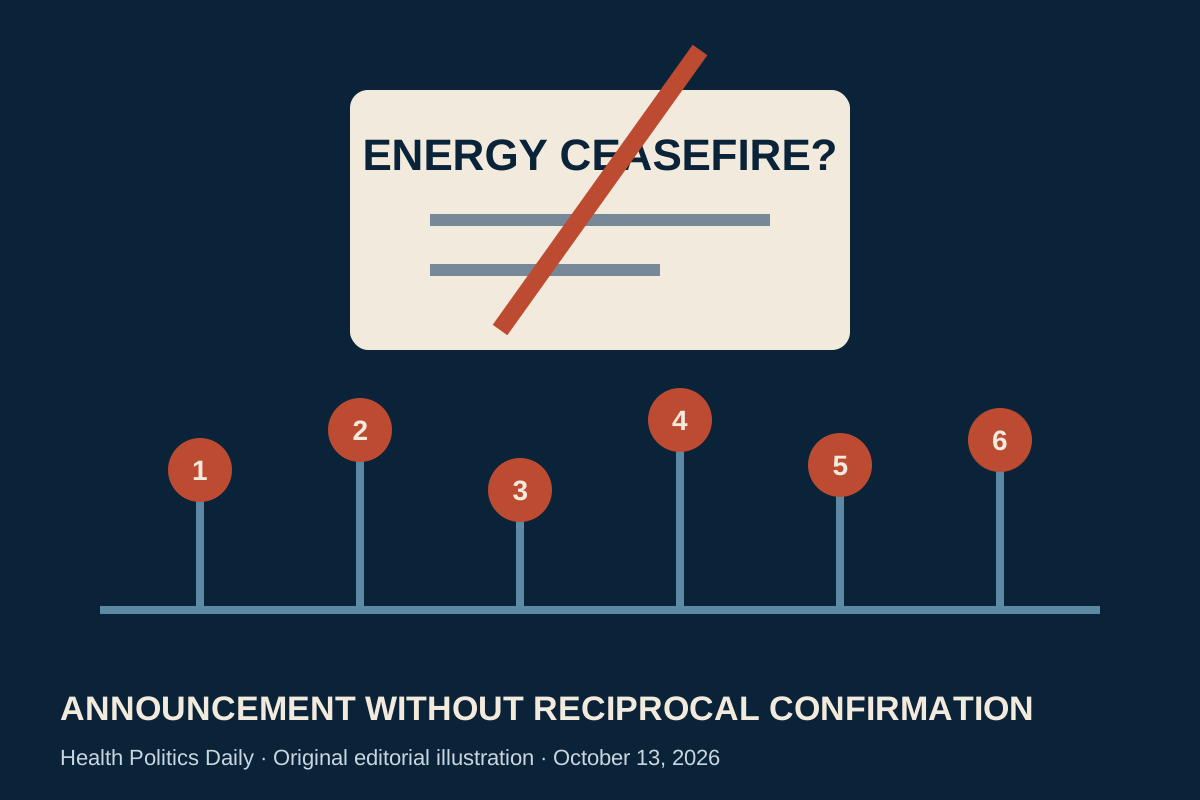
The attacks deepen doubt that an operative, reciprocal truce exists: Washington announced one, Kyiv offered conditional compliance and Moscow has not confirmed published terms.
By Health Politics Daily News Desk · Published Tuesday, October 13, 2026 at 4:00 a.m. America/New_York · Approximately 8 minutes
Verified Baseline
Strikes continued after the ceasefire announcement
Ukrainian President Volodymyr Zelenskyy said Russian forces struck at least six Ukrainian energy facilities after President Donald Trump announced Sunday that Russia and Ukraine had agreed to an immediate “energy ceasefire.” Reuters and the Associated Press independently reported the Ukrainian account and continuing attacks.
The reported targets included a power plant, gas-production facilities and a fuel station. Separate Russian drone attacks killed civilians and injured others, according to Ukrainian authorities. Individual damage and casualty reports remain subject to revision during an active war.
Russia has not publicly confirmed a signed or mutually accepted ceasefire text. Kremlin spokesman Dmitry Peskov described talks as continuing. That distinction is central: continued strikes are verified, while the existence of an operative bilateral truce is not.
What Each Side Has Said
Kyiv offered reciprocity; Washington declared a result
In an official October 11 address, Zelenskyy said Ukraine was ready to refrain from striking Russian energy infrastructure and expected the same from Russia. His statement treated reciprocal Russian restraint as a condition and said Trump’s announcement needed to “become reality.”
Trump said the ceasefire was effective immediately but published no joint text, target list, duration, monitoring process or enforcement steps. Moscow did not issue a matching confirmation. Ukraine says it temporarily refrained from attacking Russian energy sites while it awaited reciprocity.
Analysis: Because the parties did not publish identical commitments, calling the new strikes a formal legal “violation” goes beyond the public record. They are evidence that the restraint Trump announced was not operating on the ground.
Why It Matters
Energy attacks can turn military pressure into civilian hardship
Power generation, gas production and fuel distribution support homes, hospitals, water systems, communications and transportation. Damage can therefore have effects far from the strike site, especially as winter approaches.
Ukraine has also attacked Russian refineries and other energy facilities. Kyiv says it would halt those operations if Moscow stopped attacks on Ukraine’s energy system. A reciprocal pause could reduce civilian disruption and pressure on fuel markets, but unilateral restraint would leave one side exposed.
The failed announcement also matters diplomatically. A ceasefire normally requires a shared definition of protected targets, a start time, notification channels, monitoring and a process for investigating alleged breaches. None has been publicly established here.
Practical Implications
What residents, markets and governments should watch
- Residents in Ukraine: follow local emergency and utility notices; national political statements do not replace regional outage or shelter guidance.
- Energy markets: the attacks can affect risk expectations, but they do not by themselves establish a specific change in global supply or prices.
- Governments: the next meaningful evidence would be matching written commitments, verified restraint and an agreed process for disputed incidents.
- Readers: distinguish a proposed or announced truce from a confirmed agreement being observed by both parties.
What Remains Uncertain
No public mechanism exists to test compliance
Verified fact: Ukraine reported six energy sites struck after Trump’s announcement, and major news organizations corroborated that attacks continued. Uncertain: whether private U.S.–Russian understandings exist, whether Ukraine received identical terms and which facilities each side would classify as protected. Forecast: without matching public commitments or observable restraint, further strikes remain possible. Opinion: Health Politics Daily takes no position on negotiating terms; public claims of a ceasefire should be presented as provisional until reciprocal conduct or documentation supports them.
Bias Lens: “violation,” failed announcement or continuing war?
Trump announced an immediate energy ceasefire; Ukraine offered reciprocal restraint; Russia did not publish matching confirmation; and Russian attacks on Ukrainian energy facilities continued.
Left-leaning coverage: The Guardian foregrounded Zelenskyy’s conclusion that Russia did not want the ceasefire and placed the strikes in a wider European-security narrative. Center coverage: AP emphasized the mismatch between Trump’s claim and continued attacks, while Reuters focused on the six reported sites and diplomatic fallout. Right-leaning business coverage: Financial Times emphasized the breakdown of Trump’s initiative and its connection to diesel diplomacy.
The framing difference is whether the lead centers battlefield evidence, Trump’s diplomatic credibility or European pressure. None of those frames establishes a signed ceasefire that the public has not seen.
Principal Sources
Official statement and corroborating reporting
- President of Ukraine — October 11 address offering reciprocal restraint
- Associated Press — continued strikes and public positions
- Reuters — six energy sites and diplomatic response
AP published a directly relevant authorized report on its own platform, but clear permission for third-party embedding was not established. It is linked rather than embedded.
Related Coverage