Ukraine · Russia · Diplomacy
Russian Missiles Strike Kyiv Hours After Moscow Agrees to New Talks
Kyiv officials said ballistic missiles injured six people and damaged homes, a petrol station and transport equipment. The attack came after Russia accepted a new negotiating channel in principle—but no ceasefire is in force.
By Health Politics Daily News Desk · October 21, 2026 at 8:00 p.m. ET

Watch in this article
Pumpjack operating at the Kern River Oil Field
A short CC0 field video provides visual context for reporting on oil production and fuel supply.
Thomas Farley / Wikimedia Commons · CC0 1.0 · License and source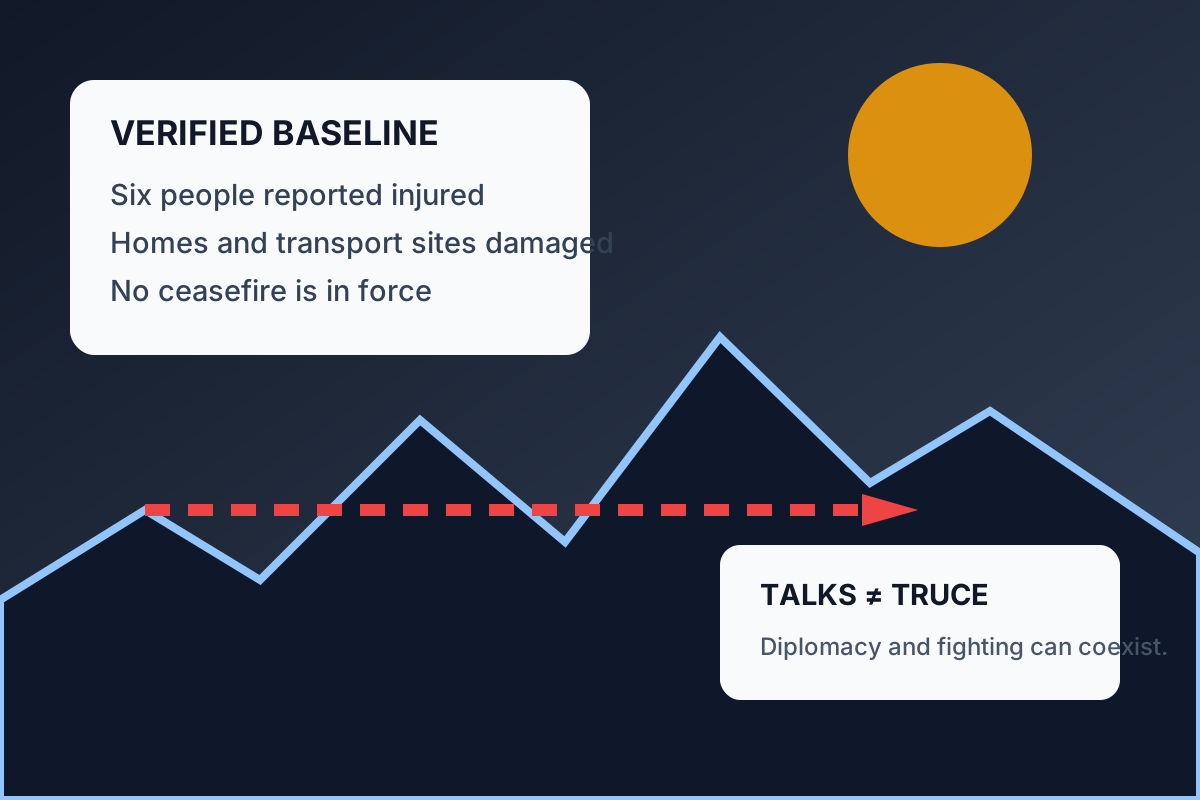
Russian ballistic missiles struck Kyiv on Wednesday evening, injuring six people, according to city officials cited by Reuters. Mayor Vitali Klitschko reported impacts in two districts on the eastern side of the Dnipro River; homes, a petrol station and transport equipment were damaged.
Further explosions were reported in the early hours of October 22 local time. Because the situation was still developing at publication, casualty and damage totals may change. Health Politics Daily has not independently verified battlefield claims.
Why the timing matters
Hours earlier, the Kremlin said Russia had accepted in principle a U.S.-proposed trilateral negotiating channel with Ukraine. As our earlier report on the proposed Russia-Ukraine-U.S. talks explained, no venue, agenda, ceasefire or settlement terms have been agreed.
The attack therefore does not necessarily prove that diplomacy has collapsed. It does show the narrow scope of the announcement: agreeing to talk does not suspend military operations. Civilians remain exposed while the parties dispute territory, security guarantees, sanctions and the sequence of any truce.
Verified facts, analysis and forecasts
Verified fact: Kyiv officials reported six injuries and damage from an evening ballistic-missile attack. Russia had separately agreed in principle to resume trilateral talks after November 10. No ceasefire exists.
Analysis: continuing attacks raise the political cost of negotiations and can shape bargaining positions, but one strike cannot establish either side’s negotiating intent. Military pressure and diplomatic contact often proceed at the same time.
Forecast: attacks are likely to continue unless the parties reach and implement a specific halt-fire arrangement. That is a conditional assessment, not a claim that tonight’s events determine the outcome of talks.
Opinion: Health Politics Daily takes no position on the terms of a settlement. Any public description of the talks should clearly distinguish a negotiating channel from a ceasefire and a ceasefire from a durable peace agreement.
Practical implications
- For residents: follow official air-alert and emergency-service instructions; initial reports can change quickly after a strike.
- For travelers and families: verify transport schedules and official advisories rather than relying on social-media videos whose location or date may be unclear.
- For policymakers: a future meeting date does not itself reduce civilian risk; confidence-building measures would need explicit terms and monitoring.
For wider context, see our coverage of the Oslo consultations that preceded the proposal and the earlier dispute over missile-warning intelligence.
Bias Lens: renewed talks or continued escalation?
Verified baseline: Russia accepted a negotiating channel in principle; no truce was agreed. Kyiv officials reported six injuries from a subsequent missile attack. These facts can coexist.
Left-leaning — The Guardian: recent coverage places attacks within concerns about Western support, intelligence warnings and pressure on Kyiv to make concessions.
Center — Associated Press: emphasizes the reopening of a diplomatic channel while noting that fighting and civilian casualties continue.
Center/business — Reuters: leads with the immediate casualty and damage reports and attributes developing details to named Ukrainian officials.
Right-leaning — Fox News: frames recent strikes more through the response to President Trump’s ceasefire push and the U.S. administration’s leverage.
The distinction is emphasis, not a verdict on accuracy: diplomatic-process framing highlights opportunity, while security framing highlights the absence of an implemented truce.
Principal sources
- Reuters: evening Kyiv missile attack
- Reuters: follow-up explosions in Kyiv
- Associated Press: proposed trilateral talks
- Office of the President of Ukraine: official updates
No directly relevant official or publisher-authorized video with clearly verified embedding permission was available, so none was embedded.