Ukraine · U.S. foreign policy · Civilian protection
Zelenskyy Says U.S. Missile-Warning Intelligence Sharing Has Resumed
Ukraine’s president says an interruption ended. The October 18 interview does not settle who ordered the pause, its full scope or the separate dispute over satellite communications.
By Health Politics Daily News Desk · October 18, 2026 at 6:08 p.m. ET
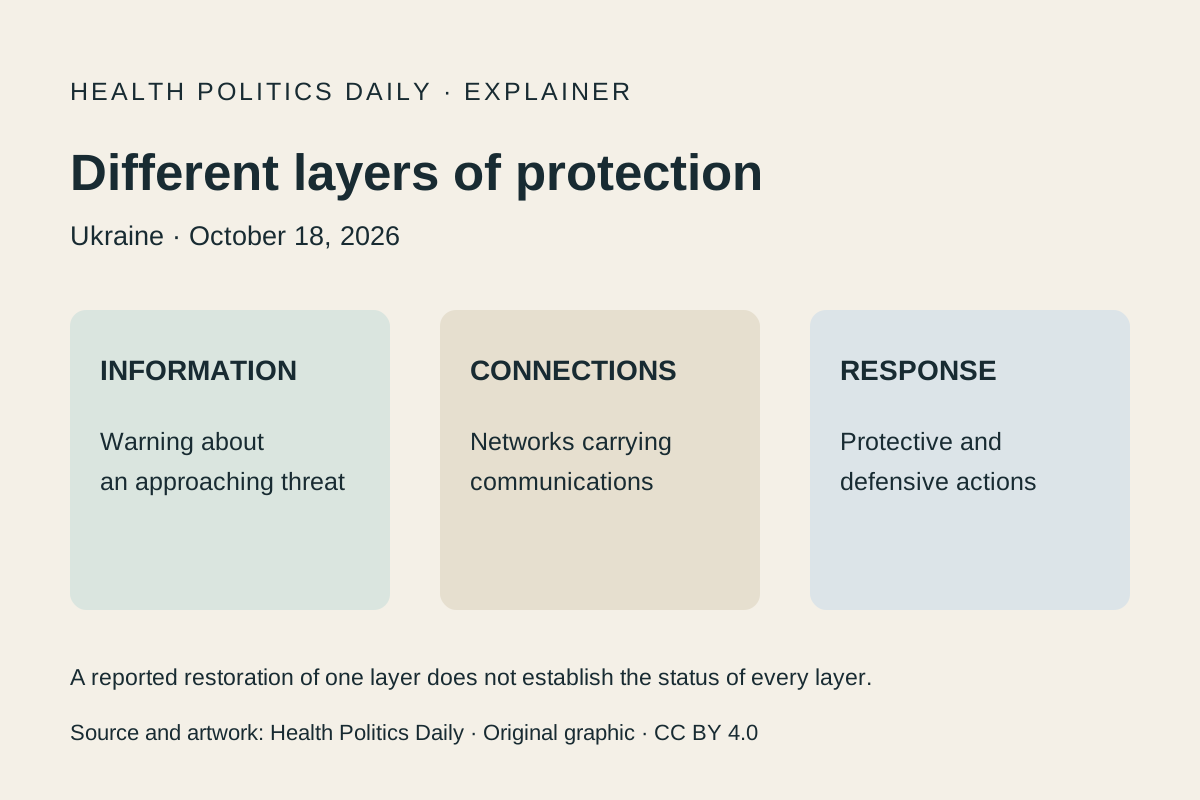
Ukrainian President Volodymyr Zelenskyy said Sunday that U.S. intelligence sharing used to warn Ukraine about Russian ballistic missiles is working again after an interruption. The statement is consequential for civilian protection, but it is his public account—not an independently audited description of classified information flows.
What Zelenskyy said
In an interview aired October 18 on NBC’s Meet the Press, Zelenskyy said the information had been blocked and subsequently restored. Reuters corroborated the interview remarks. The New York Post’s account reports his description of roughly three days without the missile-warning information.
The NBC program transcript is the primary interview reference. Direct retrieval was unavailable during this edition’s checks; the reported substance is supported by multiple outlets, rather than represented here as a separately inspected technical record.
Why the distinction matters for people under attack
Analysis: Information about an approaching attack can support decisions about warnings and defensive responses. It does not by itself intercept a missile, restore a damaged power line or guarantee that a particular community will receive adequate notice. Treating the resumption as proof that every defensive problem has been solved would go beyond the available evidence.
For families and local services, the practical issue is continuity: whether warning and response systems can keep functioning while political relations are strained. A public statement that one channel works again is an important update, but not a reason to disregard local alerts or assume that future attacks will always be detected.
This report is not an operational warning service. Residents should continue to follow current instructions from their local authorities; a news account of intelligence cooperation cannot determine when a shelter is safe to leave.
Intelligence and satellite service are different issues
The Guardian’s Sunday report describes a separate disagreement about satellite internet performance. Zelenskyy alleged U.S. involvement in restrictions; Treasury Secretary Scott Bessent disputed that allegation. The report of restored intelligence sharing does not independently resolve that dispute.
Analysis: A missile-warning information channel and a communications network can both matter to defence while failing, recovering or being governed in different ways. An explanation for one should not be silently assigned to the other. Our earlier report on satellite-service and drone restrictions provides the background, not proof of the cause of this interruption.
The diplomatic context
The reviewed accounts do not establish the precise start and end times, which categories of information were affected, or who authorized any restriction. Those missing details limit conclusions about the interruption’s diplomatic purpose.
The disagreement also sits alongside a separate debate over Russia policy. Our report on the Russia-sanctions waiver explains that policy development. Neither timing nor political criticism alone demonstrates that a sanctions decision caused an interruption in intelligence cooperation.
What remains uncertain
No complete public technical log or independently verified decision chain was established in the reviewed material. The interview does not demonstrate whether every previous category of assistance has resumed. Nor does it establish a lasting agreement preventing future interruptions.
Forecast limits: The effect on future civilian casualties, interception rates or negotiations cannot be quantified from this statement. This edition offers no numerical prediction and does not treat improved cooperation as a ceasefire.
Bias Lens: restoration, dependence and unresolved responsibility
Verified baseline: Zelenskyy publicly said the sharing had resumed. Multiple outlets reported the remarks; the underlying classified system was not independently inspected.
Left-leaning—The Guardian: Its Sunday report connects the resumption with wider tensions and disputed satellite restrictions.
Center—Reuters: Its report emphasizes the restored sharing and attributes the account to Zelenskyy.
Right-leaning—New York Post: Its report foregrounds vulnerability during the reported interruption.
These emphases concern the linked stories, not all work by their publishers. Agreement about what a president said is not independent agreement about every underlying cause. Allegations and denials should remain attributed until supporting evidence is established.
Sources and video
The primary event is NBC’s interview, corroborated by Reuters and other linked reporting. NBC’s full interview distributed on Yahoo is linked as the authorized publisher-attributed video page. Its availability may vary; no media has been copied, downloaded or embedded. The original explanatory illustration is licensed CC BY 4.0.