Finance · Regulation · Prediction markets
NBA Partners With Kalshi and Polymarket, Signs Prediction-Market Integrity Pact With CFTC
The league is giving two exchanges access to official data and branding while creating new information-sharing and integrity safeguards. The framework expands prediction markets around professional basketball, but does not settle disputes over federal and state oversight.
By Health Politics Daily News Desk · October 26, 2026 at 8:02 p.m. ET

Watch in this article
Pumpjack operating at the Kern River Oil Field
A short CC0 field video provides visual context for reporting on oil production and fuel supply.
Thomas Farley / Wikimedia Commons · CC0 1.0 · License and source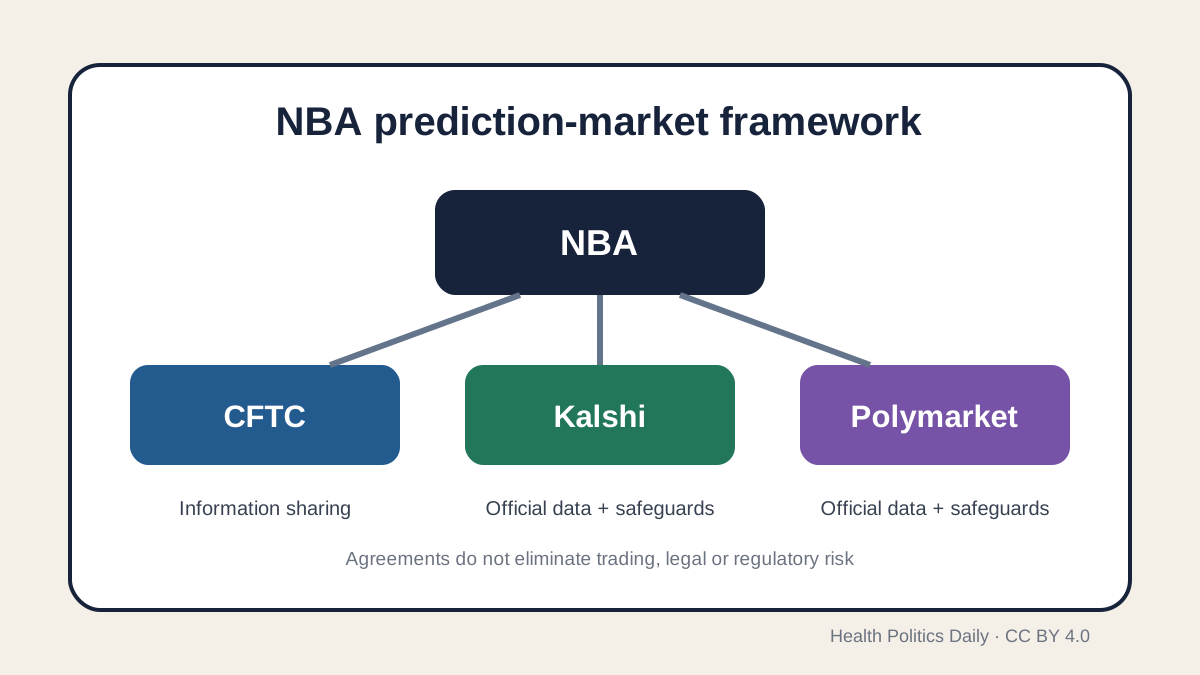
Verified baseline
The Commodity Futures Trading Commission and the NBA signed a memorandum of understanding to share information about professional-basketball integrity and fair, transparent prediction markets. Separately, the NBA designated Kalshi and Polymarket as its preferred prediction-market exchanges.
The commercial agreements provide access to NBA intellectual property and official statistics distributed through Sportradar. The league said the exchanges accepted limits on permissible markets, bans on NBA and team personnel trading NBA contracts, cooperation on suspicious trading and measures aimed at athlete safety.
What changes for users
Official data should give the designated exchanges an authoritative source for settling authorized NBA contracts. The partnerships also allow league branding and marketing, which may make prediction-market products more visible to fans.
The label “preferred” is not a promise that a trade is suitable, profitable or risk-free. Event contracts can lose their full purchase price, pricing can move quickly and platform availability may depend on location and legal disputes. This article provides general information, not financial or gambling advice.
Why the CFTC is involved
Prediction exchanges structure their products as event contracts under federal commodities law. The CFTC argues that it has jurisdiction over registered exchanges, while some state regulators contend sports contracts function like sports wagering and belong under state gambling rules. The NBA-CFTC memorandum improves communication; it does not resolve that legal conflict.
The CFTC said cooperation can help identify insider trading and fraud. The agreement itself does not disclose investigation thresholds, enforcement timelines or how information will be divided among the league, exchanges, federal regulators and state authorities.
Why it matters beyond basketball
The NBA follows Major League Baseball and the National Hockey League in formalizing cooperation with the CFTC. That pattern could accelerate the integration of federally regulated event contracts into mainstream sports while increasing pressure for consistent rules on sensitive markets, advertising, age controls and access to nonpublic information.
For players, officials and team employees, clearer prohibitions reduce ambiguity. For fans and market participants, the central test will be whether the safeguards identify suspicious activity early and whether enforcement outcomes are disclosed clearly enough to build trust.
Fact, analysis, forecast and opinion
Verified fact: the NBA signed separate agreements with the CFTC, Kalshi and Polymarket. Analysis: the league is combining commercial expansion with integrity controls rather than opposing prediction markets outright. Forecast: more leagues may seek similar arrangements, but court and regulatory disputes will continue. Opinion: Health Politics Daily favors transparent safeguards and enforcement reporting without endorsing any exchange or trading product.
Bias Lens: integrity framework or gambling expansion?
Verified baseline: the agreements create information sharing, official-data access and trading restrictions. They do not prohibit NBA prediction markets or settle the federal-state jurisdiction dispute.
Left-leaning/critical technology coverage: The Verge frames the move as an expansion of gambling-like partnerships after integrity scandals and questions whether commercialization undercuts the safeguards. Center wire coverage: Reuters foregrounds the MOU, insider-trading concerns and unresolved oversight questions. Center sports coverage: Associated Press emphasizes how fans will encounter the partnerships, including official data and league branding.
No detailed mainstream right-leaning report was available at publication. Rather than force false symmetry, this comparison identifies the substantive difference in available framing: commercialization risk versus regulatory mechanics and user-facing access.
What remains uncertain
The full commercial terms were not disclosed. It is unclear how often information will be shared, which markets the NBA may reject, how athlete-safety provisions will operate, or whether courts and lawmakers will alter the regulatory framework. Effectiveness will depend on implementation and enforcement, not the announcements alone.
Principal sources
- CFTC — memorandum and integrity objectives
- NBA — commercial partnerships and safeguards
- Reuters — regulatory and insider-trading context
- Associated Press — user-facing and jurisdictional context
No suitable official or publisher-authorized video with clear downstream embedding permission was available, so no video was embedded.