U.S. economy · Consumer finance · Inflation
U.S. Business Growth Stays Strong as Consumer Sentiment Nears Record Low
Two October surveys point in opposite emotional directions without contradicting each other: companies report robust activity while households remain deeply frustrated by prices and borrowing costs.
By Health Politics Daily News Desk · October 24, 2026 at 1:55 a.m. ET
Verified baseline
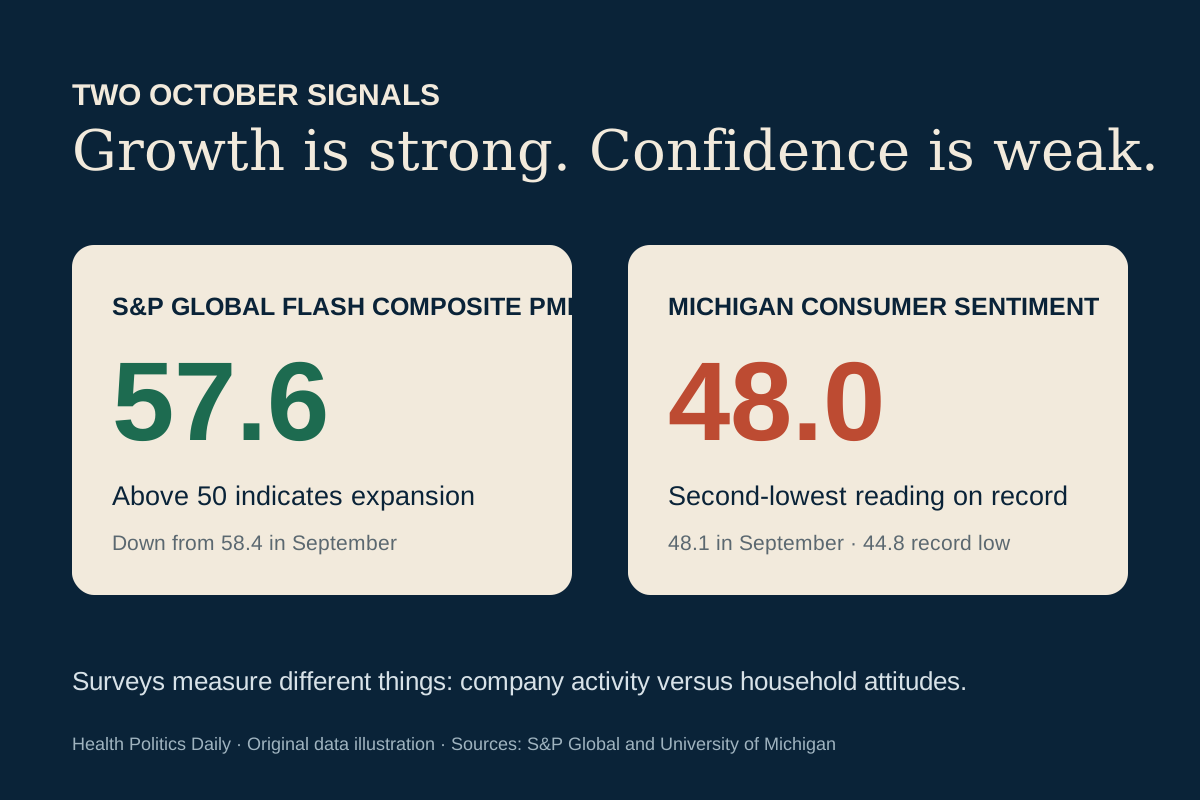
The S&P Global flash U.S. Composite PMI slipped from 58.4 in September to 57.6 in October. Because readings above 50 indicate expanding activity, the result still signals strong growth across manufacturing and services.
Separately, the University of Michigan’s final October Consumer Sentiment Index was 48.0, nearly unchanged from 48.1 in September and the second-lowest reading in the survey’s history. Year-ahead inflation expectations rose to 4.7%, while five-year expectations increased to 3.5%.
Why the surveys can diverge
The PMI asks businesses whether activity, orders, employment and prices improved or worsened from the previous month. Consumer sentiment asks households about personal finances and the economic outlook. One can show growing output while the other records dissatisfaction with purchasing power.
Companies reported strong new orders and the fastest manufacturing hiring since March 2012. At the same time, consumers cited higher prices, interest rates and worsening affordability for durable goods. Strong demand can support production and employment while also giving businesses room to raise prices.
What the price measures show
S&P Global’s composite output-price index rose to 59.8, its highest level since August 2022, while delivery times worsened amid supply constraints. The Michigan survey found elevated inflation expectations across political groups, not only among supporters of one party.
Neither survey is the official inflation rate. The Bureau of Labor Statistics measures actual consumer and producer prices, while these reports capture business conditions and household expectations. They are early indicators, not substitutes for CPI, income or spending data.
Practical implications
For households, the data help explain why a strong-growth headline may not match lived experience: employment and company sales can rise while rent, fuel, insurance and credit costs remain painful. Consumers should compare actual rates and expenses before major borrowing decisions rather than treating a sentiment index as a personal forecast.
For businesses, strong orders may support hiring and investment, but rising input costs and longer delivery times can squeeze margins. Investors should not infer a guaranteed Federal Reserve move from one month of survey data; policymakers will consider official inflation, labor-market and spending figures together.
Fact, analysis, forecast and opinion
Verified fact: the flash composite PMI was 57.6 and final consumer sentiment was 48.0 in October. Analysis: the combination describes an economy with strong private-sector activity but weak household confidence, partly because the benefits and costs of growth are unevenly distributed. Forecast: sustained high output prices and inflation expectations could keep pressure on interest rates, but upcoming official data can change that outlook. Opinion: political claims should acknowledge both signals rather than using one survey to erase the other.
For more context, read our coverage of September inflation and gasoline prices, weak builder confidence and housing affordability, and rising employer health-insurance costs.
Bias Lens: strong economy, affordability crisis or both?
Verified baseline: business activity expanded strongly in October, consumer sentiment remained near a record low, and both surveys showed price pressure. The reports measure different populations and questions.
Center coverage — Reuters on business activity and Reuters on sentiment: emphasizes the tension between growth and inflation ahead of the Federal Reserve meeting and midterms. Official research releases — S&P Global and Michigan: focus on their separate survey results and methodologies. A reliable left-center-right split had not formed around the paired release, so this lens compares source emphasis rather than forcing ideological symmetry.
What remains uncertain
The PMI is preliminary and may be revised when the full October sample arrives. Sentiment does not reliably predict near-term spending on its own, and respondents’ views can be influenced by politics and recent price shocks. Official October inflation, income and consumption figures have not yet confirmed whether the survey signals will persist.
Principal sources
- S&P Global — October flash U.S. PMI release
- University of Michigan Surveys of Consumers — October final results
- Reuters — business activity and price-pressure context
- Reuters — consumer sentiment and inflation expectations
No suitable directly relevant official or publisher-authorized video with clear embedding permission was available, so none was embedded.