Brazil · Elections · International politics
Brazil Presidential Runoff: Lula and Flávio Bolsonaro Face Tight Vote
Voters are choosing between sharply different policy directions in Latin America’s largest economy. Polls remain open, and surveys are not results.
By Health Politics Daily News Desk · October 25, 2026 at 1:58 p.m. ET

Watch in this article
Pumpjack operating at the Kern River Oil Field
A short CC0 field video provides visual context for reporting on oil production and fuel supply.
Thomas Farley / Wikimedia Commons · CC0 1.0 · License and source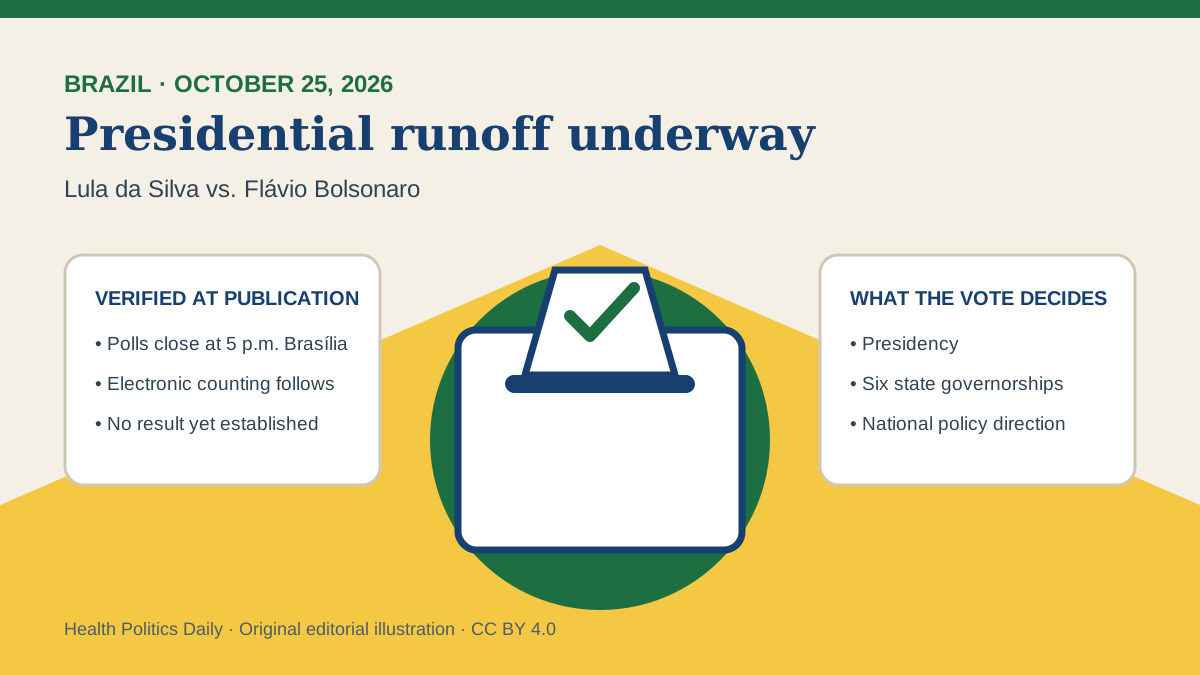
Verified baseline
Brazilian voters are choosing Sunday between incumbent President Luiz Inácio Lula da Silva of the Workers’ Party and Liberal Party senator Flávio Bolsonaro. The Superior Electoral Court, or TSE, reported that Bolsonaro received 47.03% of valid first-round votes and Lula 45.16%, sending both to the runoff. Voting is still underway at publication time; neither polling nor first-round totals establish today’s winner.
Associated Press reports that polls close at 5 p.m. Brasília time, or 4 p.m. Eastern, and that electronic tallying should produce substantial official results within hours. Six states and the Federal District are also holding gubernatorial runoffs.
What the choice means
Lula is seeking a fourth nonconsecutive term and is campaigning on social programs, poverty reduction and continuity in Amazon protection. Bolsonaro has emphasized crime, taxes, government spending and closer alignment with U.S. President Donald Trump. He has also pledged to pardon his father, former President Jair Bolsonaro, who is serving a sentence for plotting to overturn the 2022 election.
The presidency will operate alongside a Congress that shifted rightward in the first round. That means either winner will face legislative bargaining: Bolsonaro could find allies for spending cuts, security measures and deregulation, while Lula would need centrist support to protect social and environmental priorities.
Why turnout matters
More than 33 million registered voters abstained in the first round. Because the gap between the finalists was about 2.2 million votes, participation by earlier nonvoters and supporters of eliminated candidates could be decisive. Final surveys placing the candidates within their margins of error describe uncertainty; they do not predict the count with certainty.
Authorities are also scrutinizing access to transportation. AP reported that an electoral judge ordered the arrest of Salvador’s mobility secretary after public buses were prevented from operating. The allegation and any resulting legal process should not be generalized into a national assessment without further evidence.
Practical implications
Brazilian voters should use TSE channels or the e-Título application to verify polling locations and official results. People outside Brazil should distinguish the TSE’s reported count from screenshots, unofficial maps and candidate claims. Markets may react quickly, but a short-term price move is not a reliable forecast of policy or economic performance; this article provides no personalized investment advice.
Fact, analysis, forecast and opinion
Verified fact: Lula and Bolsonaro are the two runoff candidates after receiving the most first-round votes, and voting remains open. Analysis: turnout and transfers from eliminated candidates are especially important because the first-round gap was narrow. Forecast: electronic reporting may clarify the outcome Sunday evening, but close margins or legal challenges could delay final certainty. Opinion: Health Politics Daily endorses neither candidate.
Bias Lens: how outlets frame Brazil’s runoff
Verified baseline: this is a two-candidate runoff; Bolsonaro led the first round, no winner has been established today, and the next president will work with a more conservative Congress.
Left-leaning framing: The Guardian emphasizes democratic safeguards, political violence and risks it associates with a Bolsonaro victory. Center framing: Reuters focuses on the close race, first-round totals, economic implications and the regional political balance. Right-leaning framing: Fox News presents the contest mainly as a test of Latin America’s conservative movement and voter dissatisfaction with Lula. These differences concern emphasis and interpretation; all three describe the same candidates and unresolved vote.
What remains uncertain
The winner, final turnout, regional shifts, blank and null ballots, and the outcome of six gubernatorial runoffs remain unknown. Campaign promises also do not by themselves establish what Congress, courts or fiscal constraints will permit after inauguration.
Principal sources
- Brazil Superior Electoral Court — official first-round totals and runoff confirmation
- Reuters — election-day reporting and policy context
- Associated Press — voting, counting and access developments
AP provides publisher-authorized election video on its own article page, but downstream embedding permission was not clear; the article links to the publisher page and does not embed or rehost the video.