BRAZIL — NATIONAL ELECTION
Brazil Votes for President and Congress: What to Watch
President Luiz Inácio Lula da Silva and Senator Flávio Bolsonaro enter Sunday’s first round in a close race. Polls are not results, and the presidency may not be decided until an October 25 runoff.
By Health Politics Daily News Desk · Published Sunday, October 4, 2026 at 1:58 a.m. America/New_York · Approximately 8 minutes
Verified Baseline
Brazil is voting; it has not elected a president yet
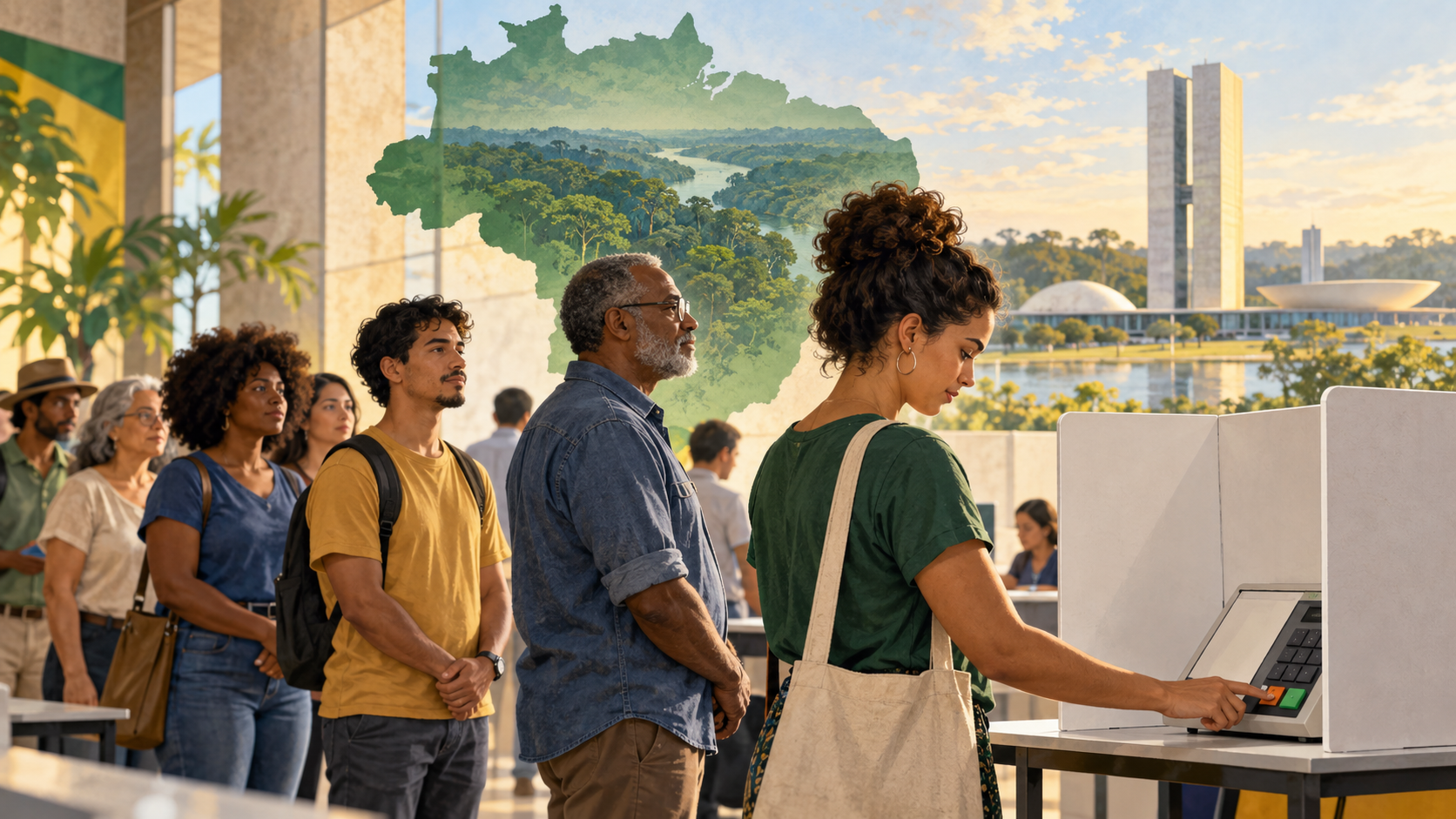
Brazil’s Superior Electoral Court, known as the TSE, says more than 158.7 million people are eligible to vote in the October 4 general election. They will choose a president and vice president, governors, senators, all 513 members of the Chamber of Deputies and state or district lawmakers.
Voting runs from 8 a.m. to 5 p.m. Brasília time, adjusted locally so polls close simultaneously nationwide. Surveys show a close contest between left-wing incumbent Lula and right-wing challenger Flávio Bolsonaro, but no poll, rally crowd or social-media trend is an official result.
How the Presidency Is Decided
A candidate needs more than half of valid votes
The TSE’s official explanation says a presidential candidate must win an absolute majority—more than 50%—of valid votes to prevail in the first round. Blank and invalid ballots do not count toward that denominator.
If nobody crosses the threshold, the two leading candidates advance to a runoff on October 25. A narrow first-round lead is therefore not necessarily a victory, and a candidate can finish first on Sunday yet lose three weeks later.
What Is at Stake
The vote reaches beyond the two presidential candidates
Lula is seeking a fourth nonconsecutive term. Bolsonaro, a senator and son of former President Jair Bolsonaro, is campaigning for closer ties with the United States, tougher crime policy and a smaller public sector. The candidates also differ sharply over environmental enforcement, social programmes and Brazil’s diplomatic balance among the United States, China and other partners.
The congressional vote will determine how much either president could enact. Voters are filling all Chamber seats and 54 of the Senate’s 81 seats. A more conservative Senate could influence leadership contests, oversight and future appointments; a fragmented Congress could force either president to build broad coalitions.
Amazon and Economic Implications
Environmental enforcement and fiscal policy may change
The Associated Press reports that Amazon deforestation fell substantially during Lula’s current term, while Bolsonaro proposes looser regulation and more commercial use of land. Campaign promises do not guarantee outcomes: Congress, courts, state governments, commodity prices and enforcement capacity all constrain national policy.
Financial markets are also watching public spending, interest rates and Brazil’s trade alignment. An election result can change expectations quickly, but it does not by itself determine the real, stock prices or borrowing costs. Those react to policy details and implementation as well as the winner.
Practical Guide
How to read election-day claims
- Before polls close: treat turnout anecdotes, campaign claims and viral posts as incomplete. Brazil spans multiple time zones.
- After 5 p.m. Brasília time: use the TSE’s official tabulation for counted votes and the percentage of precincts reporting.
- For the presidency: watch the share of valid votes, not only raw totals or the margin between first and second place.
- For policy: examine the congressional and gubernatorial results alongside the presidential count; Brazil is not choosing only one office.
What Remains Uncertain
Turnout, late movement and congressional arithmetic
Final pre-election polls differ by method and remain subject to sampling error. They cannot establish who voted, how undecided people broke or whether a runoff will occur. The pace of the official count can also create misleading early snapshots if regions report at different speeds.
Verified fact: more than 158.7 million people are eligible and the rules require a majority of valid votes for a first-round presidential win. Analysis: Congress may be as important as the presidency for policy delivery. Forecast: a runoff is widely expected, but it is not certain until the TSE reports the votes.
Bias Lens: democratic risk, rules or conservative realignment?
Brazil is holding a first-round national election on October 4. Lula and Flávio Bolsonaro are the leading presidential candidates, and a runoff follows on October 25 if nobody wins a majority of valid votes.
The left-leaning Guardian foregrounds Lula’s social-policy record and the risk it sees in a Bolsonaro return. Center-oriented Reuters emphasizes the close polling, campaign closings and runoff rules. The right-leaning Wall Street Journal presents Bolsonaro as the new vehicle for Brazil’s right and focuses on whether he can broaden that movement. These are framing differences; none establishes an election result.
Principal Sources
Rules and reporting used
- Brazil Superior Electoral Court — 2026 election dates, offices and official information
- Brazil Superior Electoral Court — voting hours and simultaneous closing
- Associated Press — candidates, electorate and international stakes
- Reuters — final campaigns and first-round outlook
The TSE’s official live-coverage page links authorized YouTube and TV Justiça election video. It is linked rather than embedded.