U.S. finance · Housing · Affordability
U.S. Builder Confidence Falls to 29 as More Builders Cut Home Prices
October’s NAHB survey shows weaker builder confidence and more price cuts. What the figures mean for housing affordability—and what they cannot establish.
By Health Politics Daily News Desk · October 19, 2026 at 10:03 p.m. ET
U.S. homebuilder confidence fell three points to 29 in October, the lowest reading since June 2012, the National Association of Home Builders announced October 19. Its survey found 43% of builders cutting prices, the highest share in the 2020–2026 period.
For people looking for a home, those findings describe a difficult combination: more sellers trying to attract buyers, while financing can still make the purchase unaffordable. A national sentiment index is neither a local price list nor a prediction that every house will become cheaper.
What the survey measures
The NAHB/Wells Fargo Housing Market Index methodology describes builders’ assessments of current single-family sales, expected sales over six months and prospective-buyer traffic. It is seasonally adjusted; above 50 means more builders rate conditions good than poor. A reading of 29 does not mean sales fell 29%, and it is not a count of homes started or sold.
NAHB reported a 6% average price cut among builders cutting prices, and 65% using sales incentives. Those statistics do not establish a 6% decline in the nationwide value of homes. They also do not tell a reader which property or financing offer is available nearby.
Borrowing costs can offset an advertised discount
Freddie Mac’s October 15 mortgage survey put the average 30-year fixed rate at 7.40%, unchanged from the previous week and above 6.27% a year earlier. The figures reflect qualifying mortgage applications submitted through its system—not a universal offer to borrowers or a new October 19 daily rate.
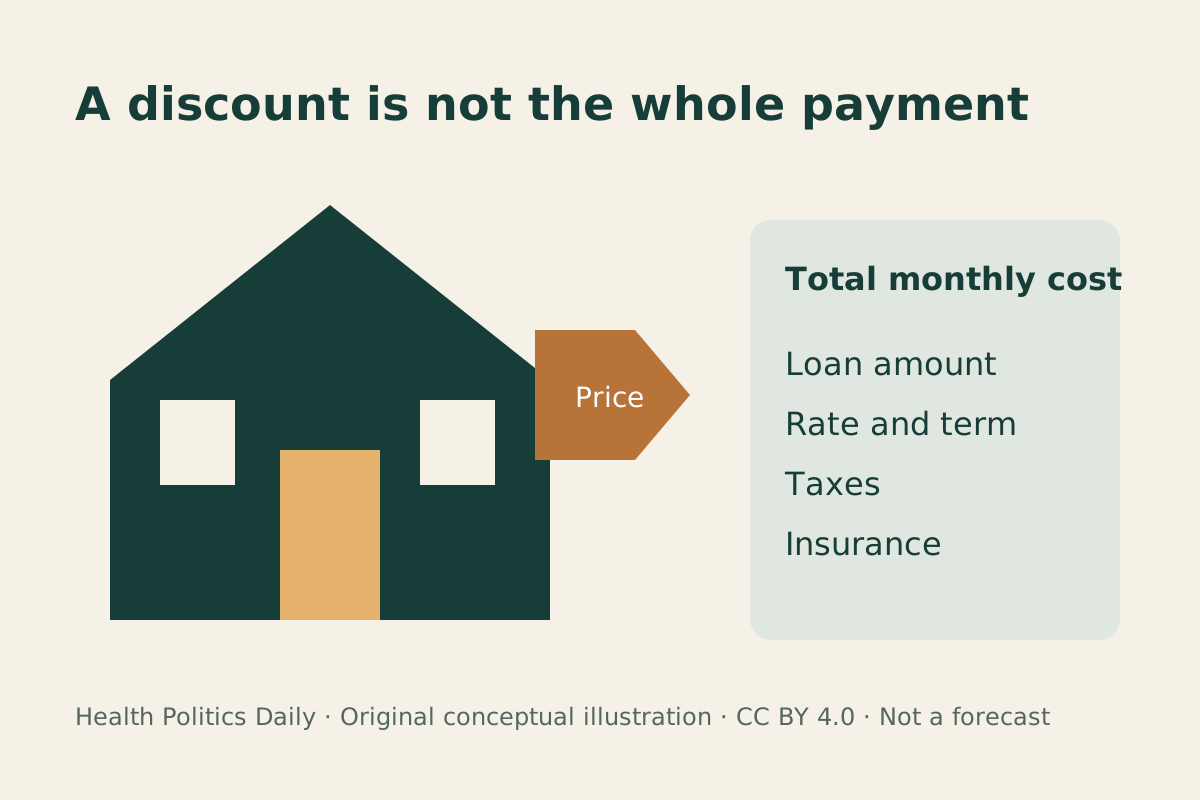
Illustrative calculation: A $300,000 loan amortized over 30 years at a fixed 7.40% has a monthly principal-and-interest payment of approximately $2,077. At 6.27%, the same loan and term produce approximately $1,851. The roughly $226 difference excludes taxes, insurance, mortgage insurance and fees; it is a calculation, not a loan quote or a recommendation to borrow.
This is why a lower advertised purchase price and a more affordable monthly payment are different propositions. A buyer must know the loan balance, duration and actual terms before comparing them. Our coverage of September inflation explains the broader pressure on household budgets, while our report on the Federal Reserve outlook distinguishes policymakers’ remarks from an actual rate decision.
Builders’ explanation is not a controlled test of causes
NAHB attributed the weaker mood to financing and construction costs, labor and lot conditions. Its statement cited immigration-enforcement-related disruption while also crediting administration regulatory reforms with easing some cost pressures. NAHB represents the building industry; its diagnosis should be read as the association’s explanation, not an independent measurement of each policy’s effect.
Reuters’ October 19 report corroborated the index decline and situated it in a wider affordability squeeze. The shared figures are useful; agreement among reports drawing on the same survey does not turn that survey into a separate causal experiment.
What people can check before relying on an offer
The Consumer Financial Protection Bureau’s Loan Estimate explainer provides a practical way to compare financing: review the loan amount, rate, projected payments, closing costs, cash needed at closing and whether the rate is locked. It encourages obtaining multiple Loan Estimates and asking about terms that differ from expectations.
Analysis: A headline concession is only one part of the transaction. Written terms are more informative than assuming that a nationwide incentive statistic applies to a specific development. This is general reporting, not personalized financial, legal or investment advice.
What remains uncertain
The survey cannot establish where rates will move, how many respondents’ prospective buyers will complete purchases, or whether incentives will translate into lower recorded sale prices. Future-sales responses are builders’ expectations, not observed future transactions. Subsequent sales and construction releases will help test whether today’s pessimism becomes reduced activity.
Bias Lens: a warning signal, affordability pressure or a divided market?
Verified baseline: This is a builder-perception survey, not a transaction-price index. Freddie Mac’s mortgage figure is separately dated October 15.
Left-leaning—Business Insider: Its October 19 account emphasizes a warning signal and economists’ pessimistic outlooks. Forecasts quoted there remain forecasts.
Center—Reuters: Its report connects the survey to borrowing costs, supply pressures and the election-season affordability debate.
Right-leaning—New York Post: The accessible headline and search extract contrast broad weakness with luxury housing. The full page was not retrievable for this edition, so this comparison is limited to that verified framing.
These are differences in emphasis, not proof of a disagreement about the index. Labels are orientation aids, not judgments about every story a publisher runs. Luxury-market performance does not establish conditions for first-time buyers; national pessimism does not establish that every segment is weak.
Sources and media
Primary sources are NAHB’s October 19 release, Freddie Mac’s October 15 survey and CFPB’s loan-comparison guidance; Reuters provides corroborating reporting. The original illustration below is explanatory, not a photograph of a particular development. No suitable directly relevant authorized video was verified, so none is embedded.