Global finance · China · Economic data
China’s GDP Growth Picks Up to 4.5% as Domestic Demand Remains Weak
China’s October 19 release shows faster third-quarter growth but weak retail spending and falling property investment. Here is what the figures do—and do not—show.
By Health Politics Daily News Desk · October 18, 2026 at 11:58 p.m. ET
China’s economy expanded 4.5% from a year earlier in the July–September quarter, up from 4.3% in the preceding quarter, the National Bureau of Statistics reported on October 19 in Beijing. The improvement is real in the official series, but it does not establish a broad recovery in household spending or housing.
What the official release says
The NBS preliminary release puts growth for January–September at 4.6% at constant prices. Third-quarter output increased 1.2% from the previous quarter. September industrial output rose 5.5% from a year earlier; retail sales of consumer goods rose 1.1%. Property-development investment fell 20.6% over the first nine months. These measures cover different periods and are not interchangeable.
Reuters independently reported the release, noting that the GDP result exceeded its poll’s 4.4% forecast. Its account emphasizes exports and factory activity alongside weaker domestic demand.
Why a bigger economy can still feel uneven
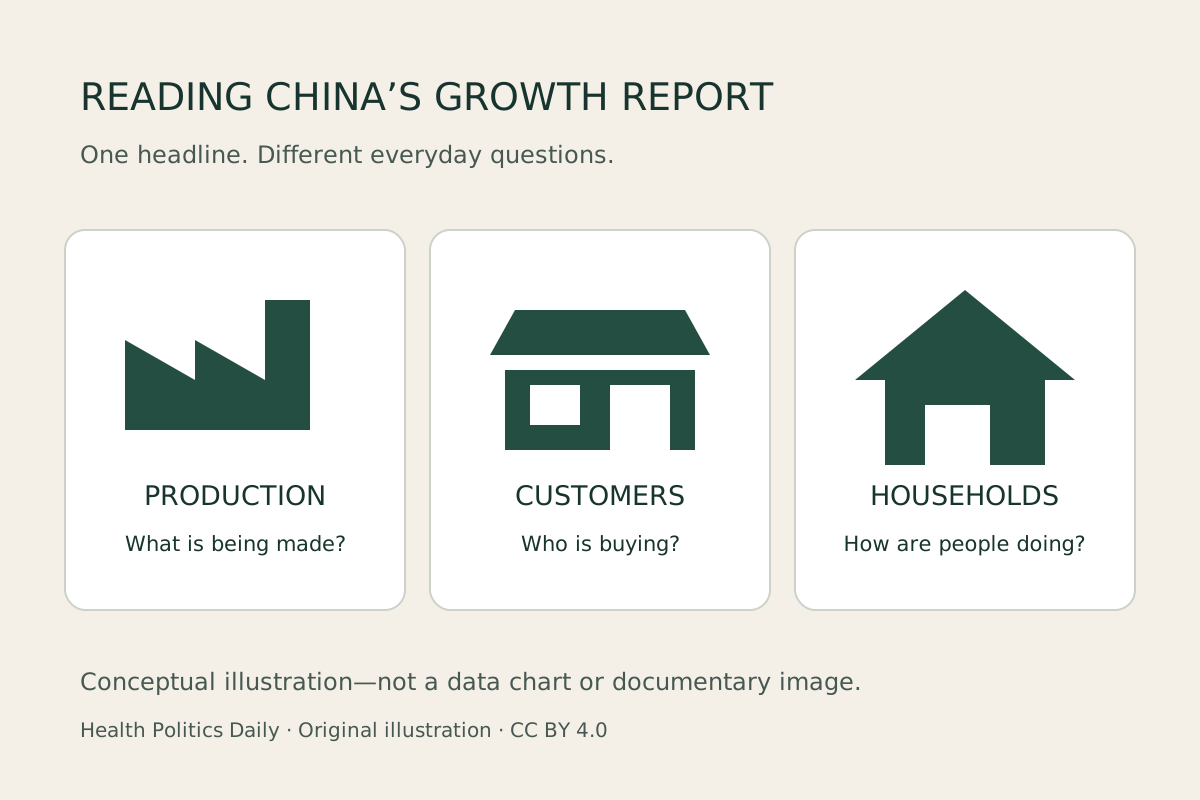
Analysis: GDP is a measure of production across an economy, not a household’s pay packet, a shop’s sales ledger or a guarantee of a job. A business selling abroad can have a different experience from one depending on local customers. Combining those experiences into one growth rate is useful for measuring scale, but can obscure who is benefiting.
The report’s retail measure is not a complete measure of all household consumption. Nor should its percentage change be subtracted from GDP growth to calculate a supposed “consumer shortfall.” The underlying concepts and coverage differ. Property investment is another distinct series, not a measure of every home’s sale price.
Analysis: For families, the more practical questions are whether earnings cover costs, work is dependable and housing commitments are manageable. For businesses, incoming orders and customer payment behavior may matter more immediately than a national quarterly average. The release is context for those questions, not a substitute for their answers.
The international stakes
The Associated Press’s reporting connects China’s export-led strength with concerns among trading partners about imbalances. That is an important distinction: rising output in one country does not by itself settle debates about market access, competition or trade restrictions.
Analysis: An importer benefits from reliable supply, while a competing producer may focus on pricing pressure. Neither experience alone describes the whole trading relationship. GDP data do not change a tariff schedule or authorize a new restriction; those require separate policy decisions. Our U.S.–China trade-truce explainer provides background, not a live customs ruling.
Targets, forecasts and what remains uncertain
The government’s announced annual growth target is 4.5%–5%. A target is a policy objective, a forecast is an expectation, and a preliminary estimate is a reported measurement. Being within the target range for nine months does not establish the full-year outcome.
The NBS itself acknowledges insufficient domestic demand. Subsequent activity, policy choices and revisions remain to be assessed. This edition does not predict stimulus, currency movements or investment returns. For the broader policy trade-offs, see our report on IMF fiscal buffers and debt risks.
Bias Lens: the same figures, different questions
Verified baseline: The NBS preliminary figures show faster GDP growth alongside much weaker retail growth and falling property investment. That combination supports scrutiny of both output and household conditions.
Center—Reuters: The current report foregrounds the forecast beat and uneven recovery.
Center-right editorial tradition—The Wall Street Journal: Its current news report leads with export-supported acceleration while noting domestic weakness. This is a description of the news article, not an attribution of the opinion pages’ positions to its reporter.
Left-leaning—The Guardian, earlier context only: Its March 5 target coverage emphasized structural reform and employment trade-offs. It is not reporting on today’s release.
No same-release left-leaning report was verified for this edition. The older item is explicitly contextual, not a manufactured three-way disagreement. The current reports largely agree on the direction of the data; different lead angles do not establish political bias or a factual contradiction.
Sources and media
The NBS release is the primary statistical source; Reuters and AP corroborate the main result. The original conceptual illustration is licensed CC BY 4.0 and is not a documentary photograph or quantitative chart. No directly relevant authorized video was verified, so none is embedded.