Public health · Influenza · Prevention
U.S. Flu Activity Is Rising Early but Remains Low, CDC Data Show
October flu reporting highlights an early rise, led by the West Coast. CDC surveillance shows why increasing activity is not a forecast of a severe season.
By Health Politics Daily News Desk · October 20, 2026 at 10:12 a.m. ET
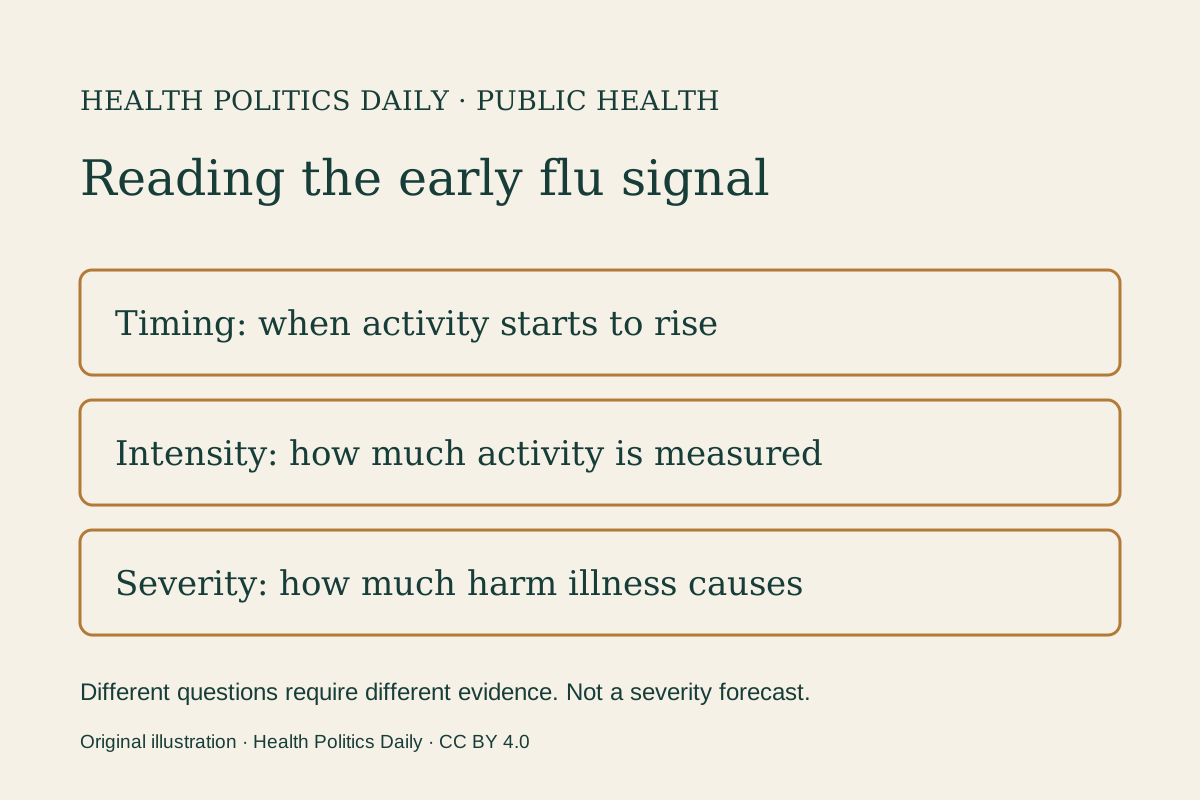
U.S. influenza activity is increasing earlier than many people associate with winter, but the latest dated CDC report reviewed for this article still classifies national activity as low. New October 20 reporting has renewed attention to prevention and questions about circulating H1N1 viruses—not established that a severe season is inevitable.
What the dated surveillance actually shows
The CDC’s October 16 FluView report covers the week ending October 10, not conditions measured this morning. Clinical laboratories reported 5.0% of specimens positive for influenza, up from 3.9% the previous week. The agency identifies the West Coast as the area of highest activity.
Among influenza A viruses subtyped by public health laboratories that week, 96.4% were A(H1N1)pdm09. CDC says the early activity is above what is typical for this point in the year but remains within expected seasonal variation. The figures are preliminary.
A positive-test percentage is not population prevalence
Analysis: The denominator is important. Five percent of tested specimens is not a finding that five percent of Americans have influenza. Nor should a percentage among subtyped viruses be read as a percentage of every respiratory illness in the country.
The CDC’s surveillance-methods explanation distinguishes diagnostic testing by clinical laboratories from public health laboratory work used to identify circulating types and subtypes. Public health laboratories often receive samples already found positive elsewhere. Their results therefore serve a different purpose and are reported separately.
Flu-like illness visits are another measure, not a laboratory diagnosis: other pathogens can produce similar symptoms. Looking across test results, medical visits and hospitalizations is more informative than treating one number as a complete national picture.
What scientists are investigating—and have not concluded
Reuters’ October 20 report describes scientists investigating an H1N1 change called G155E and possible implications for younger people’s immunity. Those concerns are questions under study, not proof that this season will be more severe for a particular age group.
Analysis: Three questions should remain separate: whether a virus has changed, whether laboratory antibodies recognize it differently, and whether people experience worse clinical outcomes. An answer to one does not automatically answer the others. A laboratory finding also does not, on its own, measure real-world vaccine effectiveness.
Forecast limit: The season’s eventual peak, total hospital burden and age-specific impact are not settled by an early rise. This article does not predict them. Later evidence could strengthen or weaken the concerns now being investigated.
What the prevention guidance means in practice
The American Medical Association’s September 30 patient explainer recommends annual flu vaccination for people aged six months and older. It identifies September and October as useful timing and explains that protection takes about two weeks to develop. It also says vaccination later in the season can still be worthwhile while flu circulates.
The AMA explains that vaccination can reduce illness and severe outcomes without guaranteeing that a vaccinated person will not get influenza. Its guidance advises prompt contact with a clinician when symptoms develop, especially for people at higher risk of complications. Individual suitability, vaccine product and treatment decisions belong with a qualified healthcare professional; this report is general information, not a personal medical recommendation.
Analysis: For families and workplaces, the practical value of early surveillance is preparation, not panic: identifying where to find current local guidance, understanding access to routine preventive care and avoiding assumptions based on a national headline. A national trend cannot diagnose a person’s symptoms or describe every community.
For related policy context, see our coverage of the vaccine-panel court appeal and dated report on COVID vaccine guidance. Those concern different decisions and do not substitute for influenza-specific advice.
Bias Lens: early activity is not a severity forecast
Verified baseline: CDC describes increasing but low activity. Timing, local intensity and eventual severity are different questions.
Center—Reuters, October 20: Foregrounds scientific uncertainty and prevention, alongside questions about younger people’s immunity.
Right-leaning—Fox News, October 15: Its segment emphasizes Western-state activity and vaccination timing.
Left-leaning contextual comparison—The Guardian, October 11: England coverage emphasizes prevention while cautioning that early timing does not determine severity.
Comparison limit: The Guardian item concerns England, not the same U.S. dataset, and is not independent corroboration of U.S. numbers. These dated examples illustrate framing, not a three-way dispute over identical facts. The broad orientation labels do not establish the accuracy of any particular claim.
Sources and video
Primary sources are CDC’s dated weekly surveillance and methods pages and the AMA’s patient guidance. Reuters supplies current scientific reporting. The image is an original conceptual illustration, not a microscopic image or a forecast. The linked Fox News segment is available on its publisher’s page; no footage is embedded, downloaded or rehosted.