HEALTH POLICY — COURTS — VACCINES
Appeals Court Weighs Block on Kennedy Vaccine Panel Appointees
A federal appeals court heard the Trump administration’s challenge to an order preventing 13 appointees from serving on the CDC’s vaccine advisory committee. The hearing did not produce a ruling, and other parts of the lower court’s vaccine-policy order are not at issue in this appeal.
By Health Politics Daily News Desk · Published Wednesday, October 7, 2026 at 1:58 a.m. America/New_York · Approximately 7 minutes

Watch in this article
Pumpjack operating at the Kern River Oil Field
A short CC0 field video provides visual context for reporting on oil production and fuel supply.
Thomas Farley / Wikimedia Commons · CC0 1.0 · License and source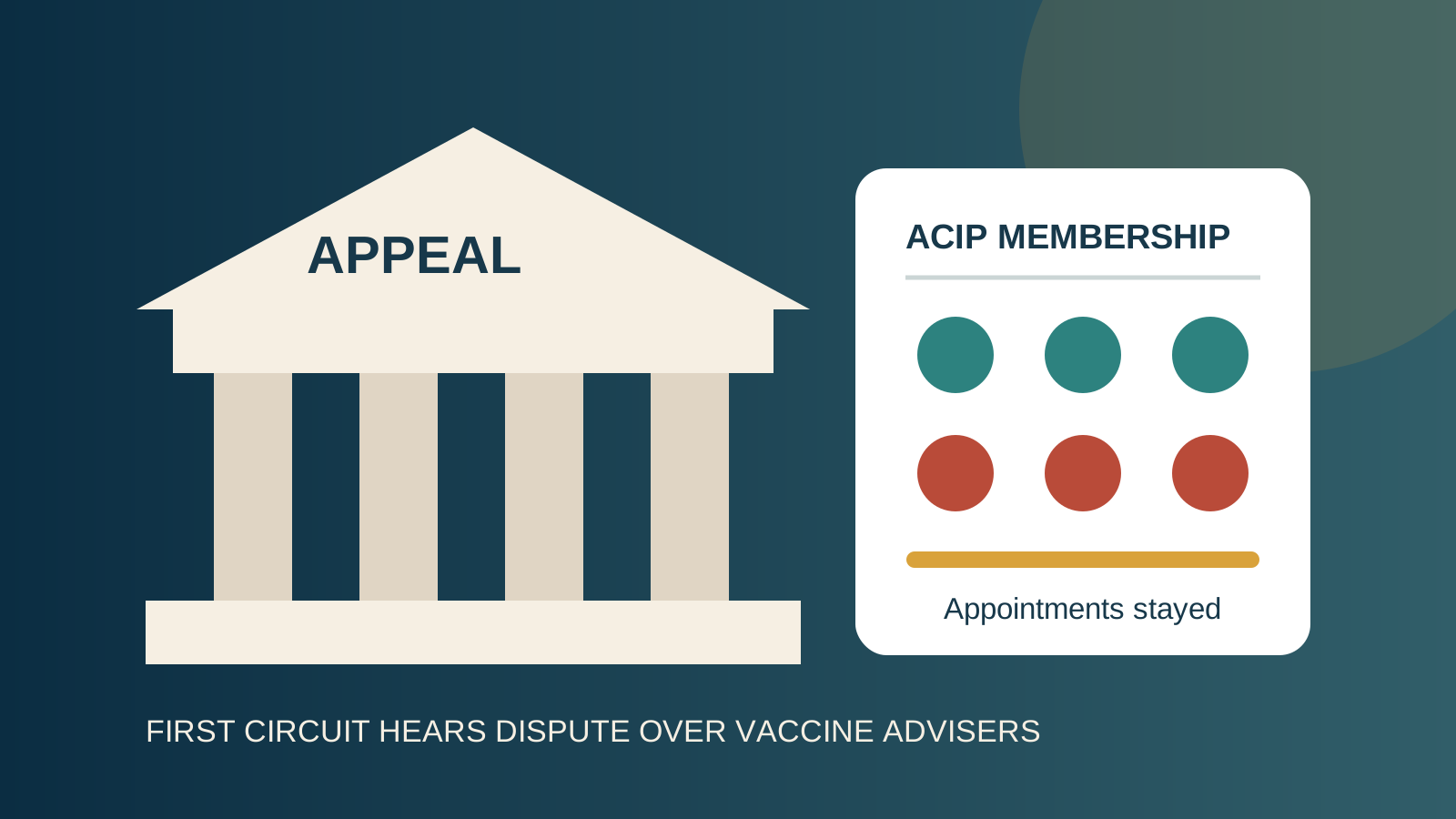
Verified Baseline
The First Circuit heard arguments; it has not decided the case
On October 6, a three-judge panel of the U.S. Court of Appeals for the First Circuit heard the government’s appeal of a March order that stayed the appointments of 13 members of the Advisory Committee on Immunization Practices, or ACIP. The committee advises the Centers for Disease Control and Prevention on how vaccines should be used in the United States.
The appellate docket and filings identify the case as American Academy of Pediatrics v. Kennedy, No. 26-1503. Reuters reported that government lawyers asked the court to vacate the appointments portion so the committee can resume work. The judges issued no decision from the bench.
What The Lower Court Did
A judge paused appointments, committee votes and schedule changes
U.S. District Judge Brian Murphy concluded that the medical organizations were likely to succeed in showing that the reconstituted committee violated the Federal Advisory Committee Act’s requirement that advisory bodies be fairly balanced. His March 16 order stayed the 13 appointments and votes taken by the challenged committee.
The same order also paused a January 2026 memorandum revising the childhood immunization schedule. The government’s current appeal focuses on the appointments remedy, Reuters reported; it does not ask the appellate court in this proceeding to restore every disputed vaccine-policy change.
The Competing Arguments
Authority to appoint versus requirements for a balanced panel
The administration argues that the district judge exceeded his authority and effectively prevented ACIP from meeting, even if the health secretary attempted to choose a new slate. The medical groups argue that Secretary Robert F. Kennedy Jr.’s replacement process produced a panel that lacked the balance and relevant expertise federal law requires.
Those are legal arguments, not findings about the safety or effectiveness of any particular vaccine. ACIP’s official CDC description says its role is to develop recommendations for vaccine use in the civilian population. The lawsuit concerns who may perform that advisory work and how federal agencies made recent changes.
Why It Matters
ACIP recommendations can influence practice and coverage
Federal vaccine recommendations guide clinicians, health departments and immunization programs. They can also affect which vaccinations insurers cover without cost-sharing under federal law. Delayed meetings therefore create practical uncertainty for seasonal and routine guidance, while an improperly constituted panel could undermine public trust and the legal durability of its decisions.
For families, the hearing changes no recommendation by itself. Patients should rely on current guidance from qualified clinicians and official public-health agencies rather than interpreting courtroom questions as medical advice or a final ruling.
What Happens Next
The panel may affirm, narrow or reverse the appointments order
The First Circuit could uphold the stay, vacate it or send the issue back with instructions for a narrower remedy. The timing is uncertain. Even if the government wins this appeal, separate challenges to vaccine-schedule changes and agency procedure could continue in the district court.
Verified fact: the appointments remain stayed and the appeal has been argued. Analysis: the judges’ questions suggest attention to the breadth of the remedy, but questions do not predict votes. Forecast: a ruling could clarify how far courts may go when enforcing federal advisory-committee rules. Opinion: this article takes no position on the litigants or any individual vaccine.
Bias Lens: how the dispute is framed
The appeal concerns a stay blocking 13 appointments to ACIP. The administration says the order prevents the committee from functioning; plaintiffs say the appointment process likely violated federal balance requirements. No appellate ruling has issued.
Left-leaning coverage: The Guardian foregrounded the lower court’s criticism of the policy changes and public-health concerns. Center coverage: Reuters centered the appellate arguments and judges’ questions about the remedy. Right-leaning coverage: The Wall Street Journal emphasized HHS’s institutional options after the lower-court ruling, including replacing the slate or appealing.
The difference is primarily emphasis—public-health consequences, appellate doctrine or executive options. None of these frames changes the controlling record: the written order, the filings and any eventual First Circuit judgment.
Principal Sources
Court record and authoritative context
- U.S. District Court — March 16 preliminary-relief order
- Georgetown Health Care Litigation Tracker — First Circuit docket and filings
- CDC — ACIP role and committee information
- Reuters — October 6 oral-argument report
No suitable directly relevant official or publisher-authorized video with clearly confirmed embedding rights was available at publication time, so no video was embedded.