HEALTH POLICY — U.S. POLITICS — PUBLIC OPINION
KFF Poll Finds 66% Support Medicare for All
Two-thirds of U.S. adults favor a single government health plan in a new KFF survey, the highest level the organization has recorded. But support changes substantially when respondents hear competing claims about taxes, wait times, benefits and private insurance.
By Health Politics Daily News Desk · Published Wednesday, October 7, 2026 at 12:00 a.m. America/New_York · Approximately 7 minutes

Watch in this article
Pumpjack operating at the Kern River Oil Field
A short CC0 field video provides visual context for reporting on oil production and fuel supply.
Thomas Farley / Wikimedia Commons · CC0 1.0 · License and source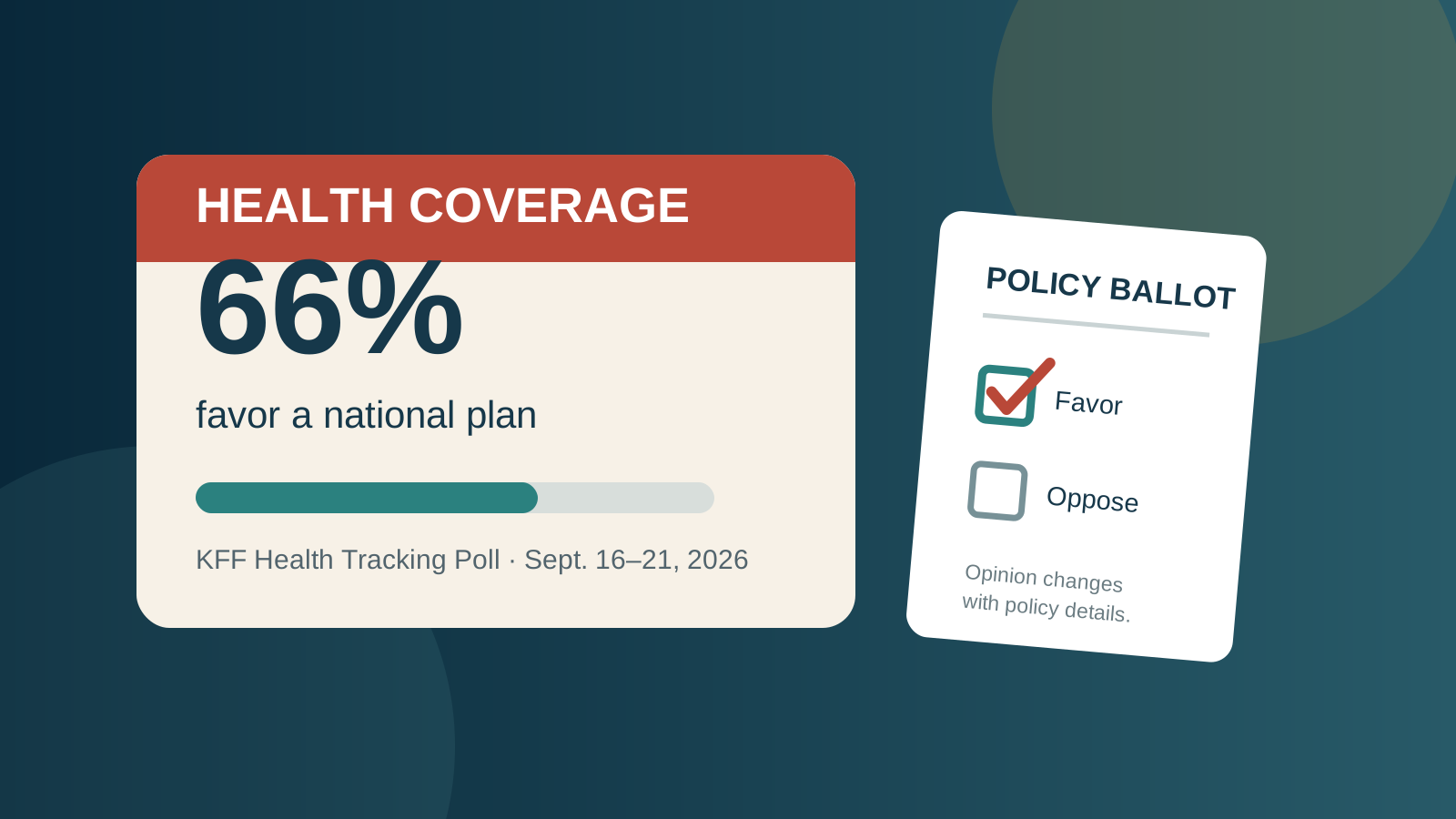
Verified Baseline
Two-thirds favor a national health plan in the initial question
KFF’s September 16–21 survey found that 66% of U.S. adults favored “a national health plan, sometimes called Medicare-for-all,” in which everyone would receive insurance from a single government plan. That is up from 53% in KFF’s comparable October 2020 question and is the highest support KFF has measured since it began tracking the proposal.
The KFF poll report and methodology show a sharp partisan divide: 84% of Democrats and 72% of independents favored the proposal, while 66% of Republicans opposed it. Reuters independently reported the findings and their election context.
How To Read The Poll
The wording and follow-up arguments materially change support
The 66% figure is a response to a broad description, not to legislative text, a financing plan or a specified benefit package. When respondents were told a national plan could eliminate private health insurance, support was 52% and opposition 47%. KFF also found that 76% opposed the idea after hearing it could cause delays in tests or treatment, while 64% opposed after hearing it could increase taxes.
Positive arguments moved opinion in the other direction: 76% favored the proposal after hearing it could make health insurance a right, and 75% favored it after hearing it could eliminate premiums and cost-sharing. These are reactions to claims presented in a survey; the poll does not establish that any given Medicare-for-all bill would produce each claimed result.
Why It Matters
Health costs are shaping the midterm debate
Sixty percent of adults told KFF they were at least somewhat worried about affording health care, slightly above concern about gasoline and groceries. Eighty-six percent said the health system needs major changes or a complete overhaul, including majorities across party groups.
That creates political demand for candidates to explain not only whether they support universal coverage, but how they would pay providers, collect revenue, handle existing Medicare, cover prescription drugs and manage the transition from employer plans. A poll showing dissatisfaction can raise an issue’s salience; it cannot enact policy or predict which proposal Congress would pass.
Practical Implications
Nothing about current coverage changes because of this survey
The poll does not alter Medicare, Medicaid, employer insurance or Affordable Care Act coverage. People should continue using official enrollment notices and plan documents for decisions about current benefits. For voters, the practical value is diagnostic: broad labels attract support, while specific tradeoffs divide the public and will matter in campaign debates.
KFF surveyed a nationally representative sample of 1,328 adults online and by telephone in English and Spanish. The margin of sampling error for the full sample was plus or minus 3 percentage points. As with every survey, non-sampling error, question order and the gap between stated opinion and voting behavior remain sources of uncertainty.
Fact, Analysis And Forecast
What is established—and what remains uncertain
Verified fact: 66% favored the proposal in KFF’s initial question, with strong partisan differences. Analysis: high concern about medical costs appears to be expanding interest in structural reform, but the follow-up questions show that support is conditional. Forecast: Medicare-for-all is likely to remain a prominent midterm issue, yet this poll alone cannot predict election outcomes or legislation. Opinion: this article takes no position for or against a single-payer system.
Bias Lens: how coverage frames the Medicare-for-all debate
KFF found 66% initial support, 52% support when replacing private insurance was mentioned, and substantial movement after respondents heard favorable or unfavorable claims. The survey measures opinion, not policy effects.
Left-leaning coverage: The Guardian emphasizes progressive candidates, universal coverage and the proposal’s return as a Democratic pressure point. Center coverage: Reuters leads with the 66% topline while also reporting the private-insurance, tax and wait-time responses. Right-leaning coverage: The Wall Street Journal places health-cost proposals within a broader affordability-driven populist turn and stresses implementation barriers.
The frames differ mainly in emphasis: movement politics, poll results or fiscal and institutional constraints. None should substitute for KFF’s complete questionnaire and methodology, and the sources are not treated as mechanically equivalent.
Principal Sources
Primary data and corroborating reporting
- KFF — full Health Tracking Poll findings and methodology
- KFF — current and historical Medicare-for-all opinion
- Reuters — national report on the survey
- AHRQ — contemporaneous federal health-affordability initiative
No suitable directly relevant official or publisher-authorized video with clearly confirmed embedding rights was available at publication time, so no video was embedded.