Health insurance · Workplace benefits · Household costs
Employer Family Health Premiums Reach $28,303 in 2026, KFF Finds
Workers paid an average $7,471 toward employer-sponsored family coverage this year, up 9% from 2025. Employees at smaller firms faced substantially higher average contributions, but the figures are national averages—not a forecast of any one household's bill.
By Health Politics Daily News Desk · October 23, 2026 at 12:04 a.m. ET

Watch in this article
Pumpjack operating at the Kern River Oil Field
A short CC0 field video provides visual context for reporting on oil production and fuel supply.
Thomas Farley / Wikimedia Commons · CC0 1.0 · License and source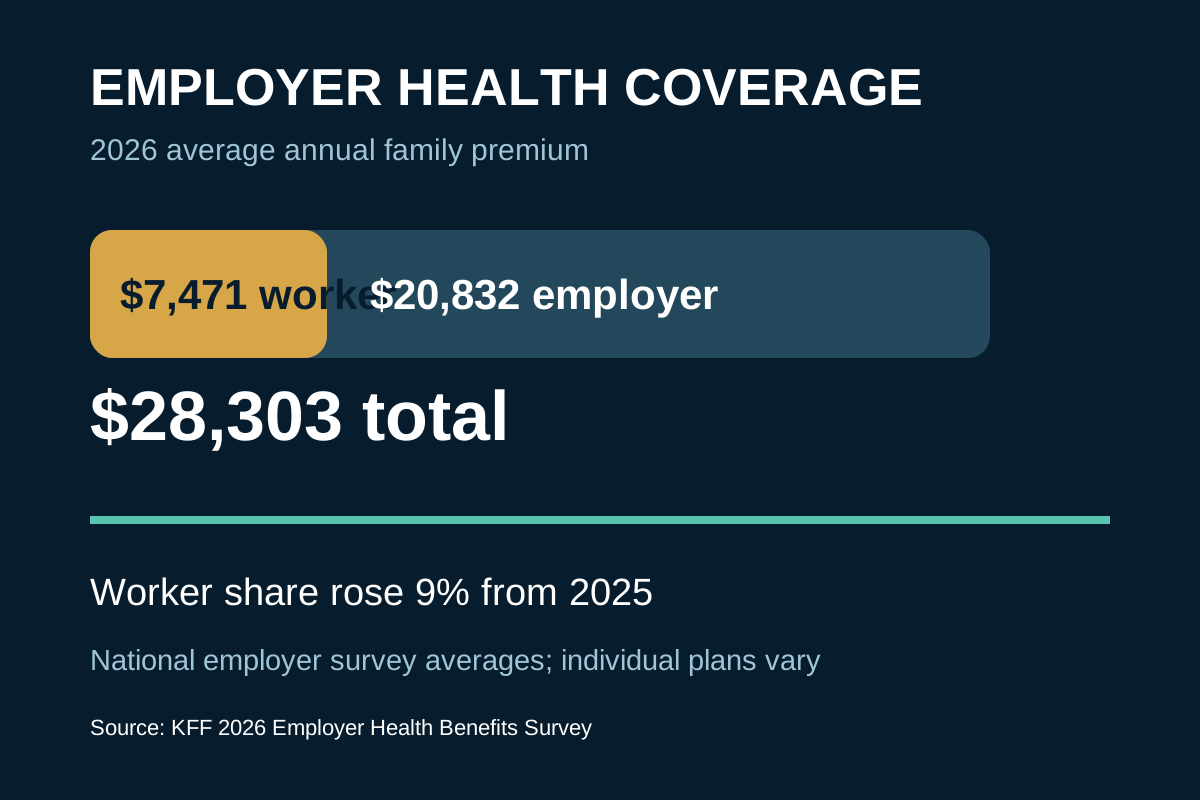
Annual premiums for employer-sponsored family health coverage averaged $28,303 in 2026, according to KFF's newly released benchmark survey. Employers paid most of that total, while covered workers contributed $7,471 on average—$621, or about 9%, more than in 2025.
The total family premium rose 5%, faster than the 2.7% general inflation rate and the 3.7% increase in wages reported for the comparison period. KFF surveyed a nationally representative sample of private and nonfederal public employers with at least 10 workers. Almost 157 million Americans under age 65 receive health coverage through work.
Small-firm workers face a larger family premium share
Workers with family coverage at firms with fewer than 200 employees contributed an average $9,687, compared with $6,840 at larger employers. At firms with 10 to 199 workers, 32% of covered employees were enrolled in plans requiring them to pay more than half of the family premium; the corresponding share at larger firms was 6%.
Those comparisons describe averages across employers, not what every small business offers. Industry, geography, plan design, workforce composition and employer contributions can all change a family's actual cost.
Premiums are only part of the bill
The average annual deductible among covered workers in a plan with a general deductible was $1,955 for single coverage. A premium is paid to maintain coverage; a deductible is generally the amount a member pays for covered services before the plan begins sharing certain costs. Copays, coinsurance and services excluded from coverage can add further expenses.
Practical implication: during open enrollment, comparing only the paycheck deduction can be misleading. Employees can also examine the deductible, out-of-pocket maximum, provider network, drug formulary, employer account contributions and expected care needs. This is general information, not personalized medical or financial advice.
What the numbers show—and what they do not
Verified fact: in KFF's survey, average total family premiums reached $28,303 and the worker contribution averaged $7,471. Analysis: the faster rise in worker contributions means many households felt more direct pressure than the 5% headline increase in the total premium suggests. Forecast: employers and consultants expect continued cost pressure in 2027, but the KFF survey does not establish the increase any specific company will impose. Opinion: employers and insurers should present total costs and benefit changes in comparable terms so workers can evaluate tradeoffs before enrollment closes.
For related context, see our reporting on why total monthly Medicare costs matter, federal changes to duplicate ACA subsidies and the federal kidney-care roadmap.
Bias Lens: household burden, employer pressure and structural reform
Verified baseline: KFF found a 5% rise in average family premiums and a 9% rise in workers' average contribution. The survey measures employer plans nationally and does not assign the increase to one law, party or single industry.
Left-leaning opinion — The Washington Post: uses rising costs to argue that employer coverage needs more structural experimentation. Center — Associated Press: foregrounds the effect on workers and the sharper small-business squeeze. Center-right business coverage — The Wall Street Journal: emphasizes employer responses, benefit redesign and cost shifting. These are differences in emphasis and format; the underlying survey figures are shared.
What remains uncertain
The survey cannot predict each employer's 2027 renewal, how many firms will absorb increases rather than shift them to workers, or how plan changes will affect access to care. It also does not isolate a single cause for the rise. Medical prices, use of services, specialty drugs and bargaining arrangements can interact differently across markets.
Principal sources
- KFF — 2026 Employer Health Benefits Survey
- KFF — summary and methodology
- Associated Press — worker and small-business context
- Wall Street Journal — employer responses
No suitable directly relevant official or publisher-authorized video with clear embedding permission was available, so none was embedded.