Health policy · Medicare · Household costs
Medicare 2027: Lower Average Advantage Premiums Do Not Guarantee Lower Bills
New reporting highlights Medicare benefit changes during open enrollment. Official 2027 premium projections are not a promise that every enrollee’s total costs will fall.
By Health Politics Daily News Desk · October 20, 2026 at 12:02 p.m. ET
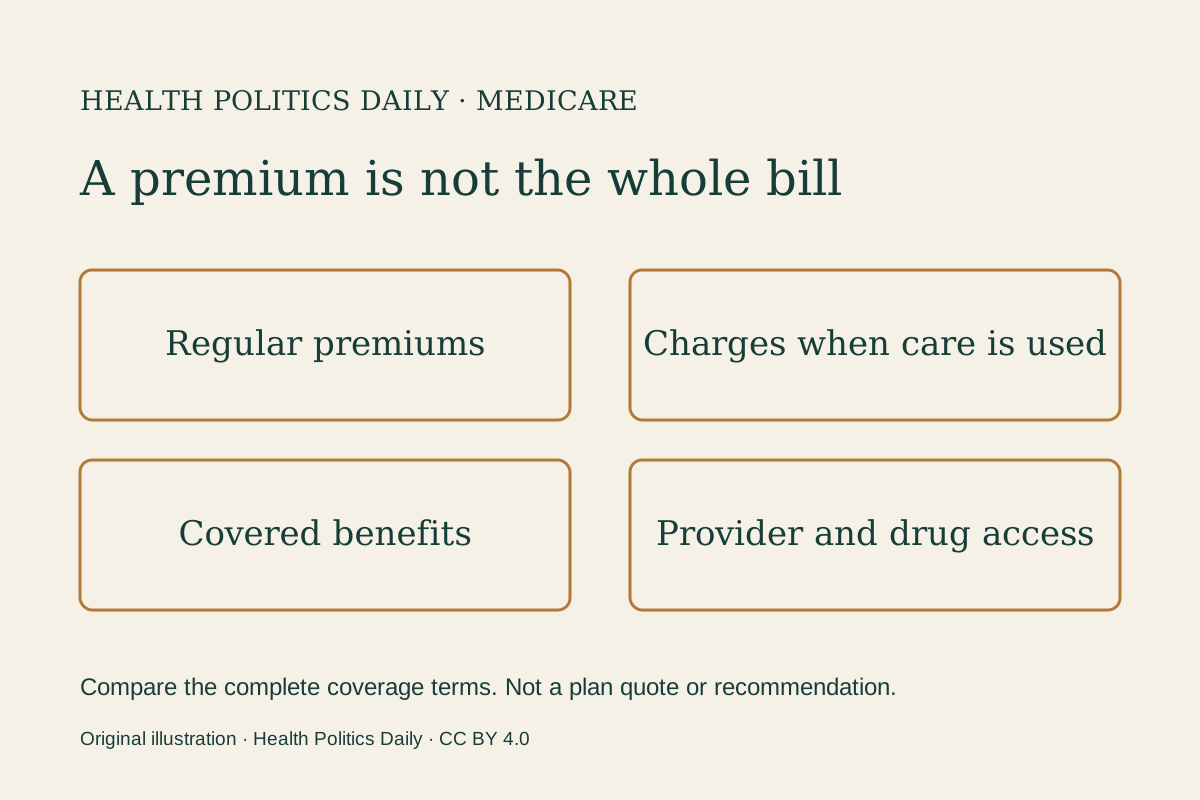
As Medicare’s annual enrollment period gets under way, two messages can both be true: the government projects a lower average Medicare Advantage premium for 2027, while some people face higher charges or reduced benefits in their own plans. A national premium average is not an estimate of every household’s medical bill.
October 20 Financial Times reporting highlights benefit reductions and higher cost sharing at major insurers. The practical question for enrollees is narrower than whether Medicare is becoming cheaper or more expensive in general: what changes in the particular coverage available to them?
What the official premium projection says
In its September 28 release, the Centers for Medicare & Medicaid Services projects the enrollment-weighted average monthly Medicare Advantage premium will decline from $14.37 in 2026 to $12 in 2027, or 16.5%. That is a plan-premium measure, not total spending on care.
CMS separately projects the average stand-alone Part D drug-plan premium will rise from $35.09 to $36 a month. Its figures for drug coverage inside Medicare Advantage are a different category and should not be substituted for the stand-alone figure.
The agency says approximately eight in 10 Medicare Advantage beneficiaries can remain in their current plan with the same or a lower premium. That does not establish that every copayment, covered service or benefit allowance in those plans is unchanged. CMS identifies the enrollment window as October 15 through December 7, 2026.
The bill has more than one moving part
Medicare’s own cost guidance explains that a plan premium, when charged, is generally additional to the Part B premium. Costs also depend on deductibles, service charges, network rules, extra benefits and how often care is needed. Some plans help with the Part B premium, but that is not available everywhere.
Analysis: A low fixed premium can coexist with higher charges when a person uses care. Conversely, a higher premium alone does not establish that a plan’s total yearly costs will be higher for every enrollee. Comparing only the headline premium leaves out both access and exposure to other expenses.
Illustration, not a plan quote: A hypothetical $5 monthly premium reduction saves $60 over a year. Six visits carrying an additional $15 copayment would add $90. In that deliberately simplified example, those two changes together raise spending by $30. Actual results depend on the plan and care used; this is arithmetic, not a recommendation or forecast.
Start with the plan’s change notice
Medicare’s Annual Notice of Change guidance says plans send the notice each fall, normally in September, to describe changes taking effect in January. It advises reviewing the changes and contacting the plan if the notice has not arrived.
For a useful comparison, distinguish three questions: what is paid regularly to maintain coverage, what is paid when services or medicines are used, and whether the needed providers and benefits remain accessible. The KFF enrollment explainer details how provider and pharmacy networks, covered drugs and benefit scope can differ across plans. A benefit listed as present may still have limits that matter in practice.
The official Medicare Plan Finder is the starting point for comparing local options. Confirm important coverage details with the plan and providers rather than assuming a national report describes a particular contract. This article does not recommend an insurer or tell any individual to switch coverage.
What remains uncertain
Uncertainty: Projected averages are not final individual bills, and future healthcare use cannot be known exactly. This report has not audited every insurer’s 2027 contract and does not claim that all plans are cutting benefits. Reported examples of higher costs should not be generalized to every enrollee, just as an average decline should not be advertised as a universal saving.
Our coverage of the separate one-time Medicare payment addresses a different policy, not the recurring price of 2027 coverage. Our report on public views of health coverage provides policy context; polling preferences do not establish the terms of any existing plan.
Bias Lens: national averages versus individual exposure
Verified baseline: CMS projects lower average Medicare Advantage premiums. Medicare’s cost guidance makes clear that premiums are only one component of spending.
Official framing—CMS, September 28: Emphasizes premium stability and plan access. A government announcement is a primary source for its projections, not an independent evaluation of every person’s costs.
Center—Associated Press enrollment coverage: Explains choices and the 2027 transition. The Financial Times’ October 20 reporting foregrounds the financial pressure on older Americans.
Consumer-cost framing—The Wall Street Journal’s October 15 headline and accessible summary: Emphasize benefit changes, networks and added charges. Its news report is not classified by the political orientation of its opinion pages.
Comparison limit: A directly comparable current left-leaning and right-leaning pair was not verified. Coverage of unrelated checks or political promises would create a misleading contrast. Here the meaningful difference is the measure being emphasized: average premiums, plan terms or household exposure—not an invented partisan disagreement about arithmetic.
Sources and media
Primary sources are CMS’s dated 2027 announcement and Medicare’s cost and annual-notice guidance. KFF, AP, Financial Times and Wall Street Journal provide explanatory context and corroboration. The original illustration is not an insurance offer. No suitable directly relevant authorized video was verified, so none is embedded.