HEALTH POLICY — ACA MARKETPLACE — PROGRAM INTEGRITY
CMS Ends ACA Subsidies Tied to 189,000 Duplicate or Deceased Enrollees
The 2026 review found marketplace subsidies overlapping with Medicare, Medicaid or CHIP, plus deceased-enrollee records. Living people kept other government coverage, and flagged records received 30 days to dispute the match.
By Health Politics Daily News Desk · Published Wednesday, October 14, 2026 at 12:00 p.m. America/New_York · Approximately 8 minutes
Verified Baseline
What CMS says it found
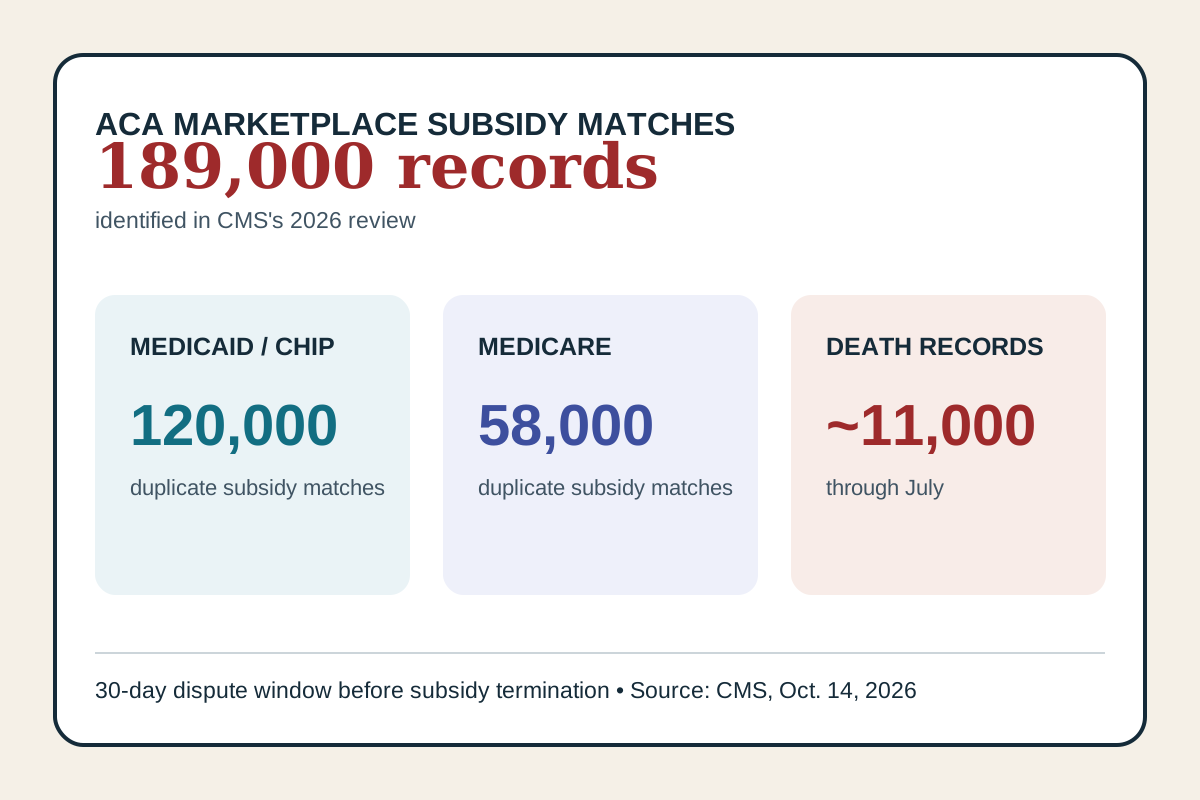
The Centers for Medicare & Medicaid Services said October 14 that its 2026 data-matching work identified 189,000 federally subsidized Affordable Care Act marketplace records connected either to other government coverage or to a death record. Officials broke the total into about 120,000 people also enrolled in Medicaid or the Children’s Health Insurance Program, 58,000 also enrolled in Medicare and roughly 11,000 deceased enrollees through July.
CMS ended the marketplace subsidies after giving the affected person—or an estate in a death-record case—30 days to dispute the match or resolve the overlap. Reuters reported that another 3,500 death-record cases were expected to be processed by the end of October.
Verified fact: the action concerns subsidies for federal marketplace plans. Important distinction: CMS and Reuters say living people in this batch retained Medicare, Medicaid or CHIP; the action did not leave them without any health coverage.
How the Process Works
A computer match is followed by notice and a response period
Federal rules generally bar advance premium tax credits for a marketplace plan when a person is eligible for qualifying government coverage. CMS calls its recurring check “periodic data matching.” The agency compares marketplace records with Medicare, Medicaid and CHIP data and separately checks some applications against death records.
CMS says it contacts people whose records appear to overlap and allows 30 days to show the match is wrong or end duplicate coverage. If the issue is not resolved, the agency ends the marketplace subsidy. For a death match, CMS says the plan is also canceled after the dispute period.
The process matters because government databases can lag or contain errors. A notice is therefore not the same thing as a final finding of intentional fraud. CMS said about half of the Medicaid matches in its first summer round were resolved before the deadline.
Practical Implications
What a person receiving a notice should verify
- Confirm the notice through a secure HealthCare.gov account or the official marketplace call center, not through an unsolicited caller or link.
- Compare the notice with current Medicare, Medicaid or CHIP enrollment records and check every household member separately.
- Use the response instructions and deadline in the notice if the match is wrong, outdated or belongs to another person.
- If other coverage has ended, update the marketplace application promptly; subsidy eligibility can depend on the effective dates of both programs.
- Keep copies of notices and submitted documents, and verify that an insurer or pharmacy has the current coverage information.
This is general insurance information, not individualized legal, tax or medical advice. People should use official notices or qualified enrollment assistance for their own case.
Savings Claim
The $738 million figure is an agency estimate
HHS estimates that the 2026 action will prevent about $738 million in subsidy payments this year and more than $1.5 billion on an annualized basis. Those figures describe projected avoided payments, not an independent audit of money already recovered.
Analysis: stopping a subsidy when qualifying public coverage is already in place protects program funds without necessarily reducing a living enrollee’s access to insurance. The risk lies in false or stale matches, which makes timely notice, a workable dispute process and public reporting on corrections essential.
What Is Separate
This is not the September cancellation action
CMS Administrator Mehmet Oz told reporters that this review is separate from the September action involving about 315,000 marketplace policies covering more than 760,000 people. That earlier action involved suspected unauthorized enrollments, identity or eligibility documentation and broker conduct. The October 14 action is specifically about duplicate government coverage and death-record matches.
Keeping those populations separate avoids double-counting and avoids labeling every person in either group as having committed fraud.
What Remains Uncertain
Correction rates and the final savings are not yet public
CMS has not published a complete state-by-state breakdown, final appeal or correction rates, or an independently audited savings total for this 2026 batch. The agency also said states must begin address checks in January 2027 after identifying potential multi-state Medicaid or CHIP overlaps; that is a future verification requirement, not proof that every flagged record is improper.
Forecast: more records will be reviewed as federal and state systems improve matching. Opinion: Health Politics Daily takes no position on the administration’s enforcement strategy; useful oversight should measure both improper payments stopped and eligible people incorrectly flagged.
Bias Lens: savings, safeguards and coverage
CMS says 189,000 records involved duplicate government coverage or deceased enrollees. Flagged records received 30 days to respond, living people retained other coverage, and the savings figures are agency estimates.
Left-leaning framing: The Guardian’s coverage of the broader September enforcement campaign emphasizes the danger that eligible people can lose affordable coverage and the burden of proving eligibility. Center framing: Reuters reports today’s totals, dispute window, savings claim and officials’ statement that no living person lost all coverage. Right-leaning framing: The Daily Wire foregrounds double payment, fraud enforcement and taxpayer savings.
The left and right examples do not examine identical batches, so they should not be treated as symmetrical fact checks. Their useful contrast is emphasis: error and coverage risk, procedural facts, or government waste. The official record supports scrutiny of both payment integrity and match accuracy.
Principal Sources
Primary records and corroborating reporting
- CMS — October 14 announcement and process
- CMS — periodic data matching rules and resources
- Reuters — breakdown, dispute period and savings estimate
- HealthCare.gov — official document and deadline guidance
No directly relevant official or publisher-authorized video with clear embedding permission was available, so no video was embedded.
Related Coverage