ECONOMICS — CENTRAL BANKS — PUBLIC POLICY
Hall and Woodford Win 2026 Nobel Economics Prize for Stabilization Research
American economists Robert E. Hall and Michael Woodford received the 2026 economics prize for research that put household and business expectations at the center of how governments and central banks respond to inflation, recessions and other shocks.
By Health Politics Daily News Desk · Published Monday, October 12, 2026 at 8:06 a.m. America/New_York · Approximately 9 minutes
Verified Baseline
Two U.S. economists share the 12 million-krona prize
The Royal Swedish Academy of Sciences awarded the Sveriges Riksbank Prize in Economic Sciences in Memory of Alfred Nobel to Robert E. Hall of Stanford University and Michael Woodford of Columbia University. The committee cited their contributions to the microeconomic foundations of macroeconomic stabilization policy.
The laureates will share 12 million Swedish kronor, about $1.2 million. The economics award was established by Sweden’s central bank and first presented in 1969; it is announced and presented alongside the original Nobel prizes but was not created in Alfred Nobel’s will.
The official prize announcement is the controlling record. Reuters and The Associated Press independently corroborated the laureates, award amount and rationale.
The Core Idea
Economic outcomes begin with millions of individual decisions
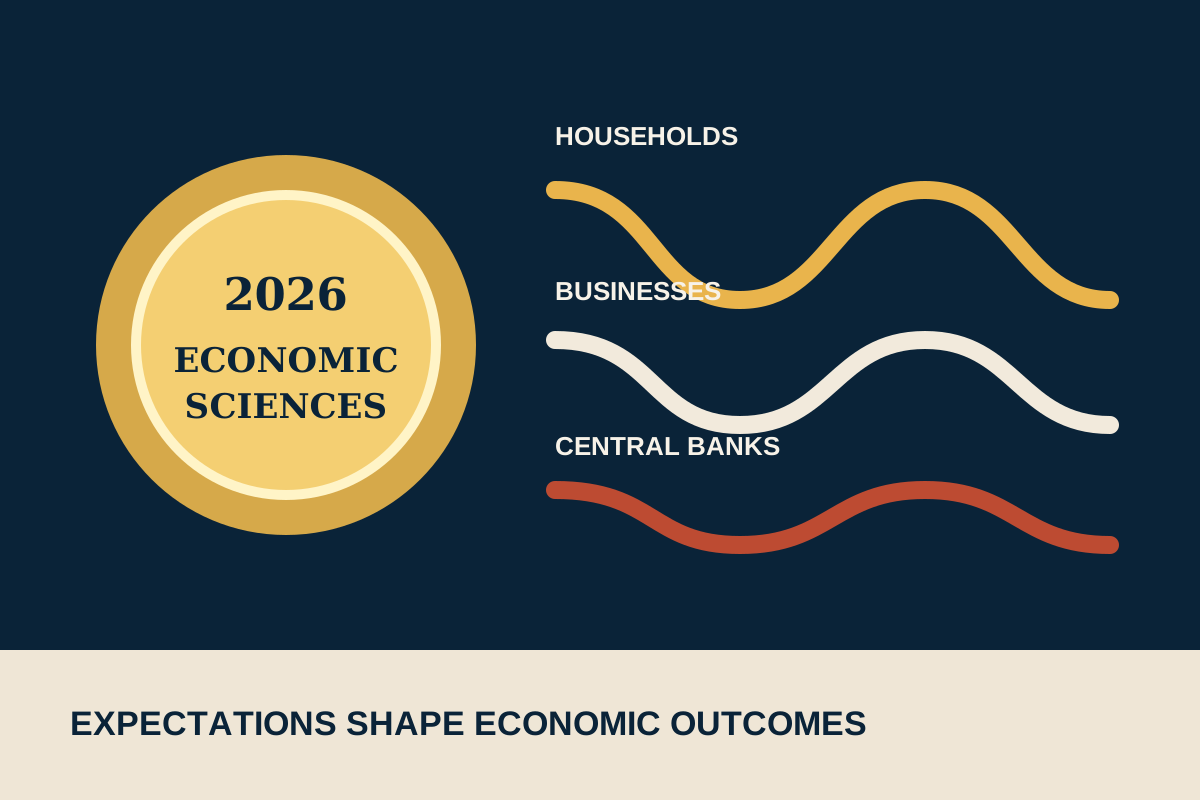
Older macroeconomic models often treated consumption, investment and prices in broad aggregates. Hall and Woodford helped build models from the choices of households and businesses: whether people spend or save, how companies set prices, and what each expects income, costs and interest rates to be in the future.
Hall’s work examined how consumption responds to expected lifetime resources and why some households cannot smoothly borrow or draw down savings when conditions change. Woodford showed how businesses’ forward-looking price decisions and a central bank’s communication can influence inflation and demand before a policy change is fully implemented.
This does not mean expectations are the only economic force. Employment, wages, credit constraints, energy costs, productivity, fiscal policy and unexpected events still matter. The models are tools for organizing those interactions, not mechanical forecasts.
Why It Matters
Central-bank words can change behavior before rates move
If households and companies make decisions based partly on the future they anticipate, a credible policy path can affect today’s borrowing, spending, hiring and pricing. That insight underpins “forward guidance”—central banks explaining how they may adjust policy as inflation and employment evolve.
The research helped modernize the New Keynesian framework used in central banks and finance ministries. It has been applied to shocks including financial crises, the pandemic and energy-price surges. The prize recognizes a body of scholarship developed over decades, not a policy intervention announced Monday.
Practical Implications
What the award means for households, markets and policy
- Central-bank communication matters: investors and borrowers react not only to today’s rate but also to the expected path of future policy.
- Credibility matters: guidance can lose influence when new data, political pressure or inconsistent decisions make a stated path less believable.
- Households differ: a model’s “average” response can obscure people living paycheck to paycheck who cannot shift consumption easily.
- The prize is not a rate signal: it does not tell the Federal Reserve or another central bank what to decide at its next meeting.
- It is not investment advice: Nobel recognition does not predict bond yields, stock prices, inflation or recession timing.
What Remains Uncertain
Models improve decisions but do not eliminate shocks or tradeoffs
Policymakers must estimate unobservable concepts such as potential output and the “neutral” interest rate, and those estimates can be revised. A model calibrated to one period may perform differently after a pandemic, war, supply-chain rupture or structural change in labor markets.
Verified fact: Hall and Woodford won for foundational research on stabilization policy. Analysis: the award highlights why communication and credibility have become core central-bank instruments. Forecast: their framework will remain influential, but future policy debates will focus on how models handle inequality, supply shocks and financial instability. Opinion: Health Politics Daily takes no position on whether the committee should have selected other candidates; nominations and deliberations remain confidential for 50 years.
Bias Lens: how coverage frames the economics prize
Hall and Woodford share the 2026 economics prize for research that grounded stabilization policy in household and business behavior, with particular attention to expectations, consumption, pricing and central-bank communication.
Left-leaning coverage: The Guardian explains the New Keynesian framework while also noting the prize’s gender imbalance. Center coverage: Reuters stresses crisis-management tools, central-bank use and forward guidance; AP uses household spending and business pricing to make the research concrete. Right-leaning coverage: The Wall Street Journal foregrounds the prize and the laureates’ influence on macroeconomic stability.
The outlets agree on the winners and basic rationale. Their differences are mainly emphasis—representation, explanatory examples or policy influence—not competing versions of the award.
Principal Sources
Official materials and independent reporting
- Nobel Prize Outreach — official 2026 economics press release
- Royal Swedish Academy of Sciences — popular scientific background
- Reuters — announcement, rationale and policy context
- Associated Press — independent explanation and laureate details
The Nobel Prize organization provides an official announcement video on its own channels. Because clear third-party embedding permission was not established, this article links to the official prize materials and does not embed or rehost the video.
Related Coverage