HEALTH — SCIENCE — NEUROSCIENCE
2026 Nobel Medicine Prize Honors Optogenetics Pioneers
Karl Deisseroth, Peter Hegemann and Georg Nagel will share medicine’s 2026 Nobel Prize for discoveries that made it possible to control selected cells with light. Their work transformed neuroscience, but it does not mean light-based brain treatments are ready for routine patient care.
By Health Politics Daily News Desk · Published Monday, October 5, 2026 at 12:01 p.m. America/New_York · Approximately 7 minutes
Verified Baseline
Three scientists share the prize for optogenetics
The Nobel Assembly at Karolinska Institutet awarded the 2026 Nobel Prize in Physiology or Medicine to U.S. neuroscientist Karl Deisseroth and German scientists Peter Hegemann and Georg Nagel “for their discoveries concerning light-gated ion channels and optogenetics.” The three will share 12 million Swedish kronor.
The official Nobel Prize announcement describes a research path that began with light-sensitive proteins in microorganisms and became a method for switching selected cells on or off with light. The European Research Council separately confirmed Hegemann’s award and the European funding behind part of his work.
How It Works
Light-sensitive proteins become cellular switches
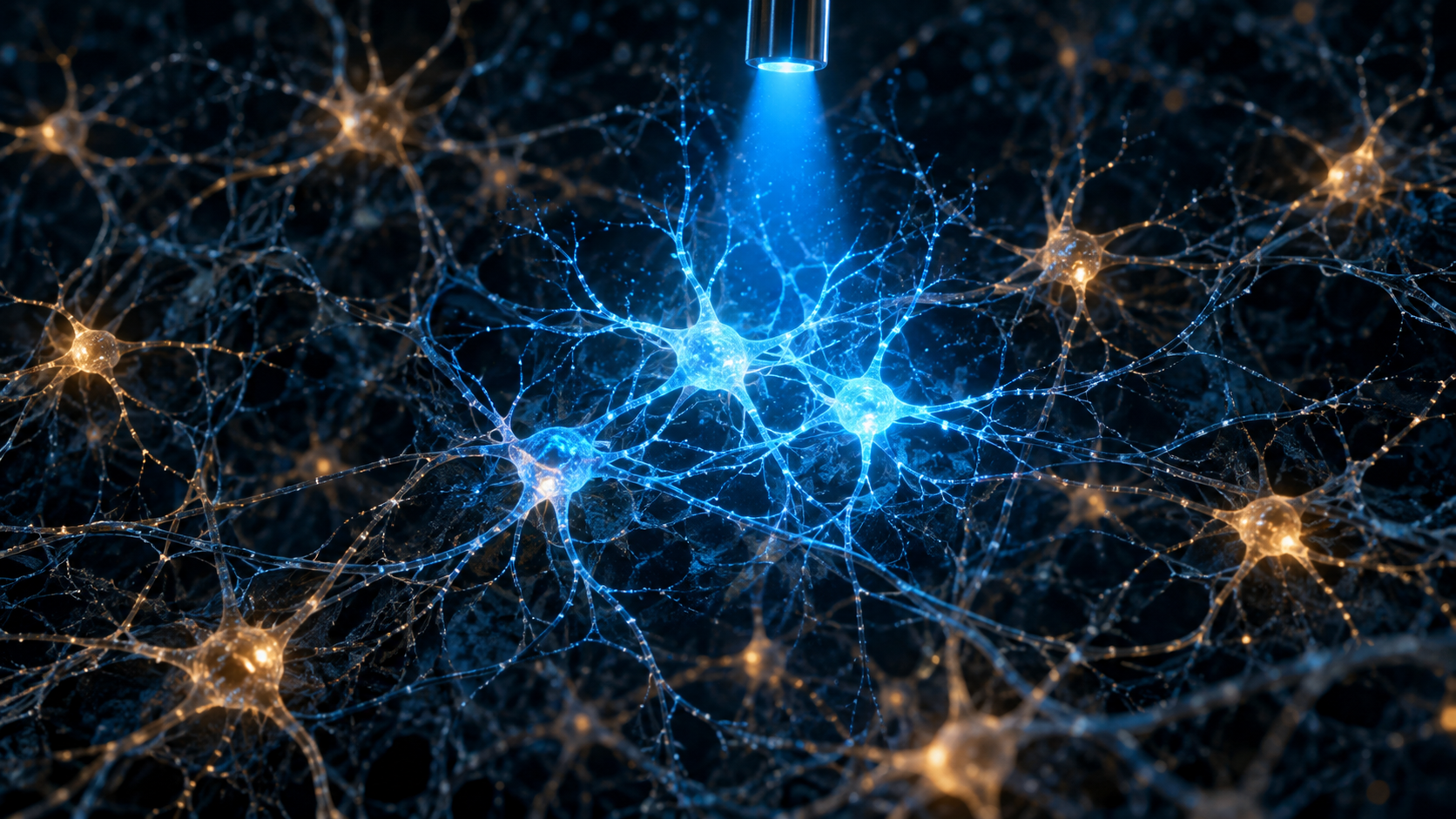
Hegemann and Nagel helped establish that channelrhodopsins—proteins used by algae to respond to light—could move charged particles across a cell membrane. Deisseroth’s team then introduced a channelrhodopsin gene into nerve cells and used pulses of light to control their electrical activity.
The technique combines genetics and optics. Researchers first make a selected cell population produce a light-sensitive protein, then deliver light at a chosen wavelength and time. Compared with stimulating a broad brain region electrically, that approach can isolate a much narrower group of cells and test whether it causes a particular movement, behavior or physiological response.
Why It Matters
A tool for testing cause and effect in living neural circuits
Brain imaging can show which areas are active during a task, but activity alone does not prove that a circuit caused the result. Optogenetics lets researchers activate or silence selected cells and observe what changes. That has helped laboratories study movement, sleep, memory, fear, reward and the circuitry implicated in neurological and psychiatric disorders.
The discovery also illustrates how basic research can travel across disciplines: curiosity about how algae sense light eventually produced one of neuroscience’s most widely used experimental tools. The award recognizes that enabling method, not a single approved medicine.
What Patients Should Know
Promising applications remain experimental
Researchers are studying optogenetic approaches for retinal disease, hearing technology and disorders involving neural circuits. Early human work in vision restoration has attracted particular interest because the eye offers a comparatively accessible target for both gene delivery and light.
Major barriers remain. Many applications require getting a gene for a light-sensitive protein into the right cells, delivering light deep inside tissue, avoiding immune or off-target effects and proving durable safety. A recent peer-reviewed review identifies gene delivery, light penetration and unintended cell activation among the unresolved limitations. The Nobel award does not approve a treatment or change anyone’s current medical care; patients should discuss established options with qualified clinicians.
Fact, Analysis And Forecast
What is established—and what remains uncertain
Verified fact: Deisseroth, Hegemann and Nagel won the 2026 medicine prize, and optogenetics is an established research method. Analysis: the award recognizes a platform technology whose value lies in asking precise causal questions about cells and circuits. Forecast: vision-related uses may remain among the nearer-term clinical applications, but timelines, safety and effectiveness are uncertain. Opinion: this article does not recommend any experimental therapy.
Bias Lens: how the discovery is framed
The Nobel Assembly awarded the prize to three researchers for light-gated ion channels and optogenetics. The method controls selected cells with light and is widely used in research; routine clinical use remains limited.
Left-leaning coverage: The Guardian emphasized the prize’s place in Nobel history and the field’s unequal gender representation. Center coverage: Reuters traced the discovery from algae to laboratories and stressed that treatments are still developing. Right-leaning coverage: The Wall Street Journal focused on the technical sequence that turned channelrhodopsins into a tool for mapping memory, emotion and behavior.
The science is not meaningfully disputed across these reports. Differences are mainly editorial emphasis—prize context, translational limits or discovery mechanics—not competing factual accounts.
Principal Sources
Official records and corroborating reporting
- Nobel Prize — official 2026 medicine announcement
- European Research Council — Peter Hegemann award statement
- Reuters — discovery history and treatment context
- Associated Press — prize announcement and scientific explanation
- Peer-reviewed review — clinical limitations of optogenetic approaches
The official Nobel announcement video is available through the Nobel Prize’s authorized digital channels. It is linked rather than embedded because a stable, directly authorized embed for this specific announcement was not confirmed.