HEALTH — CANCER SCREENING — Regulatory review · Automated Assistance Disclosed · Editor Review Recommended
Did the FDA Approve the Galleri Cancer Blood Test? What the Panel Vote Means
FDA advisers concluded that Galleri’s benefits outweigh its risks for adults 50 and older. The recommendation is influential, but the agency has not approved the test.
By Health Politics Daily News Desk, United States · Published Wednesday, September 23, 2026 at 7:58 p.m. America/New_York · Approximately 6 minutes

Watch in this article
Pumpjack operating at the Kern River Oil Field
A short CC0 field video provides visual context for reporting on oil production and fuel supply.
Thomas Farley / Wikimedia Commons · CC0 1.0 · License and source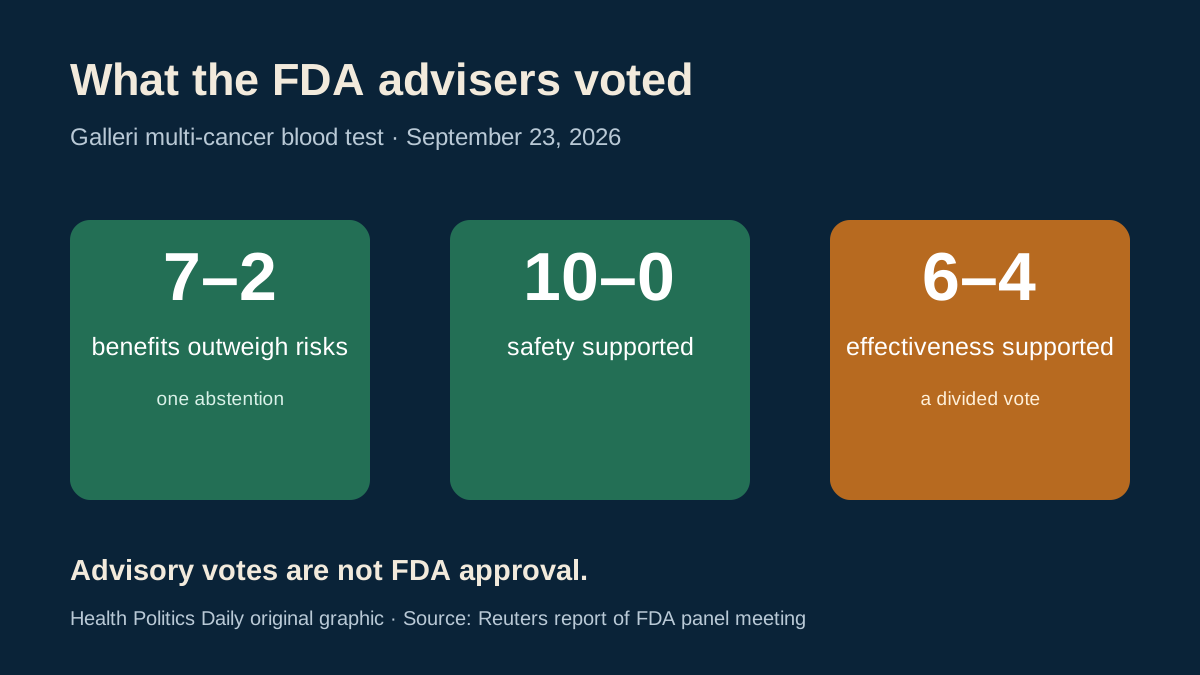
Verified Baseline
The panel recommended Galleri; the FDA has not approved it
An outside panel advising the Food and Drug Administration voted 7–2, with one abstention, that the benefits of Grail’s Galleri blood test outweigh its risks for adults 50 and older. The panel voted 10–0 on safety and 6–4 that the evidence demonstrated effectiveness, according to Reuters’ September 23 report.
The FDA considers advisory votes but is not bound by them. A final decision is expected in coming months.
What the Test Does
One blood draw looks for signals associated with many cancers
Galleri analyzes molecular signals shed by tumors and attempts to identify a likely tissue of origin. In the cited U.S. study, it detected 35% of cancers diagnosed within 12 months and reported 99.85% specificity.
High specificity means relatively few people without cancer received a positive result. It does not mean the test finds 99.85% of cancers. The reported 35% detection figure describes sensitivity in that study population.
Why the Effectiveness Vote Was Close
Finding a signal is not the same as proving better outcomes
A large three-year NHS trial did not show a statistically significant overall reduction in late-stage diagnoses. That result does not prove the test has no value, but it leaves uncertainty about whether population screening reduces advanced disease or deaths.
The panel’s 6–4 effectiveness vote captures that tension: Galleri can identify cancers that otherwise lack routine screening, while evidence that broad testing improves long-term outcomes remains incomplete.
Practical Implications
Galleri should not replace established screening
Panel members stressed that the test must supplement—not substitute for—mammograms, colonoscopies, cervical screening and other recommended care. A negative result cannot rule out cancer, and a positive result requires diagnostic follow-up.
Galleri is already offered as a laboratory-developed test but is not FDA-approved. Consumers should discuss benefits, limitations, follow-up testing and costs with a qualified clinician; this article is not personalized medical advice.
What Approval Could Change
A favorable decision could broaden access, but coverage is separate
FDA approval could support wider distribution and clinical adoption. Insurance and Medicare coverage would still depend on separate rules, evidence requirements and implementation decisions. Approval would validate a regulatory benefit-risk determination, not guarantee that every patient benefits.
What Remains Uncertain
Labeling, eligible patients and required follow-up are unresolved
The FDA could approve, reject or require narrower labeling or additional evidence. It must also decide how the product may describe “early detection,” what warnings clinicians must provide and whether post-market studies are necessary.
Bias Lens: the Galleri panel vote
The panel backed benefit over risk 7–2 with one abstention, endorsed safety 10–0 and supported effectiveness 6–4. The FDA has not issued its decision.
Health-policy, wire-service and business coverage emphasize different consequences. The vote totals and FDA status remain the common factual baseline.
Principal Sources
Evidence and reporting used
- Reuters — panel votes and study performance
- Reuters — FDA staff review and regulatory context
- Reuters — application evidence and NHS trial context
- FDA — advisory committee process
No suitable directly relevant authorized video with clear embedding permission was available.