GLOBAL HEALTH — HUMANITARIAN FUNDING — HEALTH ACCESS
WHO Says Funding Cuts Disrupted 8,317 Humanitarian Health Facilities
The Global Health Cluster says partners cut their planned 2025 reach from 84 million people to 45 million as funding retreated. Its new review documents reduced or suspended care—but does not estimate a death toll attributable to the cuts.
By Health Politics Daily News Desk · Published Monday, October 12, 2026 at 6:00 p.m. America/New_York · Approximately 8 minutes
Verified Baseline
A new WHO-hosted review measures a sharp contraction in crisis health care
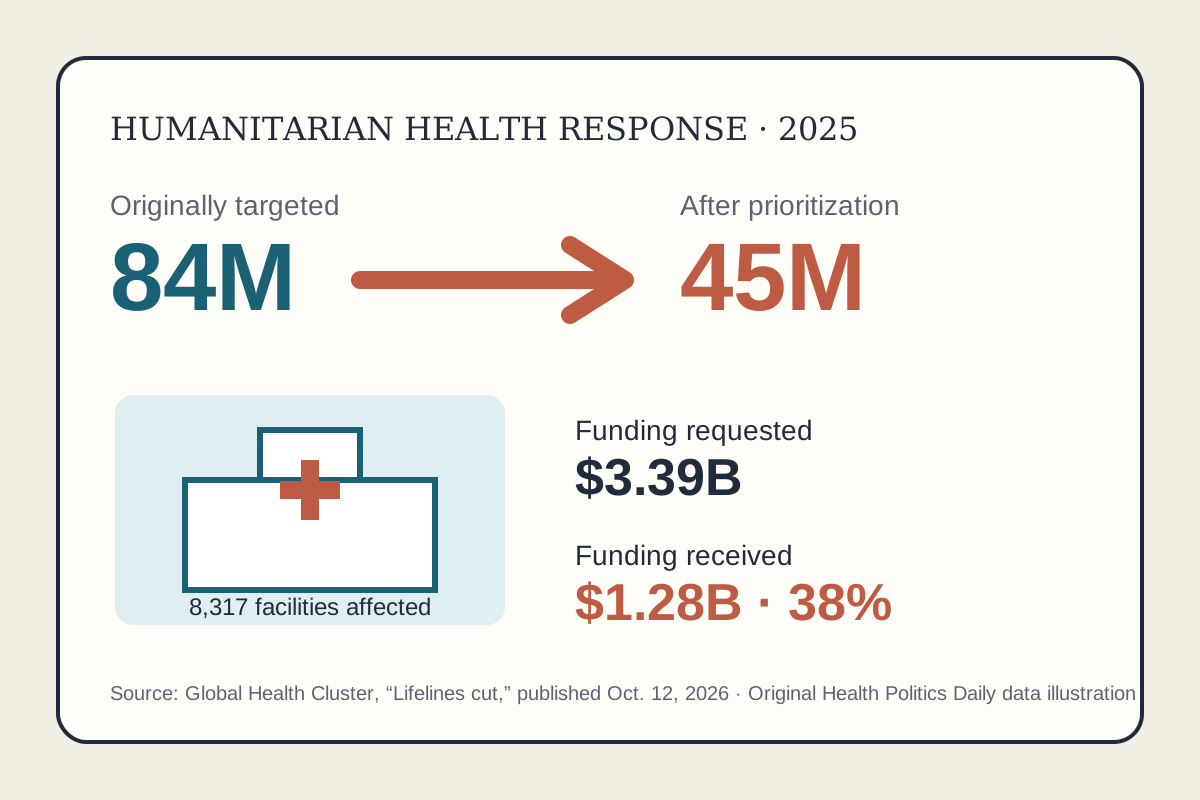
The Global Health Cluster, a WHO-hosted network of humanitarian health organizations, reported Monday that funding cuts affected 8,317 of roughly 11,000 health facilities usually supported across reporting crisis settings in 2025. Of those, 2,968 suspended services, while others reduced primary care, hospital capacity or mobile clinics.
Partners initially aimed to reach 84 million of 165 million people identified as needing health assistance. They later “hyper-prioritized” 45 million because of funding constraints and ultimately reported reaching 50 million. The response received $1.28 billion—38% of the original $3.39 billion request. The review draws on information from 22 of 24 Health Clusters and covers January through December 2025.
Those figures describe programs and populations reported through the cluster system. They do not mean every affected facility closed, that only 50 million people received any health care, or that the gap between the original target and people reached can be translated directly into deaths.
What Changed
Planning shifted from assessed need to what limited money could sustain
The central finding is not merely that an appeal went underfunded. Health partners reduced the population they planned to serve by 39 million people even though assessed needs had not fallen. The full advocacy brief says the contraction forced tradeoffs between services and places: sustaining one program often meant reducing another.
Separately, the U.N. refugee agency said Monday that it had received $3 billion, or 35%, of the $8.5 billion it needs for 2026 and had reduced its workforce from about 20,000 people in 2024 to fewer than 12,000. Reuters reported that the shortfall is already threatening specialized care and legal help for more than 50,000 survivors of conflict-related sexual violence who fled Sudan into Chad. The two releases cover different agencies and years, but together show that the squeeze extends beyond one program.
Why It Matters
Reduced routine care can turn treatable problems into emergencies
In humanitarian settings, a suspended clinic can interrupt vaccination, prenatal care, treatment for infectious disease, essential medicines and referrals. A reduced hospital may keep its doors open while limiting surgery, diagnostics or inpatient beds. Mobile teams are often the only service for displaced or isolated communities.
Analysis: the 50 million people reached—five million above the reduced target—shows that partners stretched limited funds, but it does not erase the much larger original need. Efficiency gains cannot supply medicines, staff or transport indefinitely without money. Forecast: if donor support remains near current levels, agencies are likely to continue concentrating on the most immediate life-saving services, leaving prevention, chronic-disease care and geographically difficult programs especially exposed. Opinion: Health Politics Daily takes no position on any country’s aid budget; funding choices should be evaluated with transparent program-level outcomes rather than slogans about either generosity or waste.
Practical Implications
What patients, aid groups and donors can take from the report
- For people seeking care: service availability may differ from older directories. Confirm clinic hours and referral routes through local health authorities or established humanitarian organizations when possible.
- For local providers: the report strengthens the case for publishing which services remain available, not only whether a facility is nominally open.
- For donors: headline totals should be paired with continuity measures—vaccination sessions, staffed beds, medicine stockouts, referral times and restored services.
- For policymakers: reallocating funding may preserve high-priority programs, but it also creates identifiable populations and services that fall outside the response.
These are general operational observations, not medical advice. Anyone with an urgent health problem should seek the safest available local emergency care.
What Remains Uncertain
The report does not isolate each donor decision or quantify excess deaths
The brief aggregates 22 country or regional Health Cluster responses. It does not provide a causal estimate of illness or mortality attributable to the funding contraction, and it cannot show how every facility’s reduced service affected patients. It also does not assign the $2.11 billion gap country by country or separate every donor’s contribution to it.
Some countries and programs may have received money outside the tracked appeal system. The figures therefore measure a documented contraction in coordinated humanitarian health response—not the entire universe of health spending in crisis settings. More complete facility-level data and 2026 funding outcomes will determine whether services rebound or the reductions become structural.
Bias Lens: need, efficiency and national interest
The Global Health Cluster reports that 2025 funding cuts affected 8,317 supported facilities, including 2,968 suspensions; partners received $1.28 billion of a $3.39 billion request and reached 50 million people.
Left-leaning coverage: The Guardian emphasizes people excluded from assistance and describes the wider humanitarian system as contracting under donor cuts. Center coverage: Reuters leads with agency budgets, staffing reductions and specific services at risk while attributing claims to officials. Right-leaning coverage: Fox News frames the U.S. global-health overhaul around national security, bilateral accountability and movement away from long-term dependence, while acknowledging low-cost humanitarian interventions.
These pieces do not report the same document, so the comparison is about policy framing rather than competing versions of the facility count. The WHO-hosted brief supplies the baseline; arguments about donor responsibility, efficiency or national interest are analysis and opinion.
Principal Sources
Primary documentation and corroborating reporting
- Global Health Cluster — report page and overview
- Global Health Cluster — full 2025 advocacy brief
- Reuters — UNHCR funding and service-cut context
- Associated Press — changes in the humanitarian funding landscape
No directly relevant official or publisher-authorized video with clearly established embedding permission was available, so no video is embedded.
Related Coverage