YEMEN — HUNGER AND DISPLACEMENT
Yemen Hunger Crisis: What the U.N.’s 74% Figure Means
Three in four surveyed households in accessible government-held areas cannot meet basic food needs. The finding is severe, but it is not a percentage for all Yemen and it is not a formal famine declaration.
By Health Politics Daily News Desk · Published Saturday, October 3, 2026 at 11:57 p.m. America/New_York · Approximately 8 minutes
Verified Baseline
The 74% figure covers accessible government-controlled areas
The U.N. World Food Programme says 74% of surveyed households in accessible parts of Yemen controlled by the internationally recognized government could not meet basic food needs—a record in those areas for 2026. The official U.N. Geneva briefing explicitly limits the figure to territory aid teams could reach and survey.
That distinction matters. The statistic should not be restated as “74% of all Yemeni families.” It also is not, by itself, a formal famine classification. WFP’s wider national estimate is 18.3 million people facing severe food insecurity, including 2.2 million children under age 5 with acute malnutrition.
What Happened
Renewed fighting pushed more families from their homes
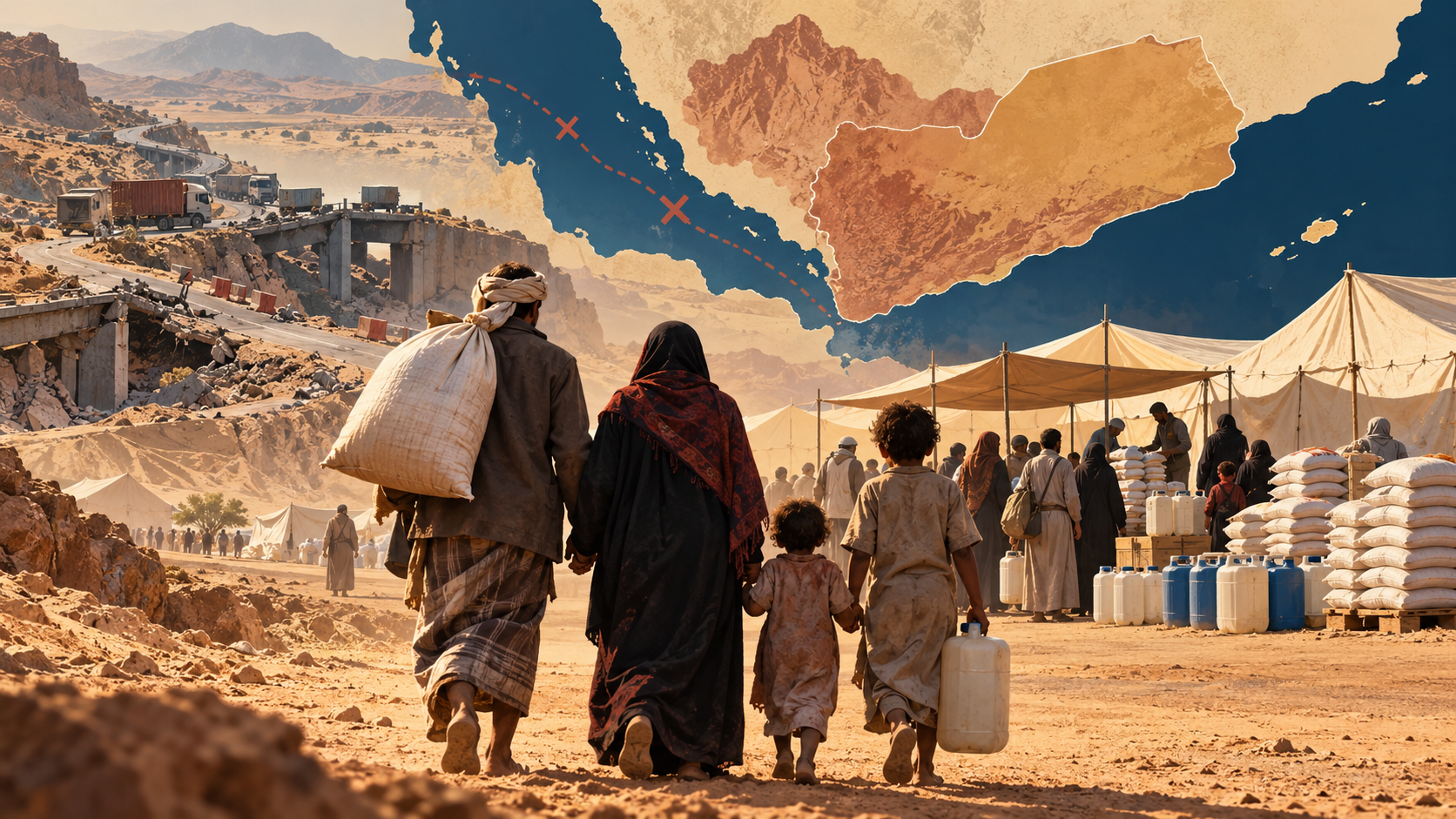
Recent conflict has displaced roughly 145,000 to 152,000 people inside Yemen, according to U.N. figures reported at different cutoff dates. More than 3,000 others have fled to Djibouti, the Associated Press reported on October 3. WFP says it has already reached more than 70,000 newly displaced people in Taiz and Lahj while continuing assistance for around 2.4 million people across government-held areas.
Those totals are not perfectly interchangeable. Some count only new internal displacement, some include cross-border flight, and some were compiled earlier. The responsible conclusion is that well over 145,000 people have been uprooted recently—not that one precise total is final while movements and registration continue.
Why Hunger Is Worsening
Conflict compounds high prices and dependence on imports
Yemen imports about 90% of its food, according to Reuters. Fighting can close roads, interrupt ports and markets, raise transport costs and prevent aid workers from reaching communities. Displaced families often leave with little food, water or income and arrive in places whose services were already strained.
WFP says its operation needs $109 million to cover newly displaced people and sustain the existing caseload. The agency has shifted food from other programmes and warned that some locations could face gaps within weeks. That is a funding and logistics warning, not a forecast that every distribution will stop on a fixed date.
Practical Implications
What the figures mean for families, aid and the wider region
- For families in Yemen: access depends on location, security, registration and available stocks. U.N. figures describe population-level need; they do not guarantee that a particular household will receive a specific ration.
- For aid organizations: displacement adds emergency shelter, water and health needs to an already large food-assistance operation.
- For the region: instability around Red Sea shipping routes can affect freight and insurance costs, but any price effect depends on duration, route changes and wider energy markets.
- For readers: “food insecurity,” “acute malnutrition” and “famine” are related but not interchangeable technical terms. A high household hardship rate does not automatically establish famine under the international classification system.
What Remains Uncertain
Access, funding and the duration of fighting will shape the next phase
Survey teams cannot reach every district, displacement counts change daily and the parties’ military claims remain difficult to verify independently. Future food conditions will depend on whether transport routes remain open, whether donors fund the appeal and whether violence forces further movement.
Verified fact: WFP measured an unprecedented level of food deprivation in the accessible government-held areas it surveyed. Analysis: the combination of displacement and import dependence makes further disruption unusually costly. Forecast: claims that famine is already nationwide—or that one funding appeal will resolve the crisis—go beyond the evidence now available.
Bias Lens: humanitarian emergency or regional-security story?
WFP says 74% of surveyed households in accessible government-held areas cannot meet basic food needs. Nationally, the agency estimates 18.3 million people face severe food insecurity.
The left-leaning Guardian foregrounds displaced children, interrupted schooling and household hardship. Center-oriented Reuters emphasizes WFP’s figures, the funding gap and Yemen’s dependence on imports. The right-leaning Times of Israel places the same U.N. finding inside a running regional-security news stream. The frames differ in emphasis; none changes the geographic limit of the 74% figure.
Principal Sources
Reporting and evidence used
- United Nations Geneva — October 2 press briefing transcript and video
- World Food Programme — displacement response and food assistance
- Reuters — WFP figures, funding need and import dependence
- Associated Press — casualties, displacement and cross-border flight
The U.N. Geneva page includes an authorized video recording of the October 2 briefing. It is linked rather than embedded.