Health · Adolescent Health · Physical Activity
One in Four Adolescents Reported No 60-Minute Active Day
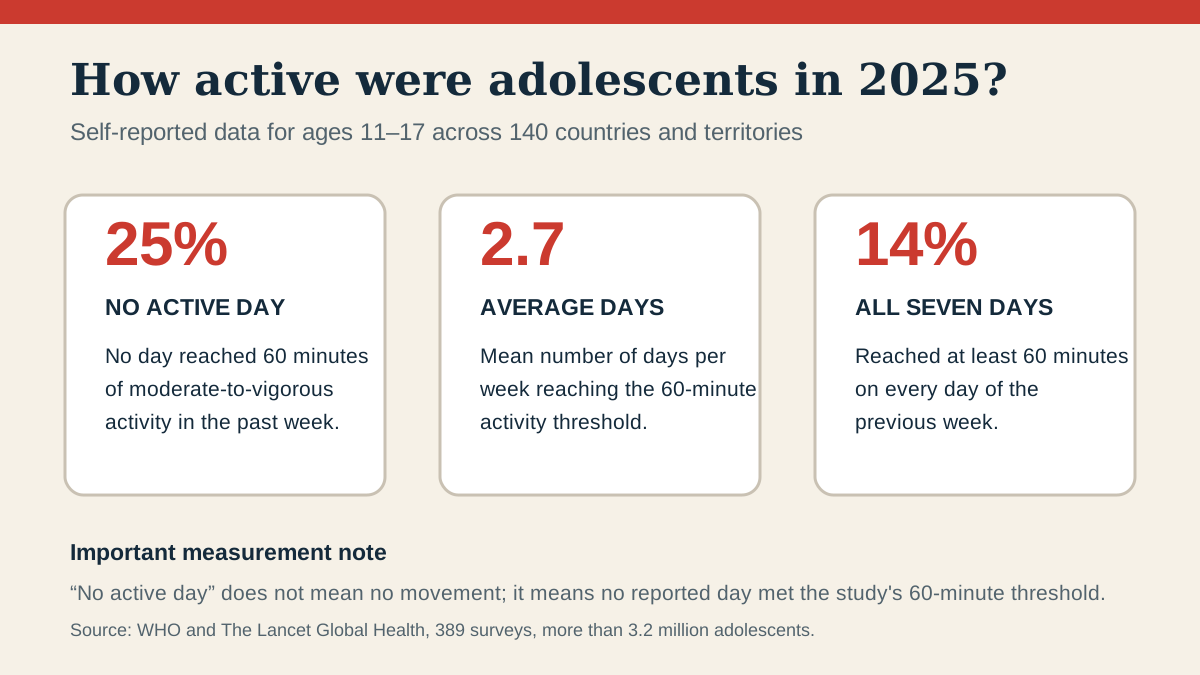
The global estimate is not a claim that 240 million young people did not move at all. It means they reported no day in the prior week with at least an hour of moderate-to-vigorous activity.
By Health Politics Daily News Desk · November 4, 2026 at 4:00 p.m. ET

Verified baseline
One in four adolescents ages 11–17—about 240 million people—reported no day in the previous week with at least 60 minutes of moderate-to-vigorous physical activity, according to global estimates released November 4 by the World Health Organization and published in The Lancet Global Health.
The pooled analysis covers 389 population-based surveys, more than 3.2 million adolescents and 140 countries and territories. In 2025, adolescents reported an average of 2.7 active days per week; 14% reported reaching the threshold on all seven days. The global average changed little from 2010 through 2025, and WHO says no country is on track for the agreed 15% relative reduction in physical inactivity by 2030.
What “no active days” actually means
An “active day” was a day on which a participant reported accumulating at least 60 minutes of moderate-to-vigorous activity. Brisk walking, cycling, dancing, active play and sports can count, depending on intensity. Someone who walked or played for shorter periods could still be classified as having no active day.
That distinction matters. The headline statistic is a measure of missing a recommended daily threshold, not proof of complete inactivity, a diagnosis or an individual health forecast. The surveys asked adolescents to recall the prior seven days; they did not continuously track movement with wearable devices.
Girls faced a persistent gap
Twenty-eight percent of girls reported no active days, compared with 22% of boys. Only 11% of girls reported being active on all seven days, compared with 17% of boys. The gap appeared across nearly every country and every WHO region.
The analysis does not establish a single cause. Safety concerns, transport, school schedules, access to affordable programs and public space, caregiving expectations, social norms, disability inclusion and opportunities for enjoyable activity all differ across communities. Screen time may compete with movement for some adolescents, but the study was not designed to assign a share of the global gap to phones or social media.
How the estimates were built
Researchers combined school-based and other population surveys using Bayesian hierarchical ordinal regression. The model estimated the distribution of active days by age, sex, country and year and borrowed information within regions where data were sparse. Country estimates were published only for countries contributing survey data.
This method produces comparable global and national trends from uneven surveys, but it also introduces uncertainty. Self-report can overstate or understate activity; survey questions and school attendance vary; and the sample represents about 59% of the world's adolescent population rather than every adolescent. Modelled estimates should not be read as precise head counts.
Why it matters
Regular physical activity supports cardiovascular fitness, bone and muscle development, sleep and mental well-being. Over time, low activity contributes to the risk of heart disease, type 2 diabetes and some cancers. Those population-level associations do not mean a teenager who misses the threshold has or will develop a particular condition.
The absence of progress since 2010 shifts attention from individual motivation to the places where young people live and learn. Safe walking and cycling routes, daily opportunities at school, affordable recreation, inclusive programs and nearby public space can make movement easier without requiring families to buy equipment or specialist memberships.
Practical implications without personalized advice
- Families and young people: ordinary movement can accumulate across the day. Health needs and safe intensity vary, so specific concerns belong with a qualified clinician.
- Schools: physical education is one tool; active travel, recess, extracurricular access and inclusive facilities affect the whole day.
- Local governments: traffic safety, lighting, parks and transit can determine whether independent activity is practical.
- Health systems: surveillance should track who lacks opportunity, not simply repeat a universal recommendation.
Fact, analysis, forecast and opinion
Verified fact: the study estimated that 25% reported zero days meeting the 60-minute threshold in 2025, while 14% met it every day. Analysis: the 15-year plateau suggests that information campaigns alone are unlikely to close structural gaps. Forecast: without faster policy change, WHO's 2030 reduction target will be missed; the model does not predict what any new intervention will achieve. Opinion: Health Politics Daily does not prescribe exercise plans. Policies should expand safe, affordable and enjoyable options while avoiding stigma toward adolescents or families.
Bias Lens: personal responsibility or public infrastructure?
Verified baseline: the primary analysis uses self-reported survey data and a 60-minute threshold; it finds low activity, a persistent gender gap and little global change since 2010.
A left-center-right comparison is not meaningful here because substantial ideological coverage had not developed at publication. A source-role comparison is more useful. Public-health authority — WHO: emphasizes environments and cross-sector policy rather than blaming adolescents. Research institution — Oxford University: explains the modelling and highlights UK comparisons. Commercial news — Sky News: leads with the UK gender gap and familiar country rankings.
These choices change what readers notice—global systems, methods or national relevance—but not the study's core estimates. The strongest reading keeps both the population-level problem and the measurement limits in view.
What remains uncertain
Researchers cannot determine from these surveys which policy mix would close the gap in each country, how much activity occurred below the threshold or how self-report error differs across cultures and ages. Future surveillance using devices could sharpen measurement, but it would create cost, privacy and comparability tradeoffs.
Principal sources
- World Health Organization — November 4 findings and policy context
- The Lancet Global Health — pooled analysis of 389 surveys
- WHO — global report and country estimates
- WHO Global Health Observatory — indicator definition and estimation method
- Science Media Centre Spain — independent expert interpretation and caveats
No suitable directly relevant authorized video with clear persistent embedding permission was available at publication.
No comments yet.