International Politics · Australia · Technology Policy
Australia's Under-16 Social Media Ban Faces High Court Test
The justices have finished hearing two challenges to the account restriction. Their ruling could preserve the law, narrow it or invalidate part of it—and influence similar proposals abroad.
By Health Politics Daily News Desk · November 4, 2026 at 2:00 p.m. ET

Watch in this article
Pumpjack operating at the Kern River Oil Field
A short CC0 field video provides visual context for reporting on oil production and fuel supply.
Thomas Farley / Wikimedia Commons · CC0 1.0 · License and source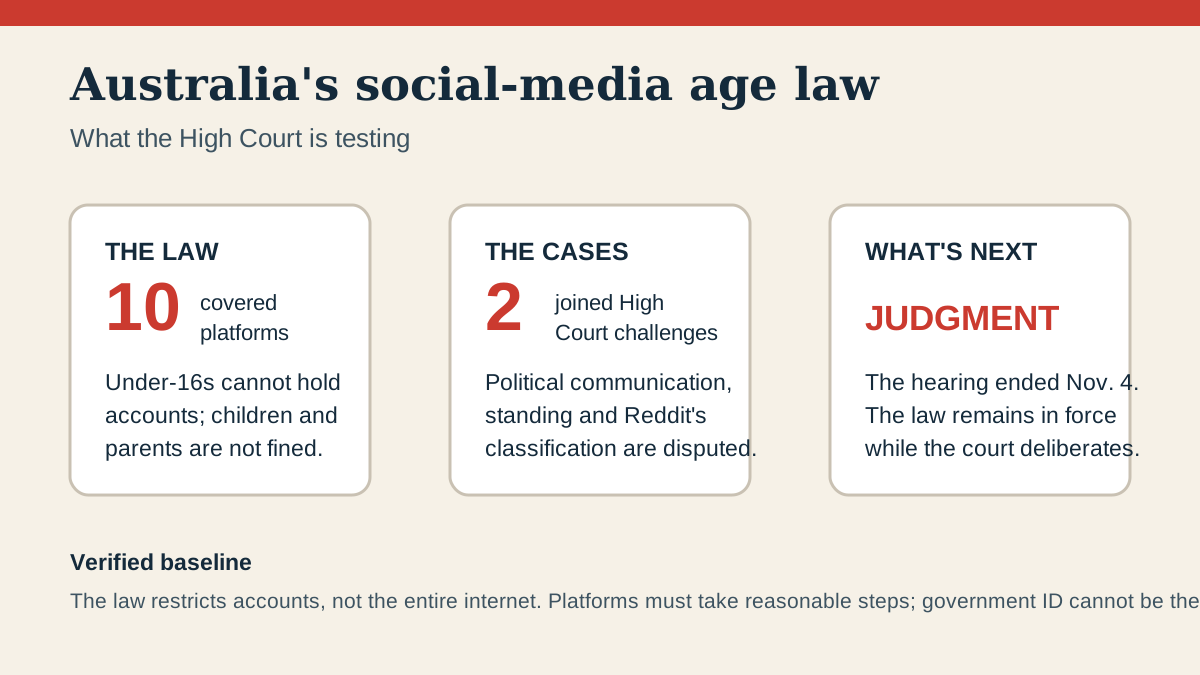
Verified baseline
Australia's High Court concluded a two-day hearing on November 4 in joined constitutional challenges brought by Reddit and the Digital Freedom Project. Both argue that Part 4A of the Online Safety Act impermissibly burdens the constitutionally implied freedom of political communication. The Digital Freedom Project also must establish standing; Reddit separately argues that its service should not be classified with the other restricted platforms.
The law, in effect since December 10, 2025, requires designated platforms to take reasonable steps to prevent Australians younger than 16 from creating or keeping accounts. It covers Facebook, Instagram, Threads, Snapchat, X, TikTok, YouTube, Kick, Reddit and Twitch. It is not a blanket ban on the internet or every piece of social-media content: some material remains viewable without an account, and messaging, gaming, education and health services may fall outside the restricted category.
What the court is deciding
Australia's Constitution does not contain a broad personal free-speech guarantee. Courts instead recognize an implied freedom protecting representative government from unjustified burdens on political communication. The challengers say people younger than 16 lose practical ways to post, respond, organize and reach political audiences even though they cannot yet vote.
The Commonwealth accepts that the law affects some communication but calls the burden indirect, modest and viewpoint-neutral. It says the restriction targets engagement features—personalized recommendations, endless feeds, notifications and visible popularity metrics—that it associates with risks to young people. The court must assess whether the law's means are constitutionally compatible with its protective purpose, not decide whether social media is good or bad.
What the law requires—and does not require
- Platforms carry the duty: children and parents are not fined for an underage account. Corporate penalties can apply to systemic failures.
- No single mandated age check: government ID cannot be the only method.
- Access is not identical to an account: logged-out viewing may remain possible, while posting, commenting and personalized features generally require an account.
- The list can change: future services may be added or removed under statutory criteria and rules.
Why the outcome matters beyond Australia
Australia was the first country to operate a nationwide under-16 account restriction across major services. Governments elsewhere are studying age floors and age-assurance rules, so a judgment explaining the constitutional limits—and whether less restrictive designs were reasonably available—will travel well beyond this case.
The government says roughly five million accounts had been closed or suspended by mid-2026, but official research and reporting indicate many under-16s still use covered services. That does not itself prove success or failure: continued use could reflect imperfect age technology, platform execution, user circumvention or all three. Enforcement and effectiveness evidence remain developing.
Practical implications now
The hearing did not suspend the law. Platforms must continue applying their age-assurance systems while the court deliberates. Families should expect platform-specific checks and appeals rather than one national process. People asked for age information should review the service's privacy notice, alternatives and appeal route; the law's existence does not make every data request necessary or risk-free.
A judgment for the challengers would not guarantee one uniform result. The court could invalidate all or part of Part 4A, resolve only a classification or standing question, or leave room for Parliament to revise the scheme. A Commonwealth win would preserve this law but would not establish that every future age restriction is constitutional.
Fact, analysis, forecast and opinion
Verified fact: two joined challenges were heard November 3–4, and the law remains in effect. Analysis: the case turns on proportionality and institutional design more than on a general right to speech. Forecast: a written ruling is expected later, but the court has not announced a date or outcome. Opinion: Health Politics Daily takes no position on the law's merits; youth protection, political participation and privacy should each be measured with evidence rather than slogans.
Bias Lens: safety rule or speech restriction?
Verified baseline: the law blocks under-16s from holding accounts on ten named services, leaves some content and other services accessible, assigns compliance duties to platforms, and is being challenged under Australia's implied freedom of political communication.
Left-leaning — The Guardian Australia: foregrounds the government's claim that the burden is narrow while examining Reddit's alternatives argument. Center/public broadcaster — ABC News: organizes the dispute around the constitutional test, standing and possible legislative fixes. Right-leaning — Sky News: emphasizes challengers' censorship and privacy claims and quotes a former teen plaintiff.
The difference is mainly emphasis: government justification, legal mechanics or civil-liberties criticism. All three identify the same parties, restriction and pending judgment. Framing cannot resolve how much harm or political communication the law changes.
What remains uncertain
The justices have not indicated when they will rule. It is unclear how they will weigh political information available without an account, standing, Reddit's classification or real-world circumvention. The effectiveness, privacy costs and distributional effects of age-assurance methods also remain contested.
Principal sources
- High Court of Australia — Reddit case docket and filings
- High Court of Australia — Digital Freedom Project case docket
- eSafety Commissioner — official requirements and covered services
- Reuters — November 4 hearing report
- Associated Press — arguments and implementation context
No suitable directly relevant authorized video with clear persistent embedding permission was available at publication.
No comments yet.