U.S. policy · Consumer protection · Online safety
Romance Scam Prevention Act Requires Dating Apps to Warn Users After Fraud Bans
The new federal law generally requires dating services to alert people who received messages from an account later banned for fraud risk. The rule takes effect in one year and does not guarantee reimbursement or prove a crime occurred.
By Health Politics Daily News Desk · October 20, 2026 at 11:57 p.m. ET
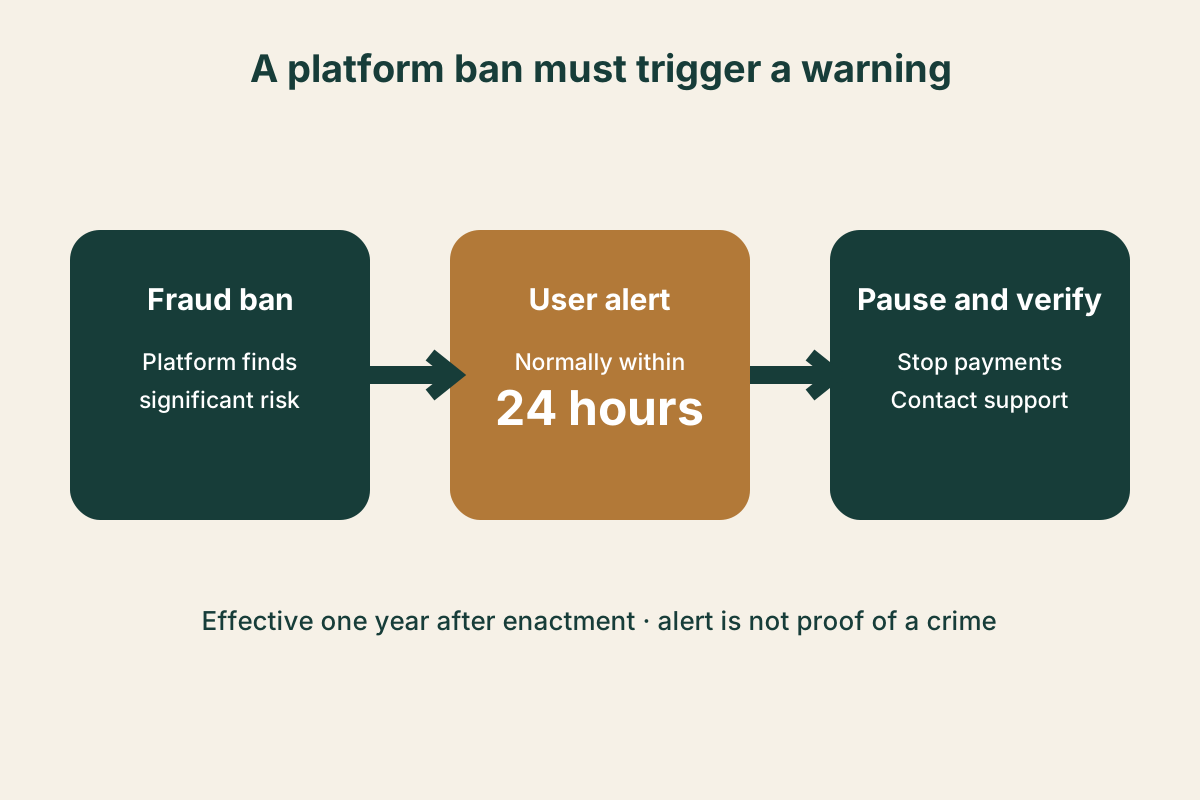
President Donald Trump signed the Romance Scam Prevention Act on October 20, creating a nationwide requirement for online dating services to warn users after banning an account for a significant risk of fraud. The alert is meant to reach people who may have moved their conversation off the app and otherwise would not know the platform acted.
The law is narrower than a general guarantee against fraud. It applies when a person received a message through the dating service from a member whose account or profile the provider later suspended or terminated because it judged there was a significant risk the member had defrauded, or would try to defraud, another user.
What the new alert must contain
Congressional reports say the notice must identify the banned member’s username or profile identifier, tell the recipient when their most recent interaction occurred, state that the member may have been attempting fraud, warn against sending money or financial information, provide fraud-prevention guidance and include customer-service contact information.
The notice must be clear and conspicuous and may arrive by email, text message or another appropriate channel. The normal deadline is 24 hours after the fraud ban. A provider may delay for up to three days when circumstances justify it or when law enforcement requests a delay.
When the requirement begins
The Act takes effect one year after enactment, placing the federal compliance date on October 20, 2027. Some services already send similar notices, and some states have had related rules, but the legislation creates one federal standard and preempts state requirements governing these particular fraud-ban notifications.
Violations are treated as unfair or deceptive practices under the Federal Trade Commission Act. The FTC and state attorneys general or other state consumer-protection officers may enforce the rule. Providers also receive a limited safe harbor from certain claims based on their actions to comply with the alert requirement.
Why it matters
Romance scams frequently begin on a dating platform and then shift to text, encrypted messaging or email. Once communication moves elsewhere, deleting the dating profile does not stop the scammer from continuing the relationship or requesting money. The required alert is designed to close that information gap.
Congress cited Federal Trade Commission data showing $1.3 billion in reported romance-scam losses in 2022. More recent congressional scrutiny has focused on how dating platforms detect suspicious accounts and whether users receive useful warnings after those accounts are removed.
What users should do after an alert
An alert is a reason to pause, not definitive proof that every statement or message was criminal. Do not send additional money, cryptocurrency, gift cards, account credentials or identity documents. Verify the person independently, preserve the messages and payment records, and contact the dating service through the app or its separately located official support channel.
If money has already moved, contact the bank, card issuer, payment service or cryptocurrency exchange promptly; reversal may be time-sensitive but is not assured. Reports can also go to the FTC at ReportFraud.ftc.gov and the FBI’s Internet Crime Complaint Center. This is general information, not personalized legal or financial advice.
What the law does not do
The law does not require dating services to reimburse losses, guarantee that platforms will identify every fraudulent account or regulate scams that begin entirely outside dating services. It also does not make a platform’s ban equivalent to a criminal charge or conviction.
Analysis: The rule can reduce harm only after a provider identifies and bans an account. Its real-world effect will therefore depend on detection quality, the speed and clarity of notices, and whether recipients recognize the alert before sending more money.
Forecast: Dating services are likely to standardize alert templates and preserve more detailed ban and message records before the 2027 effective date. That is an informed expectation, not a disclosed implementation plan.
For related reporting, see our coverage of the international Bangkok Blueprint against digital financial fraud and the U.S.–Myanmar talks that included scam-center operations.
Bias Lens: notification duty versus broader platform responsibility
Verified baseline: The President signed H.R. 2481 on October 20. The law creates a defined fraud-ban notification duty for online dating services, normally within 24 hours, beginning one year after enactment.
Left-leaning — The Guardian: Its recent investigation emphasizes victims’ emotional and financial losses and whether large dating platforms invested enough in detection. That framing treats alerts as one part of wider platform accountability.
Center — Associated Press: AP’s victim-centered reporting shows how prolonged manipulation can continue despite warning signs. It helps explain why a factual platform alert may matter without implying that one notice will end every scam.
Right-leaning local coverage — Fox Chattanooga: Coverage of Senate passage emphasizes the bipartisan public-safety measure and sponsor Marsha Blackburn’s role. It focuses more on the legislative remedy than on criticism of platform practices.
How the framing differs: These reports do not materially dispute the fraud problem. Their emphasis varies between corporate accountability, the psychology of victimization and a targeted bipartisan rule. The statutory text—not those emphases—defines who must be notified and when.