Health policy · Nursing homes · Workforce
CMS Launches $275 Million Nursing-Home Nurse Recruitment Program
The federal-state initiative offers loan repayment and stipends for three-year service commitments, but does not itself guarantee staffing gains.
By Health Politics Daily News Desk · October 23, 2026 at 8:03 p.m. ET
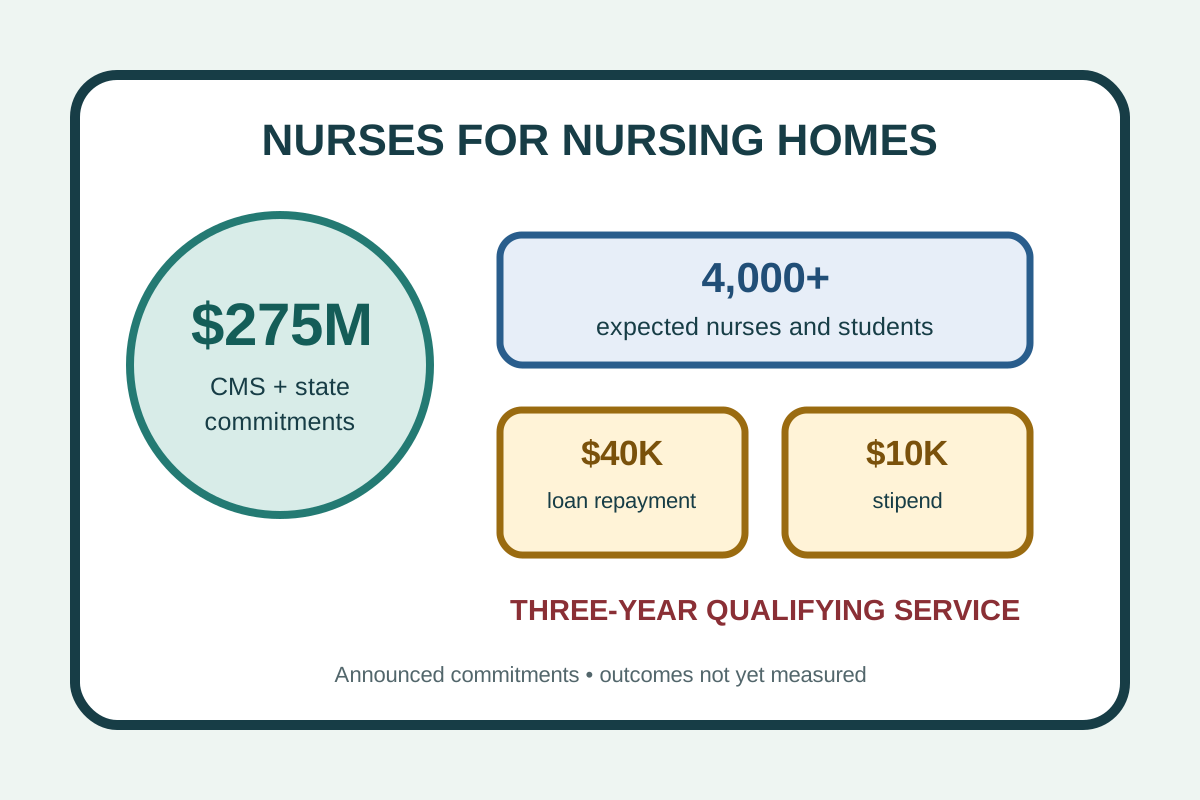
The Centers for Medicare & Medicaid Services and participating states launched a $275 million program Friday intended to recruit and retain more than 4,000 nurses and nursing students in nursing homes, including facilities in rural and higher-shortage areas.
Under the Nurses for Nursing Homes initiative, eligible participants may qualify for up to $40,000 in student-loan repayment, a $10,000 stipend or both in exchange for a three-year commitment to hands-on nursing-home work. CMS committed $100 million and said states are contributing at least $175 million.
Who may qualify and where the money comes from
The CMS announcement says licensed nurses and nursing students can apply through participating state programs. Service must be at a qualifying nursing home in a rural or higher labor-shortage area; exact application dates, participating facilities and eligibility rules are administered at the state level.
The funding comes from civil monetary penalties collected by CMS and states from nursing homes, rather than a new appropriation. CMS says those funds may be used for activities that benefit residents and improve care quality.
What the program does — and does not do
The initiative lowers education-debt and training barriers for people willing to work in long-term care. It does not establish a nationwide staffing ratio, raise wages directly, guarantee placement at a preferred facility or ensure that every state will offer identical benefits.
CMS estimates the program will support more than 4,000 participants. That is a program target, not a verified count of new hires. Some recipients may already work in nursing homes, and retention will depend on working conditions, compensation, supervision and whether participants complete the three-year commitment.
Practical implications
Nurses and students should consult their state Medicaid or survey agency before making financial or employment decisions, confirm whether a facility qualifies and obtain written terms covering repayment, service interruptions and early departure. Nursing homes may gain a recruitment tool, but families should continue checking facility-specific staffing, inspection and turnover information rather than assuming participation establishes care quality.
Fact, analysis, forecast and opinion
Verified fact: CMS committed $100 million, states committed at least $175 million, and the initiative offers defined incentives tied to three years of qualifying service. Analysis: directing penalty funds toward workforce development shifts part of enforcement revenue into recruitment and retention, but the scale is modest relative to the national long-term-care workforce. Forecast: uptake will likely vary by state and labor market; published enrollment and completion data will be needed to judge whether the program adds staff or mainly retains existing workers. Opinion: policymakers and providers should measure resident-facing outcomes—not only awards made—before calling the initiative successful.
For related context, see our coverage of the limits of an emergency health-care court order, the HHS Kidney Care National Plan and rising employer health-insurance costs.
Bias Lens: incentives, mandates and what counts as staffing progress
Verified baseline: CMS and states announced $275 million in combined penalty-fund commitments, benefits are tied to qualifying three-year service, and the agency expects to support more than 4,000 people. The announcement does not demonstrate that 4,000 additional nurses have been hired or retained.
Official — CMS: emphasizes recruitment, rural access and resident safety. Industry — LeadingAge and Skilled Nursing News: focus on operational eligibility, funding and the incentives available to workers. A meaningful left-center-right split had not developed in original coverage at publication, so this lens compares source roles rather than forcing ideological symmetry.
What remains uncertain
CMS had not published a single national application portal, a state-by-state allocation table, expected enrollment by license type or a schedule for outcome reporting. It remains unclear how many awards will go to new entrants versus existing workers, how states will define higher-shortage areas and how many participants will complete the commitment.
Principal sources
- CMS — program announcement, funding and eligibility summary
- CMS — Nursing Home Staffing Campaign
- LeadingAge — implementation context
- Skilled Nursing News — industry corroboration
No suitable directly relevant official or publisher-authorized video with clear embedding permission was available, so none was embedded.