Health policy · Kidney care · United States
HHS Kidney Care Plan Sets Prevention, Dialysis and Transplant Priorities—but Few Deadlines
The federal roadmap emphasizes earlier detection, dialysis competition and transplant reform. Most recommendations still require later rules, payment decisions or implementation plans.
By Health Politics Daily News Desk · October 20, 2026 at 6:07 p.m. ET
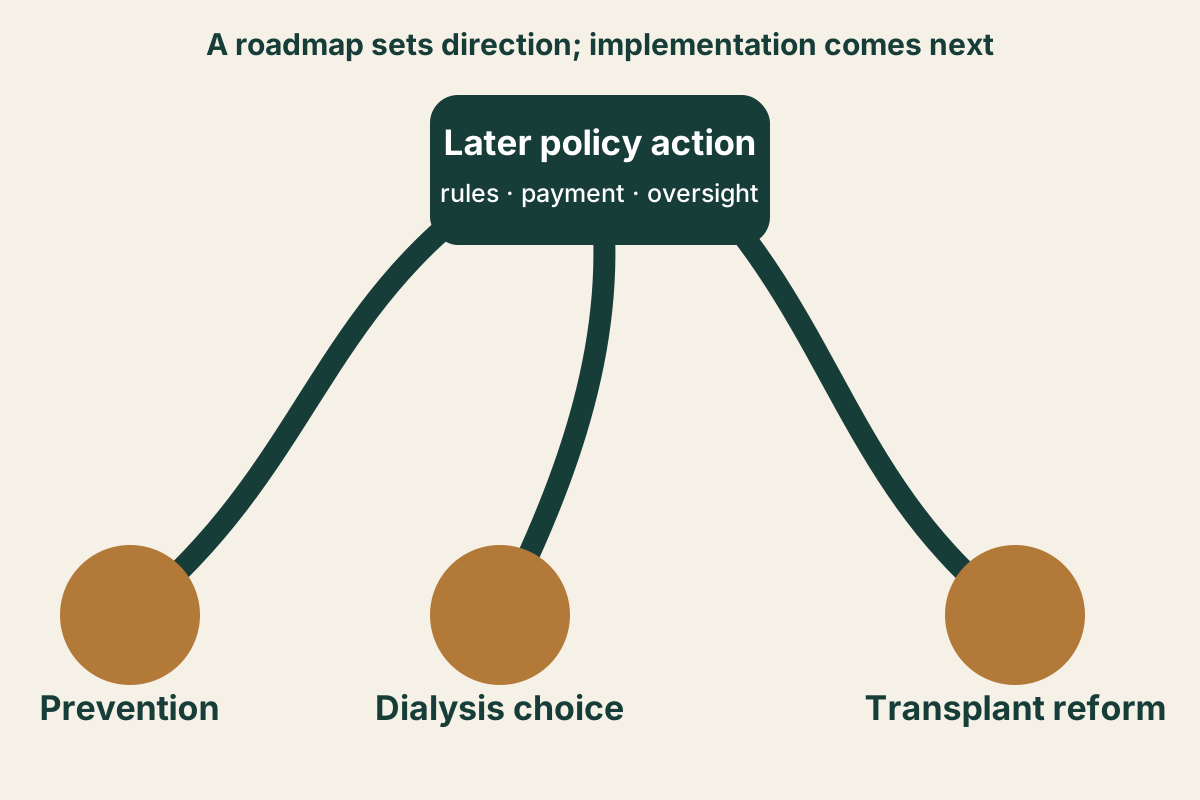
The U.S. Department of Health and Human Services released a national kidney-care plan on October 20 that directs federal agencies toward earlier disease detection, more treatment choice and changes to transplantation. The announcement establishes a policy roadmap; it does not itself create a new screening benefit, change a dialysis payment, fund a transplant or guarantee a new provider in any community.
What the federal plan says
The HHS announcement identifies three priorities: preventing kidney failure, improving dialysis care and patient choice, and reforming transplantation. It says agencies will pursue policy, payment, research, regulatory and oversight actions and will develop a National Transplant Expansion Strategy.
The accompanying HHS fact sheet describes examining screening for people at increased risk, payment models intended to reward earlier diagnosis, fewer regulatory barriers for dialysis providers and technologies, more home-based care, stronger transplant oversight and support for living donation.
Verified limit: The plan sets direction, not a single operative rule. The National Kidney Foundation, which welcomed its prevention focus, notes that most recommendations call for further review or policy development and do not establish new payment rates, coverage requirements, funding commitments or implementation deadlines.
Why earlier detection matters
CDC’s 2026 national estimates put chronic kidney disease at more than one in seven U.S. adults. CDC says many people do not know they have it and that blood and urine tests are needed to check for the condition. Diabetes and high blood pressure are major risk factors.
Analysis: Moving resources upstream could matter because treatment choices narrow as kidney function declines. Whether this roadmap changes detection will depend on details that are not yet settled: who is offered testing, how clinicians are paid, whether patients can obtain follow-up care and how results are measured.
What could change for dialysis and transplant care
The plan calls for examining barriers to new dialysis providers, alternative care settings and home dialysis. It also seeks continued modernization of the Organ Procurement and Transplantation Network, stronger accountability and expanded support for living donors.
Axios reports that HHS links limited competition to a dialysis market dominated by two large chains and suggests a Center for Medicare and Medicaid Innovation payment model for earlier-stage care. Those are proposals for subsequent work—not proof that prices, access or outcomes have changed.
Practical implication: Patients should keep using current coverage rules, care teams and official transplant channels. The roadmap does not authorize stopping dialysis, switching providers or changing medication. Individual questions belong with qualified clinicians and insurers; this report is not medical advice.
Our Medicare cost explainer shows why an average policy number does not determine an individual bill. Our NIH women’s-health order coverage similarly distinguishes an organizational directive from funded research and patient outcomes.
What remains uncertain
No reviewed document supplies a complete timetable, appropriation or final regulatory text. It remains uncertain which proposals HHS can implement administratively, which require notice-and-comment rulemaking, and which would need Congress. Competition policy can also create tradeoffs: entry may improve choice, while rapid changes without adequate staffing, quality controls or rural capacity could fail to improve access.
Forecast boundary: Earlier detection, more home dialysis and more transplants are stated goals. They are not forecast results. Useful measures will include testing and follow-up rates, patient-reported choice, dialysis quality and availability, transplant waiting times, living-donor support and safety findings.
Bias Lens: a policy roadmap is not an implemented benefit
Verified baseline: HHS released a plan with prevention, dialysis-choice and transplant priorities. Most recommendations require later policy action and currently lack binding deadlines or funding commitments.
Center—Axios: Emphasizes market concentration, proposed competition and the administration’s argument that both regulation and consolidation contribute to structural problems.
Specialist policy coverage—Bloomberg Law: Frames the release around deregulation, major dialysis companies and federal costs. That focus highlights legal and industry consequences rather than bedside implementation.
Comparison limit: Directly comparable, substantive left- and right-leaning reports were not verified in time for publication. The National Kidney Foundation is an advocacy organization, not a partisan substitute; its statement helps establish which provisions patients may value and which details remain unresolved.
Sources and media
HHS materials anchor what the plan says; CDC provides current disease context; the National Kidney Foundation, Axios and Bloomberg Law clarify implementation and market questions. The illustration is an original roadmap graphic, not a care recommendation or forecast. No suitable directly relevant authorized video was verified, so none is embedded.