Canada · Trade · Manufacturing
Canada and Ontario Announce C$8.7 Billion Industry Plan
The federal and provincial governments say the package will help steelmakers, automakers and critical-mineral development respond to U.S. tariffs. The commitments are substantial, but job and production results will depend on implementation and private investment.
By Health Politics Daily News Desk · October 21, 2026 at 10:00 p.m. ET

Watch in this article
Pumpjack operating at the Kern River Oil Field
A short CC0 field video provides visual context for reporting on oil production and fuel supply.
Thomas Farley / Wikimedia Commons · CC0 1.0 · License and source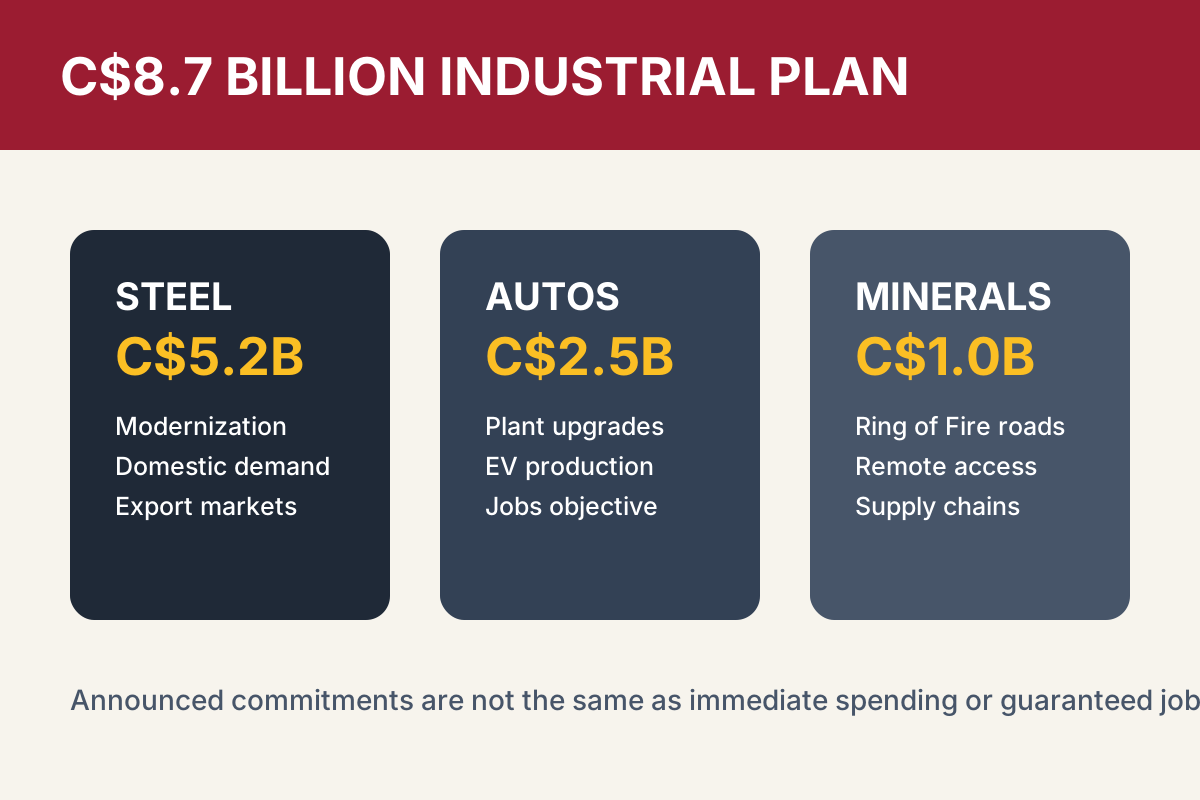
Canada and Ontario announced an approximately C$8.7 billion industrial-support plan on October 21, directing money toward steel, automotive manufacturing and road access to the mineral-rich Ring of Fire region. The Prime Minister’s Office describes the plan as protection for workers and industries facing U.S. tariffs.
What the plan contains
- Steel: roughly C$5.2 billion across federal and provincial measures for modernization, domestic production and market diversification.
- Autos: C$2.5 billion for assembly-plant upgrades and expanded electric-vehicle production.
- Critical minerals: C$1 billion in federal road funding intended to improve access to Ontario’s remote Ring of Fire region.
The total varies slightly across early reports because governments and news organizations group existing, enhanced and newly announced measures differently. The official federal backgrounder provides the program-level breakdown.
Why it matters
Canadian steel and auto production is deeply integrated with the U.S. market. Tariffs can raise cross-border costs, change plant allocation decisions and place pressure on communities built around large employers. The package represents an effort to cushion that adjustment and redirect some production toward Canadian and non-U.S. demand.
Verified fact: the governments announced the funding streams and policy objectives. Analysis: the plan shifts some tariff risk from companies to taxpayers and may make upgrades easier to finance. Forecast: the effect on jobs, output and exports will depend on application rules, company participation, trade conditions and project execution. Opinion: Health Politics Daily takes no position on tariffs or industrial subsidies; results should be judged against published costs, milestones and independently verified outcomes.
Practical implications
Companies should not assume every announced dollar is immediately available: eligibility, matching requirements and disbursement schedules matter. Workers may see projects or retraining commitments, but the announcement itself is not a job guarantee. Consumers should also distinguish assistance to producers from a promise that vehicle or steel prices will fall.
For related context, see APEC’s warning about global imbalances.
Bias Lens: industrial resilience or costly subsidy?
Verified baseline: Canada and Ontario announced an approximately C$8.7 billion package for steel, autos and critical-mineral infrastructure. Funding commitments do not by themselves prove jobs saved or economic returns.
Left-leaning — The Guardian: broader tariff coverage emphasizes household costs, worker disruption and political pressure created by the trade conflict.
Center — Associated Press: places the package within the deterioration of the U.S.-Canada trade relationship and Carney’s argument that tariffs also burden Americans.
Center/business — Reuters: emphasizes the allocation amounts and industrial targets.
Right/business — The Wall Street Journal: foregrounds the scale of government aid and trade-related strain on firms. These are differences in emphasis, not automatic evidence that one account is more accurate.
Principal sources
- Prime Minister of Canada: action-plan release
- Government of Canada: program backgrounder
- Reuters: package breakdown
- Associated Press: trade and political context
No suitable directly relevant official or publisher-authorized video with verified embedding permission was available, so none was embedded.