United Kingdom · Canada · Defence finance
UK and Canada Keep Defence Financing Plans Separate, Agree Cooperation Framework
The two governments chose distinct institutions while promising coordination on defence investment and industrial capacity. The structure, funding and timetable remain unsettled.
By Health Politics Daily News Desk · October 25, 2026 at 3:59 p.m. ET

Verified baseline
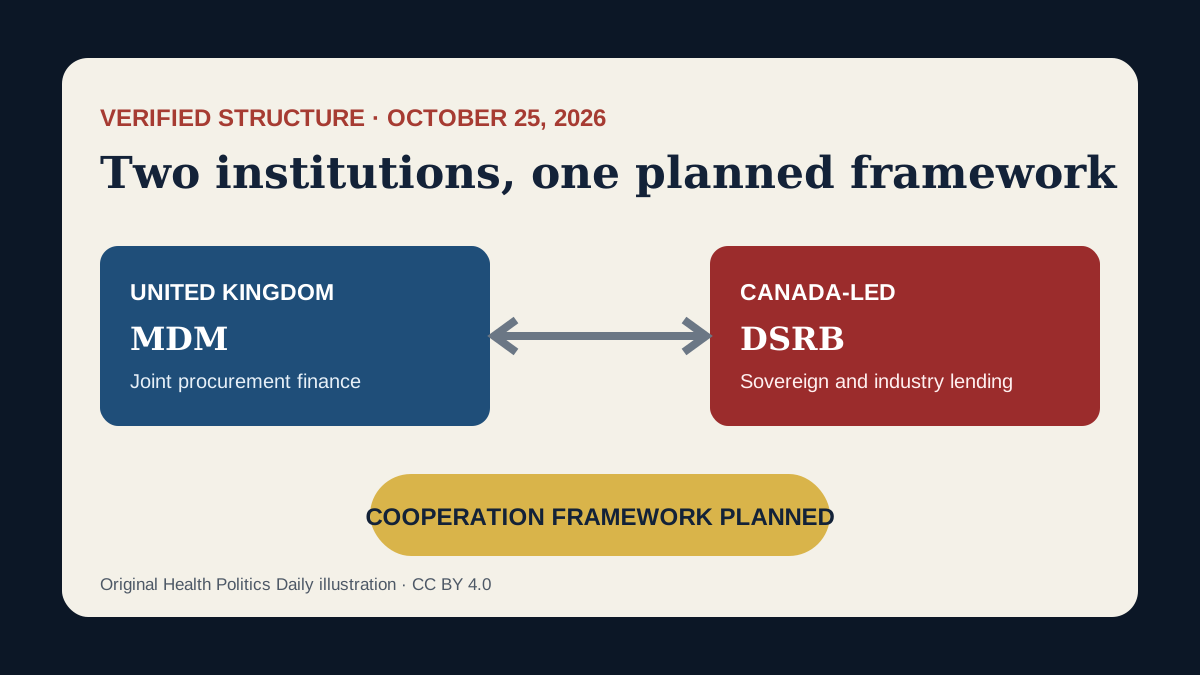
The United Kingdom and Canada said Sunday that Britain’s Multilateral Defence Mechanism, or MDM, and the Canada-led Defence, Security and Resilience Bank, or DSRB, will remain “distinct but complementary.” Their joint government statement commits both sides to develop a cooperation framework and coordinate on investment opportunities, industrial priorities and strategic financing challenges.
The statement does not announce a merger, British membership in the Canadian initiative, a new combined fund or a binding financial commitment. Canada published the same language through its Department of Finance, providing a matched official record from both governments.
What each institution is designed to do
The MDM is intended to help participating allies finance joint procurement, pool demand and potentially reduce the cost of buying equipment together. The DSRB is conceived more like a multilateral lender, supporting sovereign borrowing and investment across defence industries and supply chains. The distinction matters: procurement finance helps countries buy together, while a bank can support a wider range of national projects and firms.
Reuters, citing people familiar with the talks, reported that disagreements included headquarters, joint-purchasing expectations, lending rules and future membership. Those reported explanations are credible context but are not detailed in the official statement and should not be treated as formally confirmed terms.
Why the decision matters
Governments are trying to expand defence production while managing high borrowing costs and fragmented purchasing. Separate institutions may let each group move ahead under its preferred rules, but they also create a risk of duplicated administration, competing standards or smaller pools of capital. A well-specified cooperation framework could reduce those risks; the public statement does not yet show how.
For taxpayers, contractors and workers, the immediate effect is limited. Sunday’s statement does not award contracts or authorize spending by itself. Any practical impact will depend on participating countries, capitalization, lending terms, procurement rules and legislative approvals.
Practical implications
Defence companies should not assume that the announcement opens a new application window. Governments and lenders still need to publish eligibility, procurement and financing rules. Investors should also distinguish a political commitment to cooperate from signed contracts or guaranteed revenue; this article provides no personalized investment advice.
The development also fits a broader effort by both countries to diversify security partnerships. It follows recent UK–Canada discussions on industrial cooperation and comes days before Britain’s budget, when defence financing and fiscal constraints are expected to receive renewed scrutiny.
Fact, analysis, forecast and opinion
Verified fact: the MDM and DSRB will remain separate, and the governments say they will design a cooperation framework. Analysis: the decision preserves different financing models but may make coordination harder. Forecast: future announcements are likely to address governance, capital and participation, but no timetable is guaranteed. Opinion: Health Politics Daily takes no position on defence-spending levels or either financing model.
Bias Lens: how coverage frames the decision
Verified baseline: the official UK and Canadian releases confirm two distinct institutions and a planned cooperation framework; they do not explain disputed negotiating points or quantify new funding.
Left-leaning framing: The Guardian’s earlier coverage emphasized public-finance tradeoffs, procurement design and the debate inside Britain over joining the DSRB. Center framing: Reuters leads with Britain not joining and reports the points negotiators could not resolve. Business-oriented framing: The Financial Times connects the split to Britain’s budget pressures and the design of defence borrowing. We did not find a distinct, timely report from a credible right-leaning outlet that added verified facts, so this lens does not force a three-way symmetry.
What remains uncertain
The cooperation framework’s legal form, governance, dispute rules and launch date are not public. The governments also have not said how much capital each institution will have, which countries will ultimately participate, which projects will qualify, or whether the two systems will recognize each other’s due-diligence and procurement standards.
Principal sources
- HM Treasury — joint UK–Canada statement
- Department of Finance Canada — matching official statement
- Reuters — negotiations and institutional context
No directly relevant official or publisher-authorized video with clear downstream embedding permission was available, so no video was embedded.