International politics · Canada-U.S. relations · Elections
Carney Rejects U.S. Election-Interference Claim as Canada Trade Tensions Deepen
A U.S. embassy fact sheet cites Canadian political and trade activity but does not publicly connect 11 illegal-voting cases to Canada's government.
By Health Politics Daily News Desk · October 23, 2026 at 12:02 p.m. ET
Canadian Prime Minister Mark Carney on Friday rejected a U.S. embassy allegation that Canadian officials were trying to influence the November 3 U.S. midterm elections, saying the claim had “no merit” and criticizing Ambassador Pete Hoekstra for advancing it.
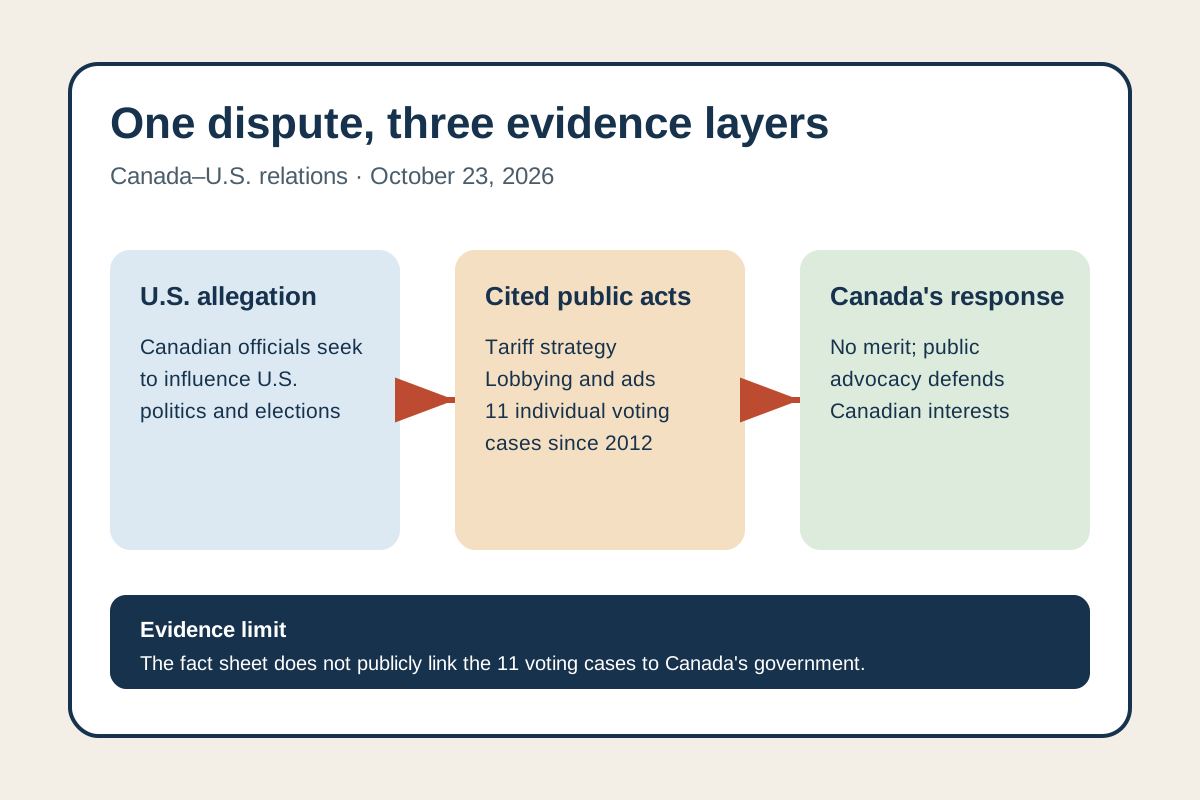
The dispute is real, but its evidence categories need to be kept separate. The embassy fact sheet points to public statements about retaliatory tariffs, lobbying and an Ontario advertisement using Ronald Reagan's criticism of tariffs. It separately cites 11 Canadians prosecuted or charged with illegal voting since 2012. The document does not say those voting cases were directed by Canada's government.
What the two governments are arguing about
Washington is using a broad conception of political influence: Canadian officials should not try to shape U.S. electoral incentives or campaign debate. Ottawa's position is that defending Canadian workers, setting tariffs and speaking publicly about cross-border policy are ordinary statecraft, not covert election interference.
The distinction matters because “interference” can describe very different conduct—from public advocacy and economic pressure to hidden financing, cyber operations or illegal voting. The embassy's published case rests mainly on overt conduct. It does not allege in the fact sheet that Canada's government organized illegal votes, hacked election systems or secretly funded a campaign.
Why this matters beyond the accusation
The quarrel lands during a worsening trade relationship. U.S.-Canada negotiations broke down in August, tariffs remain a major pressure point and Ottawa is seeking to reduce its dependence on the U.S. market. Carney said Canada could resume talks if Washington negotiated in good faith, but was prepared to wait.
Practical implication: businesses and workers should treat this as a political-risk signal, not as a new tariff order. The statements do not themselves change customs rates, border rules or election procedures. Any material change would require a separate official action.
Fact, analysis, forecast and opinion
Verified fact: the embassy published the allegation and Carney denied it; the fact sheet cites public political activity and 11 individual illegal-voting cases without publicly linking those cases to Canada's government. Analysis: the dispute expands a trade conflict into election legitimacy, making compromise harder before November 3. Forecast: further rhetorical escalation is plausible, but there is not enough evidence to predict new tariffs or formal election-related sanctions. Opinion: officials and newsrooms should use precise terms and avoid treating public lobbying, individual voting offenses and covert state interference as interchangeable.
For context, see our reporting on Canada and Ontario's C$8.7 billion industry plan, Alberta's referendum process and the Justice Department's California voter-list lawsuit.
Bias Lens: allegation, denial and the limits of the public evidence
Verified baseline: the U.S. embassy's own document alleges Canadian political influence, cites overt statements and advocacy, and lists 11 individual voting cases. It does not publicly connect those cases to Canada's government. Carney denies that Canadian government conduct constitutes election interference.
Official U.S. framing — U.S. Embassy in Canada: groups lobbying, tariff strategy, political advertising and illegal-voting cases under a warning against Canadian influence. Center — Reuters and Associated Press: foreground the allegation-denial exchange and the trade rupture; AP explicitly notes that the voting cases were not linked to Canada's government. Policy-news framing — Axios: emphasizes retaliatory tariffs and Canada's response to U.S. trade policy. A distinct, well-sourced left-versus-right split was not yet established in original reporting, so this lens does not assign ideological symmetry where the available evidence does not support it.
What remains uncertain
The embassy has not publicly identified evidence of covert Canadian government direction beyond the acts listed in its fact sheet. It is also unclear whether the accusation will produce a diplomatic protest, enforcement action or change in trade policy. With voting still ahead, claims about electoral effect cannot be verified.
Principal sources
- U.S. Embassy in Canada — fact sheet and cited conduct
- Reuters — Carney remarks and bilateral context
- Associated Press — allegation, response and evidence limits
No suitable directly relevant official or publisher-authorized video with clear embedding permission was available, so none was embedded.