U.S. elections · Federal courts · Voting rights
Federal Judge Restricts DHS Noncitizen-Voting Investigations in Nine States
The preliminary injunction limits election-related field operations and interviews likely to involve U.S. citizens through November 3. It does not prohibit every federal investigation of unlawful voting, and the administration may appeal.
By Health Politics Daily News Desk · October 22, 2026 at 8:02 p.m. ET

Watch in this article
Pumpjack operating at the Kern River Oil Field
A short CC0 field video provides visual context for reporting on oil production and fuel supply.
Thomas Farley / Wikimedia Commons · CC0 1.0 · License and source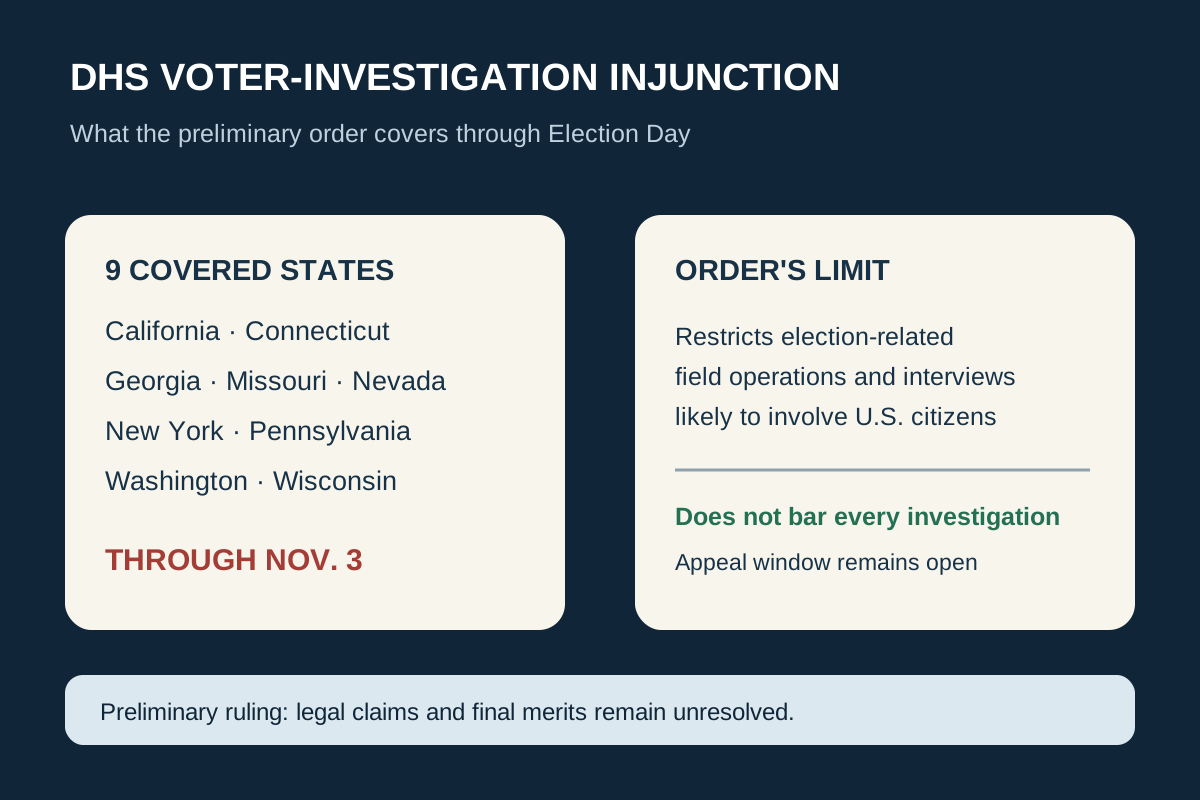
A federal judge has temporarily restricted the Department of Homeland Security from carrying out certain election-related field operations in California, Connecticut, Georgia, Missouri, Nevada, New York, Pennsylvania, Washington and Wisconsin.
U.S. District Judge Araceli Martínez-Olguín's October 21 preliminary injunction bars field operations and interviews under the department's “Unlawful Voter Initiative” when agents know or reasonably should suspect that the activity will involve U.S. citizens. The restriction runs through the close of polls on November 3. The judge temporarily stayed her own order until Friday, October 23, allowing time for an appeal.
What the judge found
The court concluded that the nurse organizations challenging the initiative were likely to succeed on a Voting Rights Act claim. Evidence showed members had reduced voter outreach, reconsidered in-person voting and withdrawn from poll-monitor work because they feared contact with federal agents.
The judge also found substantial reliability problems in the data used to generate investigative targets. Citizenship databases can lag after naturalization, and commercial voter files may contain incomplete or outdated records. The ruling does not decide the lawsuit's final merits; it determines that the plaintiffs met the higher threshold for temporary relief while litigation continues.
What the order does not do
The injunction is narrower than a total halt to noncitizen-voting enforcement. It does not legalize noncitizen voting, prevent ordinary criminal investigations based on reliable evidence or govern states outside the nine listed. It focuses on field operations likely to involve citizens and their effect on voter-assistance activity.
DHS said it is focused on identifying and prosecuting noncitizens who vote and said it has no plans to question people it believes are citizens. Government lawyers have argued that preventing investigations of potential federal crimes would itself harm the public interest.
Fact, analysis, forecast and opinion
Verified fact: a preliminary injunction restricts specified DHS operations in nine states through November 3, but is stayed until October 23. Analysis: the order balances election-law enforcement against evidence that unreliable targeting and armed field interviews can deter lawful participation. Forecast: an emergency appeal is possible, and a higher court could leave the order in place, narrow it or suspend it; no outcome is certain. Opinion: Health Politics Daily supports enforcement grounded in reliable evidence and safeguards that let eligible voters participate without intimidation.
Practical implications
- For eligible voters: the ruling does not change registration rules or voting eligibility. Official state and local election offices remain the best sources for ballot questions.
- For voter-assistance groups: covered organizations can continue outreach, while documenting any federal contacts and following counsel's guidance.
- For investigators: the order requires added care when data may include naturalized or native-born citizens and when field activity could affect protected voter assistance.
For related context, see our reporting on the Justice Department's California voter-registration lawsuit, the Supreme Court order involving the federal voter-eligibility database and the federal indictment of Virginia Sen. Louise Lucas.
Bias Lens: voter protection or blocked enforcement?
Verified baseline: the order limits specified field operations likely to involve citizens; it does not bar every investigation of unlawful voting. Noncitizen voting remains illegal, and the ruling is preliminary.
Left-leaning — The Guardian: emphasizes flawed data and the risk of voter intimidation. Center — Associated Press: explains the nine-state scope, the plaintiffs' evidence and DHS's response. Right-leaning — Just the News: foregrounds the restriction on voter-fraud operations and the administration's opportunity to appeal. These frames emphasize different public interests; the order itself defines the operative scope.
What remains uncertain
The administration has not said whether it will appeal, and the temporary stay means the injunction's immediate practical effect could change quickly. The court has not issued a final judgment on the Voting Rights Act, constitutional or administrative-law claims. It is also unclear how many planned field operations fall within the order and whether DHS will revise its targeting methods.
Principal sources
- U.S. District Court preliminary injunction
- California Nurses Association v. Mullin docket
- Associated Press
- Washington Post corroboration
No suitable directly relevant official or publisher-authorized video with clear embedding permission was available, so none was embedded.