CANADA — ALBERTA — CONSTITUTIONAL POLITICS
Carney and Alberta Premier Oppose Separation Ahead of Referendum
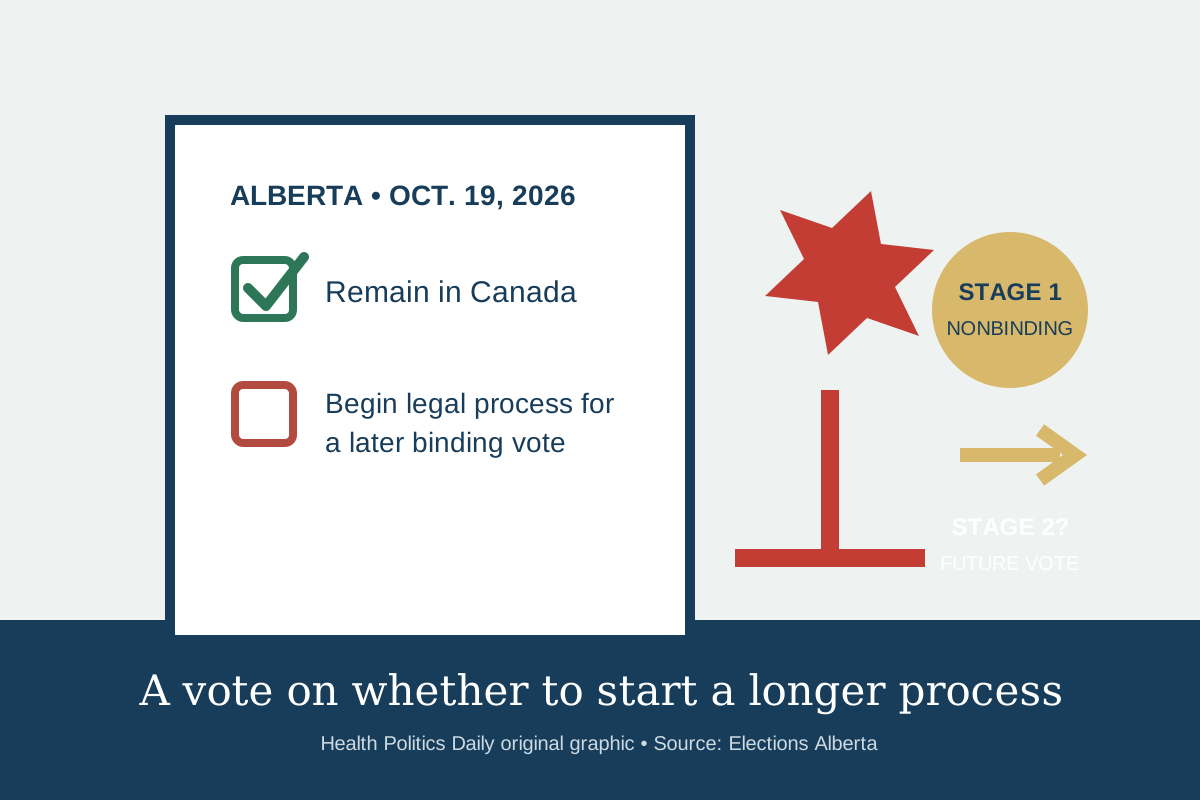
Alberta voters will decide Monday whether to remain in Canada or direct the province to begin the legal process toward a later binding separation vote. The ballot cannot itself make Alberta independent.
By Health Politics Daily News Desk · Published Friday, October 16, 2026 at 6:00 p.m. America/New_York · Approximately 8 minutes
Verified Baseline
Monday’s ballot asks whether to start a process—not whether Alberta leaves now
Elections Alberta says the referendum is set for October 19. Voters will choose between Alberta remaining a province of Canada and instructing the provincial government to begin the constitutional process required for a future binding referendum on separation.
Prime Minister Mark Carney and Alberta Premier Danielle Smith appeared together Friday in Red Deer and both urged a vote to remain, according to the Associated Press. Smith called the referendum but has said she opposes independence; Carney leads the federal Liberal government. Federal Conservative leader Pierre Poilievre also supports remaining in Canada.
What a Separation-Path Vote Would Do
A majority for the second option would create political pressure, not automatic independence
The current referendum is nonbinding. A majority for beginning the legal process could oblige Alberta’s government politically to pursue a second vote, but unilateral secession is not available under Canada’s Constitution. Canada’s Supreme Court has held that a clear majority on a clear question would trigger negotiations, and Parliament’s Clarity Act gives the House of Commons a role in judging both.
Any negotiated change would also confront constitutional-amendment rules, division of assets and debt, borders, federal programs and treaty rights. Reuters notes that Indigenous rights and treaties are central unresolved issues, not details that can be settled by the provincial ballot alone.
Why It Matters
The vote tests national unity in Canada’s largest oil-producing province
Alberta’s energy resources, federal transfers and environmental rules have fueled long-running disputes with Ottawa. The referendum converts those grievances into a province-wide constitutional signal at a time when Canada is also managing trade conflict with the United States.
Analysis: Friday’s joint appearance matters because Smith and Carney have different political bases and histories, yet presented improved federal-provincial cooperation as an argument for staying. The alliance narrows the institutional support for separation even as it gives the issue national prominence.
Opinion: whichever option wins, public officials should describe the result precisely. A vote to begin a legal process is not a declaration of independence; a vote to remain does not erase Alberta’s policy grievances.
Practical Implications
Most immediate rules and services continue unchanged
- For residents: Canadian citizenship, pensions, taxes, health coverage and federal services do not change on referendum night.
- For businesses: the vote may affect perceptions of political risk, but it does not itself alter contracts, currency, trade rules or provincial jurisdiction.
- For voters: Elections Alberta’s official materials, polling-place information and ballot wording are the controlling sources.
- For governments: a separation-path majority would open further legal and political decisions rather than supply a complete roadmap.
What Remains Uncertain
Turnout, the margin and the government’s response will determine the next phase
Recent surveys reported by major outlets show a clear lead for remaining in Canada, but polls are estimates and the ballot’s two-stage wording may not map neatly onto support for immediate independence. Unofficial results are expected after polls close, with formal administration governed by Alberta election law.
Forecast: a remain victory would reduce near-term pressure for a binding separation vote but would not end western-alienation politics. A vote to start the process would bring litigation, intergovernmental bargaining and sustained uncertainty well before any binding referendum could occur.
Bias Lens: constitutional process, national unity or political gamble?
The October 19 vote is nonbinding and offers a choice between remaining in Canada and starting the legal process toward a later binding referendum. Alberta does not become independent if the second option wins.
Left-leaning coverage: The Guardian emphasizes the separatist movement’s activist culture, internal tensions and unresolved costs. Center coverage: AP foregrounds the Carney–Smith unity appearance, while Reuters explains the ballot and constitutional steps. Right-leaning coverage: The Wall Street Journal frames the vote as a major political gamble for Smith and stresses oil-policy grievances.
The differences are mainly emphasis: movement credibility and social cost, legal mechanics and coalition politics, or leadership risk and resource conflict. None changes the official ballot wording or makes the first vote legally self-executing.
Principal Sources
Ballot rules, constitutional context and current reporting
- Elections Alberta — official referendum information
- Government of Canada — Clarity Act
- Supreme Court of Canada — Reference re Secession of Quebec
- Associated Press — Carney and Smith joint appearance
- Reuters — referendum explainer and polling context
No suitable directly relevant official or publisher-authorized video with clear embedding permission was available.
Related Coverage