GLOBAL TRADE — MARITIME LAW — ENERGY SECURITY
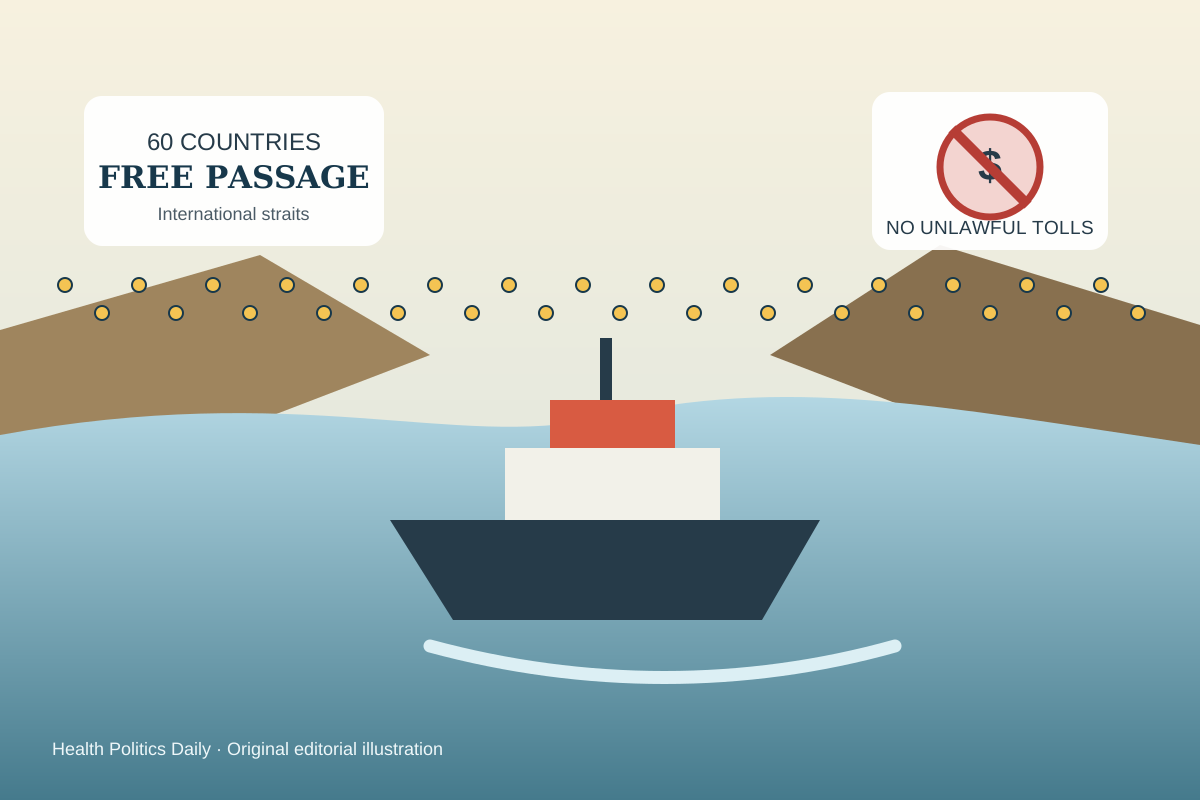
Sixty Countries Back Declaration Opposing Tolls in International Straits
The coalition says lawful shipping should not face unilateral fees, discriminatory restrictions or prior-authorization rules—a diplomatic marker with immediate relevance to the Strait of Hormuz.
By Health Politics Daily News Desk · Published Monday, October 12, 2026 at 2:00 p.m. America/New_York · Approximately 8 minutes
Verified Baseline
The declaration defends toll-free lawful transit
Sixty countries endorsed a declaration Monday committing to preserve freedom of navigation through straits used for international navigation. The signatories oppose unlawful fees, tolls, discriminatory restrictions, prior-authorization requirements and other conditions that would hamper lawful passage. They also support what the text calls defensive and non-escalatory multilateral initiatives.
Reuters reported the declaration is supported by European Union members, Australia, Japan and the United Kingdom. The report did not publish a complete signer list or identify a new enforcement mechanism, so this article does not treat the declaration as a treaty or an operational security commitment.
The legal baseline predates Monday's statement. Under Part III of the U.N. Convention on the Law of the Sea, ships and aircraft enjoy transit passage through qualifying international straits. Bordering states may regulate navigation safety, pollution, fishing and customs matters, but their rules may not discriminate in practice or deny, hamper or impair transit passage.
Why It Matters
A common rule is meant to prevent a patchwork of maritime toll booths
International straits connect seas, ports and supply chains. If one government can make ordinary passage conditional on a unilateral cargo-value fee, others could attempt similar charges at different chokepoints. Even before a fee is collected, uncertainty can raise insurance costs, delay voyages and push shippers toward longer routes.
The declaration is especially relevant to the unresolved negotiations over the Strait of Hormuz. Iran and the United States have both floated or asserted toll concepts during the 2026 conflict, while shipping states and the U.N. maritime agency have argued that compulsory charges for mere passage would undermine established navigation rules. Monday's coalition broadens that objection beyond any single government or strait.
For households and businesses, the practical link runs through freight, fuel and insurance. The Strait of Hormuz is a central energy route, and recent tanker and airport attacks have already added a risk premium to oil and transport markets. The declaration cannot by itself remove those risks, but it signals that a wide group of governments rejects normalizing tolls as the price of passage.
What It Does—and Does Not—Change
Political coordination is not automatic enforcement
- It establishes a broad diplomatic position: signatories can cite shared language in negotiations, maritime forums and sanctions or security discussions.
- It does not create a new court ruling: legal disputes still turn on treaty obligations, customary international law, facts on the water and available jurisdiction.
- It does not ban service charges: ports, pilots and other requested services may lawfully carry fees; the dispute is over compulsory payment for mere transit.
- It does not guarantee safe passage: shipowners still assess military threats, insurance terms, crew safety and government advisories.
- It does not authorize force: the declaration's published language emphasizes defensive and non-escalatory initiatives.
Practical Implications
What shippers, governments and consumers should watch
Shipping companies should continue to rely on flag-state notices, insurers, port agents and official maritime-security guidance rather than assume the declaration changes access overnight. Cargo owners should watch whether insurers treat any demanded payment as a prohibited toll, a covered expense or a sanctions risk.
Governments now face a credibility test: whether they publish the full signer list, define which initiatives they support and explain how they will distinguish lawful service fees from coercive passage charges. Consumers should not interpret the statement as a promise of lower fuel or freight prices; it is a policy signal, not a price control.
What Remains Uncertain
The coalition has not disclosed an implementation plan
The declaration leaves important operational questions open: who will coordinate action, whether China or the United States signed, how disputes will be verified, and what governments would do if a coastal state demands payment. It is also unclear whether the group will seek an International Maritime Organization resolution, pursue litigation or rely on diplomacy and naval presence.
Verified fact: sixty countries support the declaration's opposition to tolls and other restrictions that impair lawful navigation. Analysis: the breadth of the coalition increases diplomatic pressure against unilateral toll regimes but does not settle enforcement. Forecast: the statement is likely to become a reference point in Hormuz negotiations and future maritime-security meetings. Opinion: Health Politics Daily takes no position on military operations or the preferred enforcement mechanism.
Bias Lens: how strait tolls are framed
UNCLOS provides transit-passage rights through qualifying international straits and bars rules that have the practical effect of denying, hampering or impairing that passage. Monday's declaration is a political commitment by sixty countries; it is not itself a new treaty or court judgment.
Left-leaning coverage: The Guardian has emphasized the inconsistency of both Iranian and U.S. toll proposals with established navigation rules, while placing them inside the wider war and civilian-risk context. Center coverage: Reuters leads with the coalition's exact policy position and named groups of signatories, without claiming the declaration solves enforcement. Right-leaning coverage: Fox News has foregrounded the security and global-supply threat from Iranian toll demands and the U.N. maritime agency's warning about precedent.
The difference is mainly emphasis—war accountability and consistency, institutional/legal baseline, or coercion and energy security. All three frames can coexist with the verified rule that ordinary lawful transit is distinct from payment for requested port or pilot services.
Principal Sources
Declaration reporting and maritime law
- Reuters — sixty-country declaration and quoted provisions
- United Nations — UNCLOS Part III on international straits
- Reuters — legal analysis of Hormuz toll claims
- NATO — Ankara Summit declaration on Hormuz navigation
No directly relevant official or publisher-authorized video with clearly established embedding permission was identified, so this article does not embed or rehost one.
Related Coverage