Ukraine · Technology policy · Military communications
Ukraine Says Starlink and Starshield Speeds Restored After Weeklong Disruption
Ukraine says satellite links used for frontline communications and drones have returned to prior speeds. Who imposed the restrictions and what prevents another disruption remain unresolved.
By Health Politics Daily News Desk · October 24, 2026 at 1:56 p.m. ET
Verified baseline
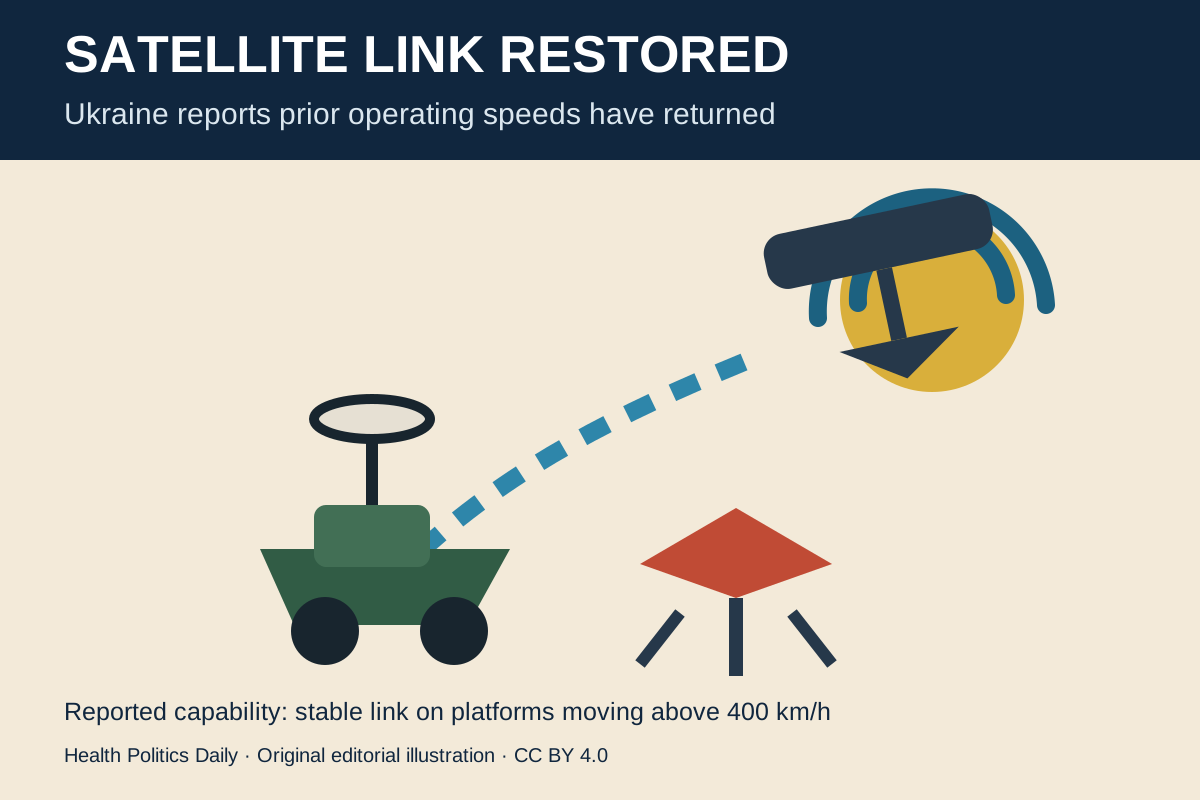
Ukrainian President Volodymyr Zelenskyy said Saturday that Starlink and Starshield had returned to the speeds available before recent restrictions. He said restoration began overnight and that tests showed the systems were usable by morning. Ukraine’s defense minister reported stable connections on fast-moving platforms, while Reuters and the Associated Press independently reported the Ukrainian announcement.
The “more than 400 km/h” figure describes the movement speed at which a terminal retained a connection, not internet download speed. It matters because terminals mounted on drones and other fast-moving equipment had stopped working above roughly 160 km/h during the restriction.
What changed on the front line
Starlink provides commercial satellite internet, while Starshield is SpaceX’s military-focused service operated under U.S. government arrangements. Ukrainian officials said the speed-related restriction disrupted drone missions, logistics and air-defense operations, including links to interceptor drones used against Russian attacks. Restoring the prior threshold removes that specific operating limit; it does not end broader shortages of air-defense interceptors or other military support.
For civilians, the immediate significance is indirect but real: communications that help detect and intercept attacking drones can affect the protection of cities and infrastructure. The restoration does not mean ordinary internet service is uniformly normal in every location, and battlefield conditions can still produce local outages.
Responsibility remains disputed
The public record does not establish who ordered the restriction. Elon Musk has said Starshield use limits are determined by the U.S. government, while U.S. officials offered conflicting accounts and President Donald Trump denied ordering the change. Reporting has also attributed decisions to SpaceX. Zelenskyy thanked U.S. lawmakers, the State Department and Trump for helping restore service, but that acknowledgment does not identify who imposed the limit.
The episode extends concerns described in our initial report on the speed restriction: Ukraine depends heavily on infrastructure controlled through a private company and U.S. contracts. Our coverage of restored U.S. intelligence sharing shows a parallel vulnerability when essential battlefield support changes without transparent rules.
Fact, analysis, forecast and opinion
Verified fact: Ukraine says tests show Starlink and Starshield again work at their earlier movement-speed threshold. Analysis: the restoration resolves an immediate technical constraint but leaves the governance problem intact. Forecast: operations dependent on fast-moving terminals should recover if the reported performance is sustained across the front; independent nationwide performance data are not yet public. Opinion: Health Politics Daily takes no position on military strategy; governments and contractors should publish clear authority, notice and continuity rules for critical communications where security permits.
Bias Lens: restored capability or warning about private power?
Verified baseline: Ukrainian officials report that the prior speeds are restored after more than a week of disruption; responsibility for imposing the limit remains unresolved.
Left-leaning coverage — The Guardian: emphasized the disruption’s effect on Ukrainian defense and the political tensions surrounding Musk and Trump. Center coverage — Associated Press and Reuters: led with the restoration, operational effects and competing accounts of responsibility. Right-leaning coverage — New York Post: foregrounded administration criticism of Zelenskyy’s public accusations and the dispute over whether Washington caused the restriction. These differences concern emphasis and attribution, not whether Ukraine now reports restored service.
What remains uncertain
No party has published a complete technical record showing when the limit was applied, who authorized it or whether every affected terminal and region has recovered. Contractual safeguards, notification requirements and an appeal process have not been made public. The durability of restoration will be tested by operations, not by one day of measurements.
Principal sources
- President of Ukraine — official restoration statement
- Reuters — restoration and operational context
- Associated Press — frontline effects and disputed responsibility
Official video of Zelenskyy’s address is available on the Ukrainian presidency’s website. It is linked rather than embedded because reusable third-party embedding permission was not clear.