UKRAINE — SATELLITE COMMUNICATIONS — DRONES
Starlink Speed Restrictions Disrupt Ukrainian Drone Missions
Ukraine says an unexpected limit on military-grade satellite connections interrupted attack and interceptor-drone operations. Connections improved later Wednesday, but neither the reason for the restriction nor who authorized it has been publicly established.
By Health Politics Daily News Desk · Published Wednesday, October 14, 2026 at 8:00 p.m. America/New_York · Approximately 8 minutes
Verified Baseline
Units reported connection losses and canceled missions
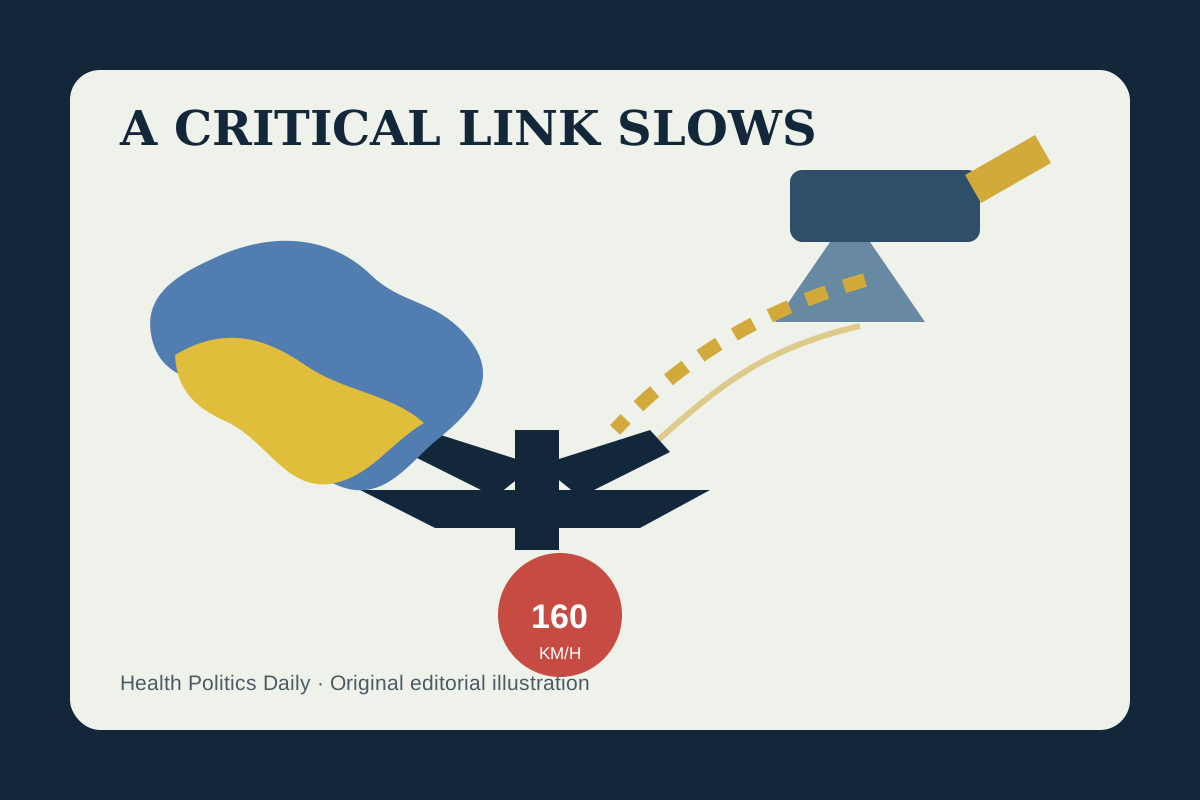
Ukrainian presidential adviser Serhiy Beskrestnov said military-grade Starshield terminals began losing connectivity on fast-moving platforms without advance warning. He described a threshold of roughly 160 kilometers per hour, or 100 mph. Ukraine's 7th Rapid Reaction Corps told Reuters that some missions were canceled and that connections sometimes dropped for 10 to 20 seconds even at 110–120 km/h.
Associated Press reported that by late Wednesday operators were again seeing improved connections at speeds up to about 161 km/h. Ukrainian officials said that remained inadequate for some faster interceptor drones.
Verified fact: Ukrainian military users experienced speed-related connection limits and operational disruption. Not verified: that Elon Musk personally ordered the change, that President Donald Trump directed it, or that it was designed to assist Russia.
Why It Matters
One network supports both attack and defensive systems
Starshield is the government-oriented service derived from SpaceX's Starlink network. Ukrainian forces use satellite links for battlefield communications, logistics, medium-range strike drones and interceptor drones that defend cities against Russian unmanned aircraft.
A moving-platform speed restriction matters because a drone may remain physically capable of flying while losing the continuous data link needed for control, navigation or targeting. A short interruption can force an operator to abort or make a fast interceptor less effective.
Analysis: the episode exposes a strategic dependency: a technical or policy change made outside Ukraine can quickly affect frontline and civilian-defense operations. It also shows why “Starlink was not shut off” would be an incomplete description; service can remain available generally while a narrower operational limit still changes what a weapon or interceptor can do.
What Officials Say
Ukraine links the timing to Russian attacks, but causation is unsettled
President Volodymyr Zelenskyy said Russia launched 39 ballistic missiles and more than 100 attack drones overnight and argued that Russian forces were trying to exploit Ukraine's Starlink problems. His office said the strikes hit energy, transport and rail infrastructure. That statement describes Ukraine's assessment; it does not prove Russia had prior knowledge of the restriction.
Musk said Starshield systems are owned and controlled by the U.S. government and that usage limits are ultimately decided by U.S. authorities. AP reported that the Pentagon, Space Force and White House did not immediately answer questions about the restriction. SpaceX also had not publicly explained the change.
Washington Post reporting said Ukraine's Defense Ministry was still assessing whether the problem reflected a policy decision or a technical limit. That uncertainty is central: the observed effect is better established than its cause.
Practical Implications
Ukraine is seeking restoration and alternatives
Ukraine contacted SpaceX and U.S. and NATO partners, while Britain said it would accelerate delivery of air-defense systems. European satellite providers may eventually offer redundancy, but switching networks is not immediate: terminals, coverage, capacity, contracts and integration with individual systems all matter.
For civilians, the direct concern is air-defense performance during continuing Russian strikes. The restriction does not mean every Ukrainian drone or communications terminal stopped working, and it should not be treated as proof that any specific casualty resulted from the service change.
Forecast: technical thresholds may continue to change while officials negotiate. A durable resolution would require clear operating rules and backup communications, but neither has been announced. Opinion: Health Politics Daily takes no position on military strategy; governments and contractors controlling essential systems should communicate operational changes clearly enough to reduce avoidable danger.
What Remains Uncertain
Authority, purpose and duration remain unanswered
It is not publicly known whether the restriction originated with SpaceX, a U.S. military customer, an automated safety setting or another technical process. The contractual authority over moving-platform limits has not been released. It is also unclear whether the restored 160 km/h performance is temporary, whether all units received it, and whether the original unrestricted capability will return.
Bias Lens: operational facts, blame and alliance strain
Ukrainian units reported unexpected speed-related Starshield connection limits, canceled missions and later partial improvement. The public record does not establish who ordered the restriction or why.
Left-leaning coverage: The Guardian centers Zelenskyy's sense of betrayal and broader concern that Washington is shifting away from Kyiv. Center coverage: Reuters foregrounds verified unit reports and says the reason was unclear; AP connects the restriction to simultaneous uncertainty over intelligence warnings while noting competing official claims. Right-leaning coverage: Fox News emphasizes potential battlefield consequences and contractual ambiguity while stating there was no public confirmation that Musk personally ordered the change.
The disagreement is mainly over political meaning and responsibility. All three frames should remain subordinate to the verified operational effect and the unresolved chain of authority.
Principal Sources
Official account and corroborating reporting
- Office of the President of Ukraine — Russian attack and interceptor dependence
- Reuters — unit reports, speed threshold and disrupted missions
- Associated Press — partial restoration and unanswered U.S. questions
- The Washington Post — Defense Ministry uncertainty and operational effects
AP provides a publisher-authorized audio report on its article page. Because no clear third-party embedding permission was established, it is linked rather than embedded.
Related Coverage