U.S. foreign policy · Middle East · Diplomatic security
U.S. Reduces Staffing at Four Embassies After Iran Threat Warning
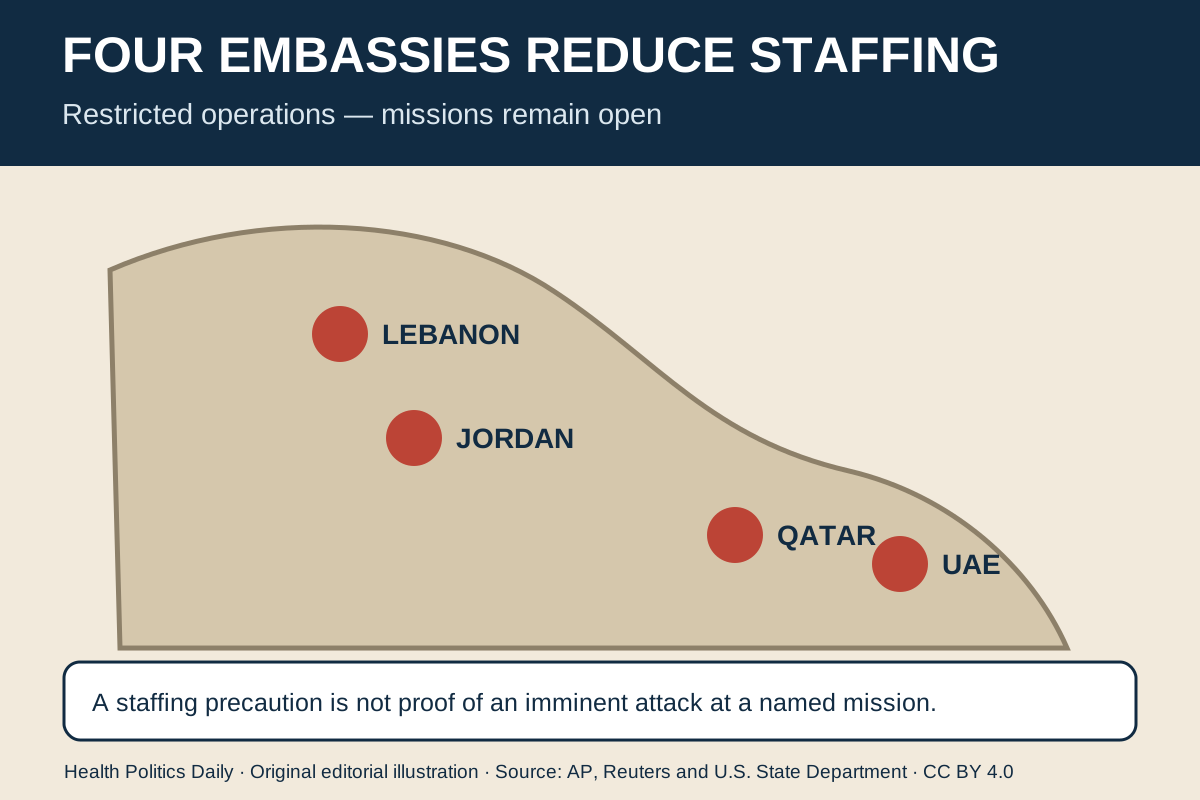
U.S. diplomatic missions in Jordan, Lebanon, Qatar and the UAE are limiting operations after intelligence warned of Iranian plots. The embassies remain open and no attack was announced.
By Health Politics Daily News Desk · October 24, 2026 at 3:58 p.m. ET
Verified baseline
The U.S. State Department is reducing staffing and placing embassies in Jordan, Lebanon, Qatar and the United Arab Emirates under restricted operations after an intelligence warning about increased Iranian efforts to target Americans, according to Associated Press and Reuters. The missions remain open, and personnel at those four posts were not ordered to leave.
An October 23 memo from Director of National Intelligence Jay Clayton to Secretary of State Marco Rubio said intelligence indicated Iran had substantially increased efforts to target U.S. personnel and that lethal plots had reached advanced stages in the Middle East and some other countries. News organizations obtained the unclassified memo; the government has not publicly released the underlying intelligence or identified targets.
What changed — and what did not
Restricted operations allow a mission to limit staffing, movement and public services as security conditions require. That is different from closing an embassy or evacuating all personnel. Earlier in the week, the United States ordered non-emergency employees and eligible family members to leave its missions in Saudi Arabia, a stronger step covered in our report on the Saudi Arabia departure order.
The latest security posture reflects officials’ assessment of both Iranian planning and attacks by the Iran-aligned Houthis. It does not establish that an attack is imminent at any named embassy. No public account identifies a specific plot, date or target, and the allegations have not been independently tested in court.
Practical implications
U.S. citizens in or traveling to the region should use the State Department’s current country advisories and embassy alerts rather than relying on broad social-media warnings. The Jordan advisory and Kuwait advisory, for example, were updated October 23 to cite Iranian and Houthi threats. Advice differs by country, and an embassy staffing reduction does not by itself prohibit civilian travel.
Reduced staffing can slow routine consular work and narrow emergency capacity. Travelers can enroll in the Smart Traveler Enrollment Program and monitor the specific embassy’s official website. This is general public information, not individualized security or travel advice.
Fact, analysis, forecast and opinion
Verified fact: four embassies are operating with reduced staffing, while separate departure orders apply in Saudi Arabia. Analysis: the measures distribute risk across a region already facing Houthi attacks, shipping disruption and U.S.–Iran conflict. Forecast: restrictions could expand or ease as intelligence changes, but the memo alone does not predict an attack. Opinion: Health Politics Daily takes no position on U.S. or Iranian policy; public communication should distinguish protective measures from proof of an imminent event.
Bias Lens: precaution, escalation or intelligence alarm?
Verified baseline: the United States reduced staffing at four open embassies after an intelligence memo warned of increased Iranian targeting efforts; the public has not seen the underlying intelligence.
Left-leaning coverage — The Daily Beast: foregrounded the leaked warning and the possibility that renewed U.S. military action could intensify risk. Center coverage — Associated Press and Reuters: emphasized the memo, staffing changes and distinctions among restricted operations and departure orders. Right-leaning coverage — Fox News: emphasized the severity of alleged plots and protection of Americans abroad. These are differences in emphasis; none provides the classified evidence needed to assess individual plots publicly.
What remains uncertain
The public does not know which people, facilities or countries the alleged plots concern, how agencies assessed their maturity, or whether planned actions were disrupted. Iran had not publicly confirmed the allegations. It is also unclear how long restricted operations will last or which services will be affected at each mission.
Our earlier report on changing threats to Gulf shipping explains the broader security environment, but maritime incidents and alleged plots against personnel are separate claims requiring separate evidence.
Principal sources
- Associated Press — embassy staffing and memo confirmation
- Reuters — intelligence warning and regional context
- U.S. State Department — Jordan travel advisory
No suitable directly relevant official or publisher-authorized video with clear embedding permission was available, so none was embedded.