ENERGY — SHIPPING — MIDDLE EAST
Oil Rises Above $105 as Tanker and Saudi Airport Attacks Deepen Supply Risk
Brent crude rose above $105 after two tanker incidents and renewed attacks on Saudi airports. The move reflects higher disruption risk—not proof that oil supplies have already fallen by the same degree.
By Health Politics Daily News Desk · Published Sunday, October 11, 2026 at 8:02 p.m. America/New_York · Approximately 8 minutes
Verified Baseline
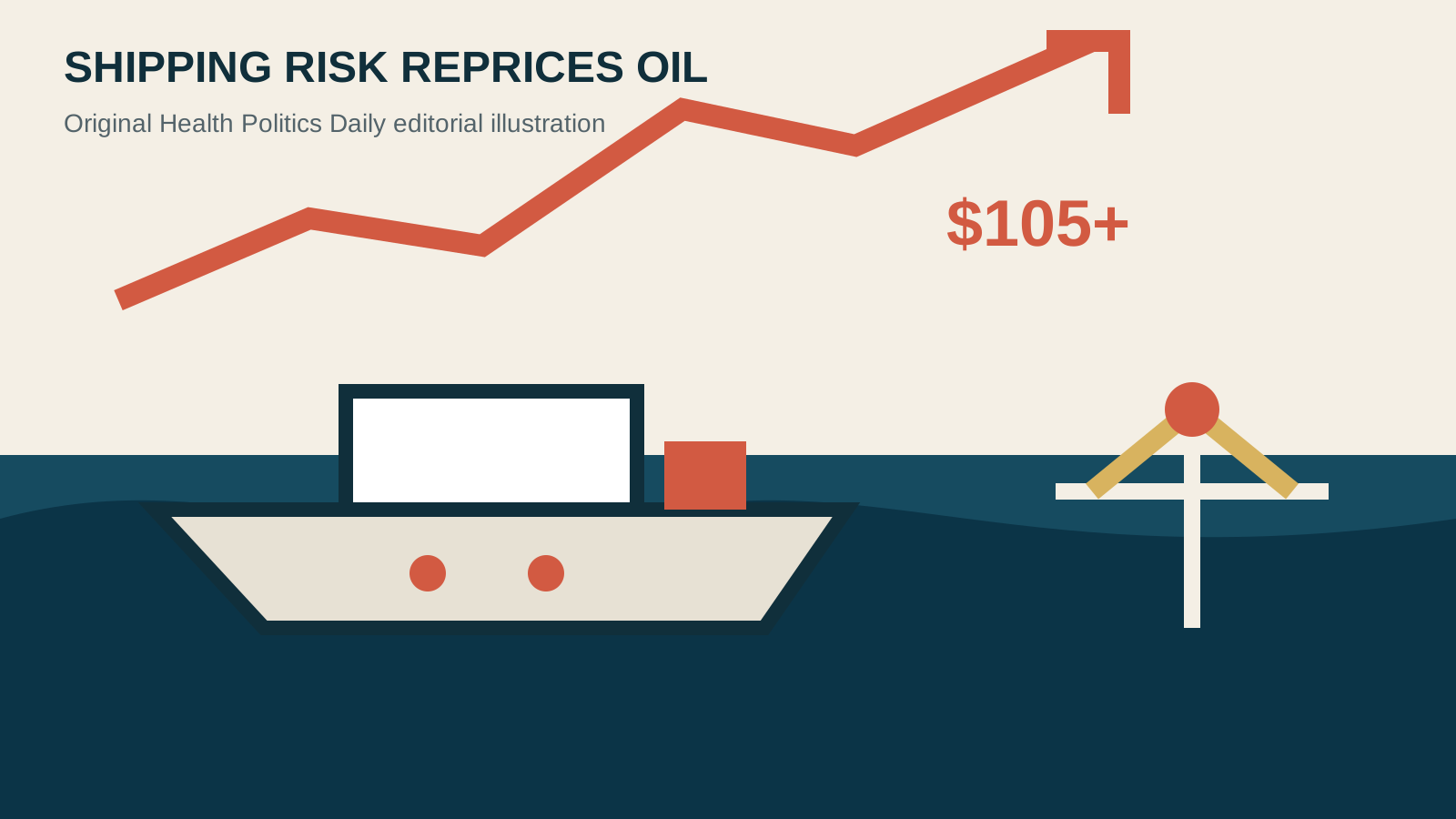
Brent reached $105.48 in early Monday trading
Brent crude futures rose 76 cents, or 0.73%, to $105.48 a barrel by 11:04 p.m. GMT Sunday, while U.S. West Texas Intermediate reached $92.44, according to Reuters market reporting. Prices can change continuously; these figures are a timestamped market snapshot, not a forecast or retail fuel quote.
The U.K. Maritime Trade Operations agency separately reported that an outbound tanker in the Strait of Hormuz was struck on its port side by an unidentified projectile. The crew was safe, damage was reported and no environmental impact had been identified at the time of the notice. A second incident involving a tanker and military forces in the Gulf of Oman remained under investigation.
Verified fact: maritime authorities recorded the incidents and crude prices rose. Not established: who carried out the tanker strikes, how much physical supply was lost or how long the price increase will last.
What Drove the Move
Markets are pricing several risks at once
The latest rise follows attacks on shipping around the Strait of Hormuz, a renewed strike on Riyadh’s King Khalid International Airport and another attack on King Fahd International Airport in Dammam. Saudi Arabia’s General Authority of Civil Aviation said Sunday’s Riyadh strike caused injuries while inspections continued; it later said the Dammam airport was also targeted.
Those events matter because the Strait of Hormuz and the Bab el-Mandeb connect major oil and fuel exporters with global markets. Traders also are watching possible U.S. involvement against the Houthis and the pace at which Gulf of Mexico production returns after Hurricane Isaias.
For the underlying aviation escalation, read our report on the deadly Riyadh airport attack. For the separate diplomatic track affecting oil transit, see our update on the unresolved U.S.–Iran Hormuz negotiations.
Why It Matters
A risk premium can raise costs before an actual shortage appears
Oil futures incorporate expectations about future supply, shipping delays, insurance, storage and demand. A higher price can therefore reflect the possibility of disruption even if current cargo data have not yet shown an equivalent drop in delivered barrels.
If elevated crude prices persist, they can feed into gasoline, diesel, jet fuel, freight and petrochemical costs. The timing and magnitude differ by product and region because refinery margins, inventories, taxes, exchange rates and competition also matter.
The move complicates Washington’s effort to reduce fuel costs through a temporary license for Russian diesel transactions. Additional diesel supply could ease one part of the market, but it cannot by itself eliminate crude and shipping risks across the Middle East.
Practical Implications
What households, businesses and policymakers should watch
- Drivers: a one-session crude move does not translate immediately or one-for-one into pump prices.
- Airlines and freight carriers: sustained fuel-price increases can raise operating costs, while airport and airspace disruptions add routing expense.
- Importers: war-risk insurance, vessel availability and transit time may matter as much as the benchmark price.
- Central banks: persistent energy inflation could complicate interest-rate decisions, especially if it spreads into food and transport costs.
- Governments: official incident attribution, reserve releases and evidence of restored production will shape whether the risk premium expands or fades.
What Remains Uncertain
Attribution, damage and the duration of the price move are unresolved
UKMTO has not publicly attributed the tanker projectile. Damage assessments at the Saudi airports were continuing, and Sunday’s official statements did not provide a complete casualty or operations update. The effect of possible military retaliation on shipping remains unknowable.
Analysis: the latest gain is best understood as a higher probability assigned to future disruption, not a measured barrel-for-barrel shortage. Forecast: oil is likely to remain volatile while tanker safety, Saudi aviation security and Hormuz access remain unsettled, but prices could fall quickly if transit normalizes or diplomatic progress becomes verifiable. Opinion: Health Politics Daily offers no trading recommendation; short-term commodity moves are not a reliable basis for personalized investment decisions.
Bias Lens: how coverage frames the oil-price risk
Brent traded at $105.48 and WTI at $92.44 in early Monday trading. UKMTO reported damage to an outbound tanker in the Strait of Hormuz, with the crew safe; Saudi authorities reported new attacks on Riyadh and Dammam airports.
Left-leaning coverage: The Guardian emphasizes spillovers into inflation, bond markets and household costs. Center coverage: Reuters foregrounds the benchmark move and balances conflict risk against restoring U.S. production and potential supply adaptation; Associated Press concentrates on the renewed Saudi airport attack and regional escalation. Right-leaning coverage: The Wall Street Journal emphasizes the administration’s strategic dilemma: intervention could widen attacks on shipping, while restraint leaves Saudi Arabia exposed.
The main difference is emphasis—consumer inflation, immediate market mechanics or U.S. strategic choices. The price timestamp and official maritime incident reports are the strongest common baseline.
Principal Sources
Official incident records and market reporting
- UK Maritime Trade Operations — incidents 162 and 164
- Saudi Press Agency / GACA — renewed Riyadh airport attack
- Saudi Press Agency / GACA — Dammam airport attack
- Reuters — oil benchmarks and supply-risk context
- Associated Press — renewed Saudi airport strike and regional context
No suitable official or publisher-authorized video directly documenting the tanker incidents with clear embedding permission was available, so none was embedded.
Related Coverage