SAUDI ARABIA — AVIATION — TRAVEL
Most Riyadh Flights Canceled After Deadly Airport Attacks
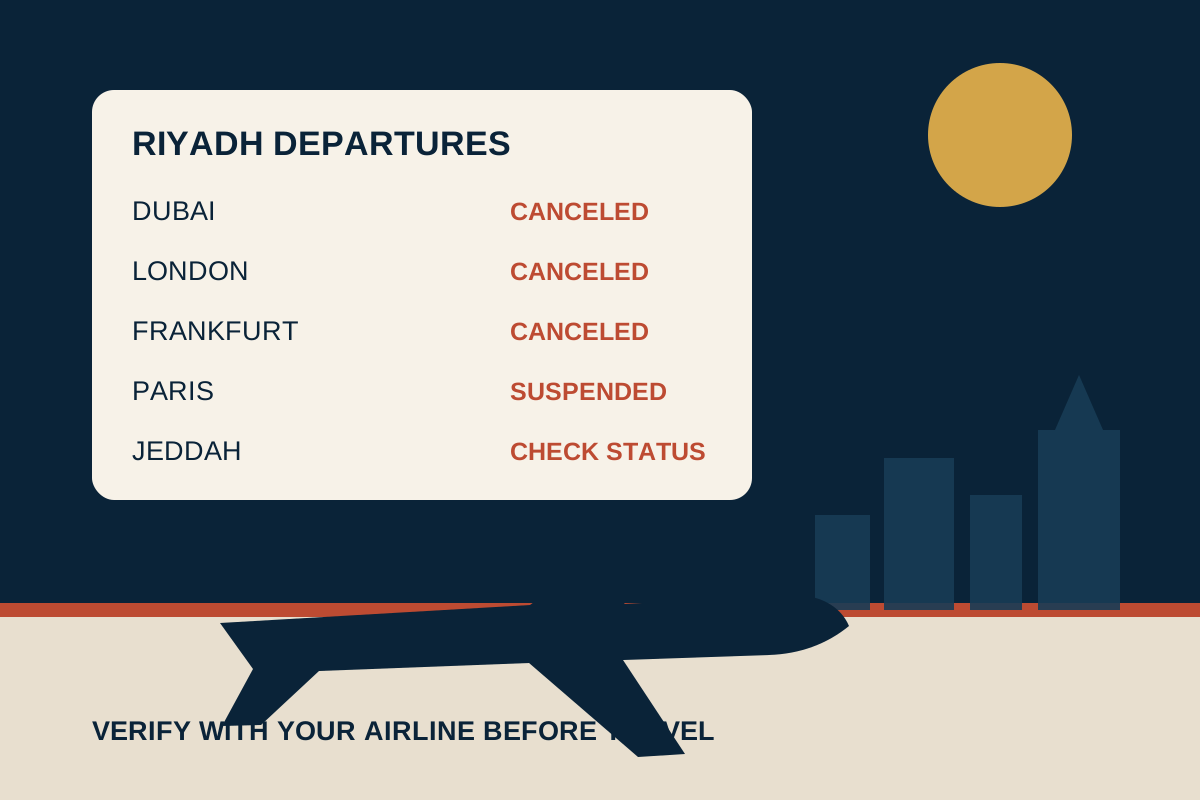
Flight schedules at Saudi Arabia’s busiest airport remained severely disrupted Monday after two deadly Houthi attacks. Independent trackers differed on the exact share canceled, but both showed that most scheduled service was not operating.
By Health Politics Daily News Desk · Published Monday, October 12, 2026 at 6:04 a.m. America/New_York · Approximately 8 minutes
Verified Baseline
Two independent estimates show most Monday service canceled
Cirium expected about 60% of Monday’s scheduled flights at King Khalid International Airport to be canceled, while Flightradar24 estimated roughly 78%, according to Reuters reporting published October 12. Cirium found that 99.7% of scheduled service was canceled Sunday, when the airport closed after a second attack.
The figures are estimates, not a single final airport tally. Trackers can differ because of update times, what counts as scheduled, and whether a flight is coded as canceled, delayed or removed. The reliable conclusion is that most service remained disrupted; the exact percentage was still moving.
The operational crisis follows attacks that killed and injured people at the airport. Our earlier report details the casualty figures and evidence around the Riyadh airport attack; this update focuses on the passenger and airline consequences.
Airline Response
Some international suspensions extend well beyond Monday
Reuters reported that Lufthansa canceled Riyadh service through October 16 and that Air France-KLM extended its suspension through the end of October. Other airlines were adjusting individual flights, aircraft rotations and crew schedules, which means service can change after a passenger first checks.
The U.S. Federal Aviation Administration advised U.S. operators to use caution when flying to or over Saudi Arabia. That is a safety warning to operators, not a blanket closure of Saudi airspace and not proof that every airline will make the same decision.
Passengers should use the airline’s own app, website or direct notification as the controlling source for a booking. A flight appearing on a third-party tracker does not guarantee that check-in, connections or ground handling will operate normally.
Practical Implications
What passengers should check before leaving for the airport
- Confirm the exact flight: verify the flight number and date directly with the operating airline, including a codeshare partner.
- Check the full itinerary: a first leg may operate while an onward connection is canceled or no longer protected.
- Do not assume compensation: refund, rebooking, hotel and meal rights vary by airline, ticket, departure country and cause of disruption.
- Keep records: save cancellation notices, receipts and written rebooking offers for any later claim or travel-insurance filing.
- Avoid unnecessary airport travel: follow official airline and airport instructions, especially if a flight has no confirmed departure time.
This is general travel information, not legal advice. Travelers needing urgent consular help should use their government’s official travel-advisory and embassy channels.
Why It Matters
Riyadh is a hub, so disruption can spread far beyond Saudi Arabia
King Khalid International Airport connects Saudi domestic routes with Europe, Asia, Africa and the Middle East. Cancellations can strand passengers elsewhere, displace aircraft and crews, and reduce available seats even after the airport itself resumes more operations.
The disruption also adds to pressure already visible in energy and transport markets. Our separate analysis explains why oil rose above $105 after tanker and Saudi airport attacks. Earlier attacks on another regional airport are covered in our report on Aden airport and displacement from Yemen.
What Remains Uncertain
There is no firm timetable for normal operations
Public schedules do not establish when capacity, staffing and airline confidence will return to normal. Further security incidents could reverse a reopening, while even an incident-free day would not immediately restore aircraft and crews to their planned positions.
Verified fact: most scheduled service was canceled Monday, and major airlines announced multi-day suspensions. Analysis: the recovery is likely to be uneven because each carrier makes its own security and operational decision. Forecast: schedules may remain volatile for several days even if more departures resume. Opinion: Health Politics Daily takes no position on the conflict; public claims about normal service should be judged against completed flights, not announced timetables alone.
Bias Lens: how coverage frames the aviation disruption
Independent aviation trackers differed on the precise Monday cancellation share, but both showed that most scheduled flights were canceled. Sunday service was almost entirely canceled, and several international airlines extended suspensions.
Center coverage: Reuters emphasizes operational data, airline suspensions and the near-empty skies over Riyadh. The Associated Press centers the second strike, casualties and the wider regional conflict.
No timely, directly comparable mainstream left-leaning or right-leaning report focused primarily on Monday’s cancellation data was available at publication. Rather than force ideological symmetry, this lens identifies the meaningful difference in available coverage: operational travel consequences versus attack and conflict context.
Principal Sources
Aviation data, official guidance and corroborating reporting
- Reuters — cancellations, airline suspensions and FAA warning
- Associated Press — second strike and conflict context
- Federal Aviation Administration — current international airspace restrictions and notices
- King Khalid International Airport — live flight information
No directly relevant official or publisher-authorized video was available with clear embedding permission. No video was embedded.
Related Coverage