Middle East · Energy security · Yemen conflict
Houthis Claim Attacks on Saudi Oil Pipeline and Riyadh Airport
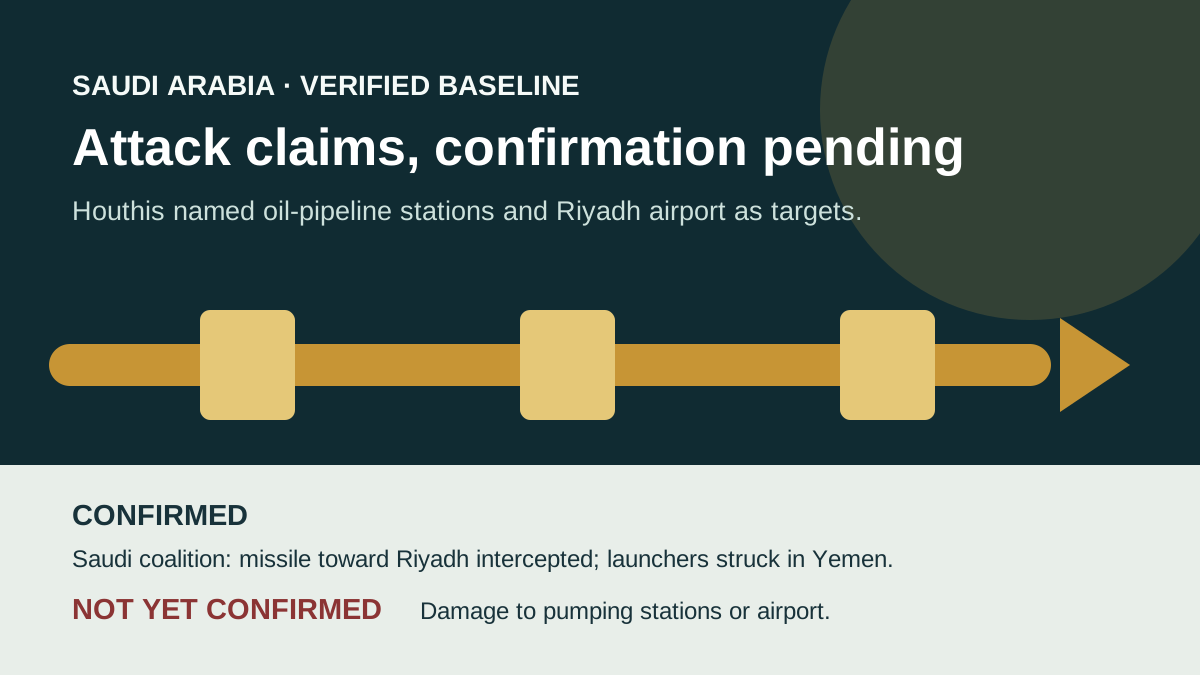
Saudi Arabia confirmed intercepting a missile fired toward Riyadh but had not confirmed damage at the pumping stations or airport named by the Houthis.
By Health Politics Daily News Desk · October 26, 2026 at 4:26 a.m. ET

Verified baseline
Yemen’s Houthi movement said Monday that it fired a ballistic missile at King Khalid International Airport in Riyadh and sent drones toward pumping stations on Saudi Arabia’s East-West crude-oil pipeline. Saudi Arabia had not confirmed strikes or damage at those named locations when this article was published.
The Saudi-led coalition did say it intercepted a missile launched toward Riyadh. It also said it destroyed two ballistic-missile launchers in Sanaa, including the launcher used for that missile, and struck other Houthi missile infrastructure. These official statements confirm active exchanges, but do not independently verify every Houthi target claim.
Why the East-West pipeline matters
The roughly 1,200-kilometer pipeline carries crude from Saudi Arabia’s eastern production region to the Red Sea. That route lets some exports bypass the Strait of Hormuz, where shipping has already been disrupted. Any sustained reduction in the pipeline’s capacity could therefore remove an alternative outlet at the moment it is most valuable.
No publicly verified evidence established a shutdown, production loss or export interruption from Monday’s claimed attack. Oil prices actually eased from a six-month high during Asian trading as markets weighed diplomatic efforts alongside supply risks. A target claim and a confirmed supply loss are not the same event.
A wider military escalation
The episode follows repeated attacks on Saudi airports, energy facilities and military targets, as well as intensified Saudi-led strikes in Yemen. Fighting that had been constrained by a UN-brokered truce since 2022 has resumed at a scale that threatens civilians, aviation and shipping near the Bab el-Mandeb passage.
The coalition said Monday that it struck missile-storage tunnels, launchers and supply routes. The Houthis describe their attacks as retaliation for Saudi operations. Claims by parties to a conflict require independent verification, particularly where access is limited and each side has an incentive to emphasize successes and minimize losses.
Practical implications
Travelers should rely on airline and airport notices rather than social-media footage or claims. A missile interception can lead to temporary airspace changes even when the airport itself is not hit. Passengers should confirm flights directly before traveling and follow local civil-defense instructions.
For households and businesses, a claim involving oil infrastructure does not automatically translate into an immediate change in fuel prices. Prices respond to verified outages, expected duration, inventories, shipping capacity and broader geopolitical risk. This article does not provide individualized investment advice.
Fact, analysis, forecast and opinion
Verified fact: the Houthis claimed attacks on the pipeline stations and airport; the coalition confirmed intercepting a missile toward Riyadh and conducting strikes in Yemen. Analysis: naming the East-West pipeline puts attention on a critical Hormuz-bypass route, even before physical damage is verified. Forecast: confirmed damage or repeated attacks could add an oil-risk premium, but the scale and persistence cannot yet be estimated. Opinion: Health Politics Daily supports protection of civilians and critical infrastructure and takes no side in the conflict.
Bias Lens: claims, confirmation and emphasis
Verified baseline: a Houthi attack claim and a Saudi-reported missile interception are established; damage to the named pumping stations and airport was not confirmed at publication time.
Center-oriented wire coverage: Reuters leads with the claim and explicitly foregrounds the absence of Saudi confirmation. Left-leaning coverage: The Guardian places attacks in a consumer-price and global-supply frame. Center-right financial coverage: The Wall Street Journal emphasizes market pricing, diplomacy and shipping flows. Those differences reflect audience and subject emphasis; none substitutes for confirmation from operators or authorities.
What remains uncertain
Unresolved questions include whether drones reached any pumping station, whether the airport sustained damage, whether crude flows changed, and whether casualties occurred. The Saudi coalition’s interception account and the Houthis’ operational claims have not been reconciled by an independent investigation.
Principal sources
- Reuters — attack claims, coalition statements and energy context
- Associated Press — renewed Yemen fighting and regional context
- Al Jazeera — Saudi interception reporting and official imagery
No suitable directly relevant official or publisher-authorized video with clear downstream embedding permission was available, so no video was embedded.