ENERGY — RUSSIA — SANCTIONS
Trump Announces Russian Diesel Deal as U.S. Waives Sanctions
President Donald Trump says Russia will supply diesel to U.S. and global buyers. Treasury has authorized the transactions, but delivery volumes, destinations and the effect on retail prices remain uncertain.
By Health Politics Daily News Desk · Published Friday, October 9, 2026 at 4:01 p.m. America/New_York · Approximately 7 minutes

Watch in this article
Pumpjack operating at the Kern River Oil Field
A short CC0 field video provides visual context for reporting on oil production and fuel supply.
Thomas Farley / Wikimedia Commons · CC0 1.0 · License and source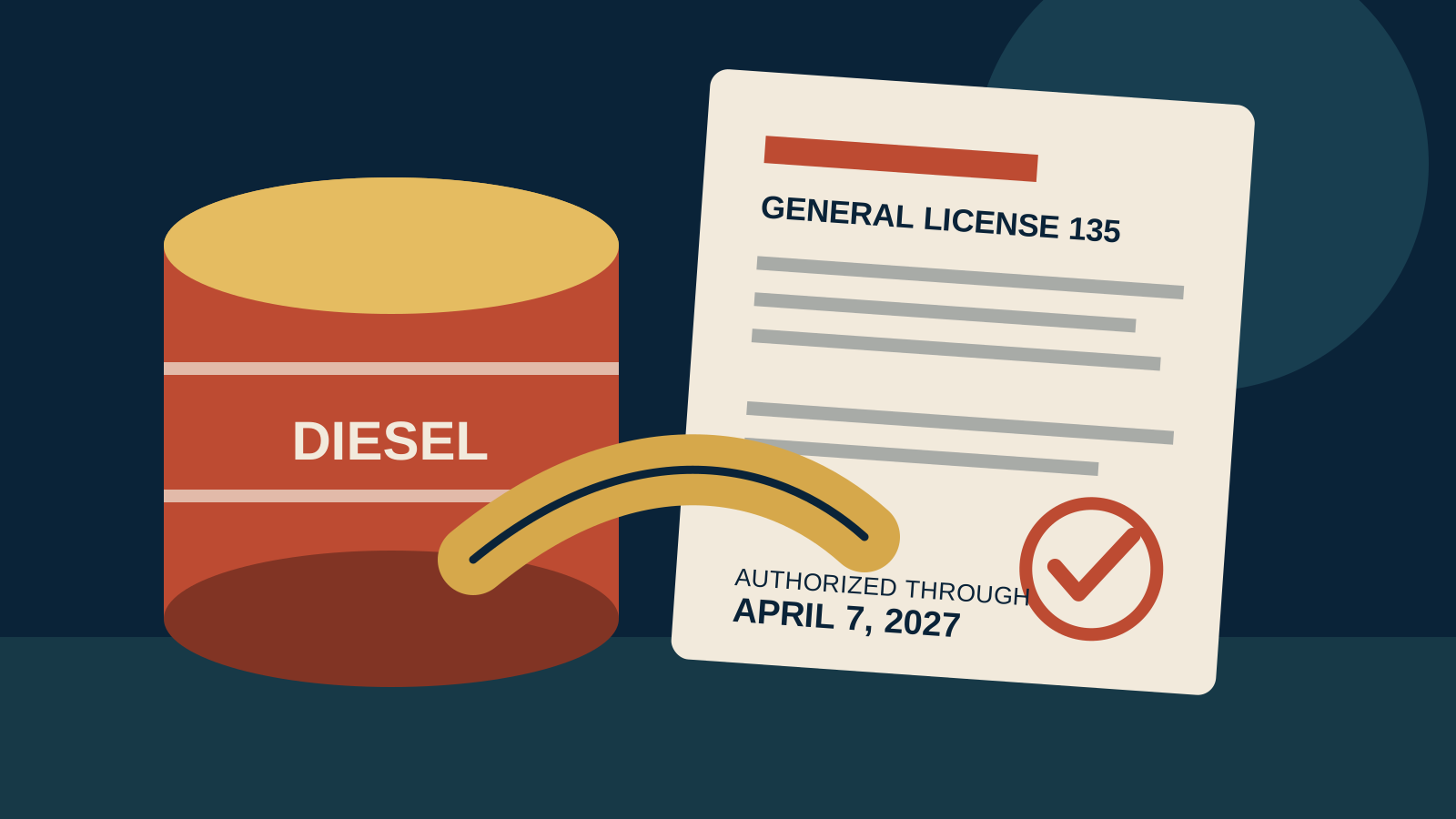
Verified Baseline
Treasury authorized Russian diesel transactions through April 7
The U.S. Treasury Department’s Office of Foreign Assets Control issued General License 135 on Friday. It authorizes transactions otherwise prohibited by two Russia sanctions programs when they involve the sale, delivery, offloading or importation—including importation into the United States—of Russian-origin diesel.
The authorization expires at 12:01 a.m. Eastern daylight time on April 7, 2027. It does not permit debits to accounts held at U.S. financial institutions for Russia’s central bank, National Wealth Fund or Finance Ministry.
That signed license is the clearest confirmed policy change. It creates legal space for qualifying transactions; it does not itself compel Russia, traders, shippers or refiners to deliver any specific volume.
What Trump Announced
The promised schedule totals as much as 4.8 million tons
Trump wrote after a call with Russian President Vladimir Putin that Russia would supply more than 300,000 tons immediately, another 500,000 tons in November and 1 million tons “immediately thereafter.” He said a further 3 million tons could follow within a short period, depending on the condition of Russian refineries.
Reuters and the Associated Press reported the announcement. Putin’s envoy Kirill Dmitriev praised U.S.–Russia energy cooperation, but the Kremlin had not published a detailed shipment agreement at publication time. The countries, companies, ports and prices attached to the volumes were not disclosed.
Verified fact: OFAC issued the authorization. Presidential claim: Russia agreed to the delivery schedule. Not yet verified: that all 4.8 million tons will be produced, sold, shipped and delivered on that timetable.
Why It Matters
The move trades some sanctions pressure for additional fuel supply
The United States restricted Russian energy trade after Russia’s 2022 invasion of Ukraine. General License 135 is a targeted exception for diesel, not a cancellation of all Russia sanctions, but it marks a significant policy change by allowing imports into the United States.
Diesel is central to trucking, farming, construction and heating. Reuters reported that the U.S. retail average reached $6.28 a gallon Thursday, about 70% higher than before the U.S.–Iran war began. Tight refining capacity, attacks on Russian refineries, Middle East disruption and low inventories have all constrained supply.
The decision also creates a geopolitical tradeoff. More Russian diesel could ease a global shortage, while the associated sales may provide revenue to a government still at war with Ukraine. How much revenue reaches Russia will depend on prices, sellers, intermediaries and transaction terms that have not been made public.
Practical Implications
Authorization can help supply, but it does not guarantee cheaper fuel
- At the pump: additional supply may reduce wholesale pressure, but retail prices also reflect refining margins, transport, inventories, taxes and local competition.
- For businesses: qualifying transactions can proceed without violating the covered sanctions provisions until the license expires, subject to its limits and other applicable rules.
- For farmers and truckers: price relief, if it arrives, will depend on actual cargoes and where they are delivered—not the headline tonnage alone.
- For Ukraine policy: the diesel exception narrows energy pressure on Moscow while other U.S. sanctions remain.
- For markets: traders will watch shipping data, refinery output and Russia’s own export restrictions for evidence that the promised barrels are moving.
What Remains Uncertain
Commercial terms and delivery evidence have not been released
No public contract identifies buyers, sellers, payment terms, ports or the share intended for the United States rather than other markets. Russia had extended restrictions on most diesel exports through October after Ukrainian attacks damaged refinery capacity, adding another execution risk.
Analysis: the license can affect markets immediately because it removes a legal barrier, but durable price relief requires physical supply. The initial 300,000 tons is meaningful yet small relative to global consumption.
Forecast: wholesale prices may respond before retail prices. Any sustained decline will depend on whether later, much larger shipments materialize and whether new disruptions offset them.
Opinion: Health Politics Daily takes no position on the deal. Claims of immediate consumer relief and claims that the license dismantles the entire sanctions regime both go beyond the available evidence.
Bias Lens: how coverage frames the diesel agreement
Trump announced a Russian supply schedule, and OFAC issued a time-limited license covering Russian-origin diesel transactions. Shipment completion and consumer-price effects are not yet established.
Left-leaning coverage: The New Republic emphasizes the benefit to Putin and the tension with sanctions policy. Center coverage: Associated Press leads with the reversal of U.S. pressure on Moscow while detailing the shipment schedule and temporary license; Reuters foregrounds supply and price politics. Right-leaning coverage: The Wall Street Journal frames the agreement around household and farm costs while noting the sanctions and Ukraine-policy tradeoff.
The central framing difference is whether the first question is consumer prices, sanctions leverage or political timing. The signed OFAC license and evidence of actual cargo movements provide the most reliable baseline for evaluating each emphasis.
Principal Sources
Primary record and corroborating reporting
- U.S. Treasury OFAC — General License 135
- U.S. Treasury OFAC — recent actions
- Associated Press — announcement, sanctions context and responses
- Reuters — shipment schedule and diesel-market context
- Reuters — Russia’s October export restrictions
No directly relevant official or publisher-authorized video with clearly confirmed embedding permission was available at publication.