WORLD — SERBIA
Serbia’s Vučić Resigns as President: What Happens Next
Aleksandar Vučić left the presidency seven months before his term was due to end so he can seek the prime minister’s office. The move changes his position, not his political ambitions, and puts Serbia on two election tracks.
By Health Politics Daily News Desk · Published Sunday, September 27, 2026 at 4:00 p.m. America/New_York · Approximately 7 minutes
Verified Baseline
Vučić resigned and Serbia must elect a new president
Vučić announced his resignation on Sunday, ending his second presidential term about seven months early. He had already called a snap parliamentary election for October 25 and said he intends to run for prime minister.
Under Serbia’s constitutional process, outgoing parliament speaker Ana Brnabić becomes interim president. A presidential election must be completed within 90 days. The Serbian presidency’s constitutional summary explains the succession and election requirement, while the government confirms the October 25 parliamentary date.
What the Resignation Means
He is leaving one office while seeking another
The president represents Serbia, signs laws and nominates a candidate for prime minister after consulting parliamentary groups. The prime minister leads the government and depends on support in parliament. Vučić’s resignation therefore does not itself make him prime minister.
He can return to executive power only if his Serbian Progressive Party and allies secure enough parliamentary support and the constitutional appointment process is completed. Until then, Serbia has an interim president and its existing government continues under the applicable rules.
Why It Matters
The October election becomes a direct test of Vučić’s political model
Vučić has served as president or prime minister for roughly 12 years. The parliamentary contest pits his governing bloc against Students Win, a student-led anti-corruption movement, and European Serbia, a pro-Western opposition alliance.
The vote follows nearly two years of protests driven by anger over corruption, public accountability and the deadly Novi Sad railway-station canopy collapse. Opposition groups have also raised concerns about media conditions and the fairness of earlier elections. The governing party rejects claims that it has undermined democratic competition.
Practical Implications
Serbia now has separate parliamentary and presidential campaigns
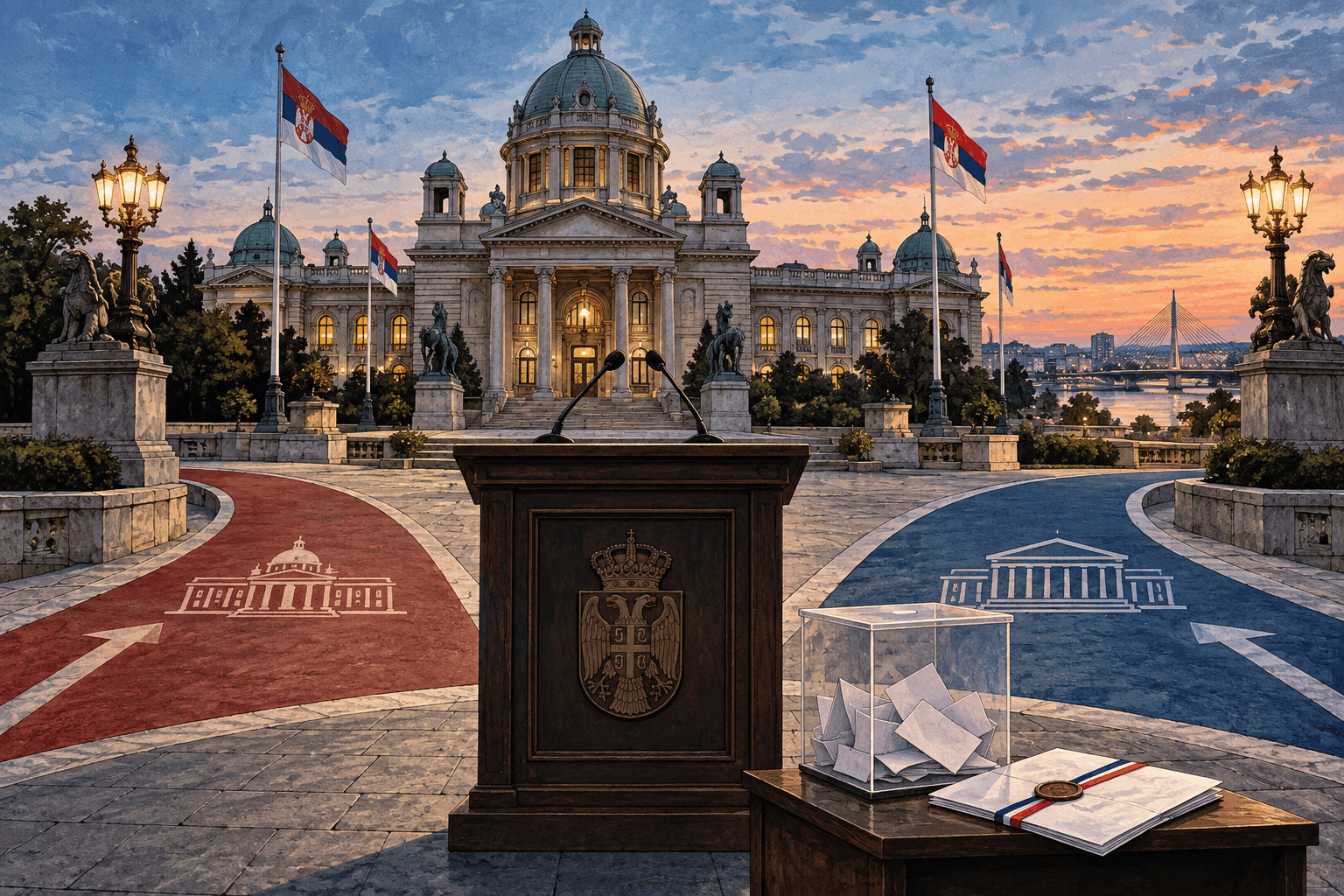
Voters will choose lawmakers on October 25. That result determines who can form a government and whether Vučić can plausibly become prime minister. A separate presidential election must follow within the constitutional deadline, and opposition parties had not all selected presidential candidates at publication.
For Serbia’s foreign partners, the institutional transition does not immediately change policy toward the European Union, Russia, Kosovo or regional security. Those positions may be contested during the campaigns, but any forecast about a new government remains conditional on the election results and coalition arithmetic.
Bias Lens: how coverage frames the resignation
Vučić resigned as president, Brnabić becomes interim president, parliamentary elections are scheduled for October 25, and a presidential election must be completed within 90 days.
Reuters emphasizes the constitutional sequence and the two election contests. Associated Press foregrounds the student-led protests and describes the election as a test of Vučić’s long rule. Tanjug, Serbia’s state news agency, centers Vučić’s own explanation of service and electoral accountability. These frames reflect different editorial priorities; the official election dates and succession rules remain the same. A meaningful left-center-right English-language comparison was not available, so labeling outlets by ideology would add more assumption than clarity.
What Remains Uncertain
Neither Vučić’s return nor the next government is guaranteed
The major unknowns are the October parliamentary result, possible coalition negotiations, who will contest the presidency and whether opposition groups will accept the conduct and outcome of the votes.
Vučić has set a political goal, not completed a transfer to the prime minister’s office. Claims that he has already “switched jobs” or retained the presidency under another title are inaccurate.
Principal Sources
Evidence and reporting used
- President of Serbia — constitutional duties and succession
- Government of Serbia — October 25 parliamentary election
- Reuters — resignation, succession and election timetable
- Associated Press — political context and opposition challenge
No suitable directly relevant authorized video with clear embedding permission was available.