INTERNATIONAL POLITICS — UKRAINE — Developing · Automated Assistance Disclosed · Editor Review Recommended
Is There a Russia–Ukraine Ceasefire? What the Limited Proposal Covers
Secretary of State Marco Rubio says both sides have expressed interest in protecting energy and grain-related targets. That is a diplomatic opening—not a signed ceasefire.
By Health Politics Daily News Desk, United States · Published Wednesday, September 23, 2026 at 2:02 p.m. America/New_York · Approximately 6 minutes

Watch in this article
Pumpjack operating at the Kern River Oil Field
A short CC0 field video provides visual context for reporting on oil production and fuel supply.
Thomas Farley / Wikimedia Commons · CC0 1.0 · License and source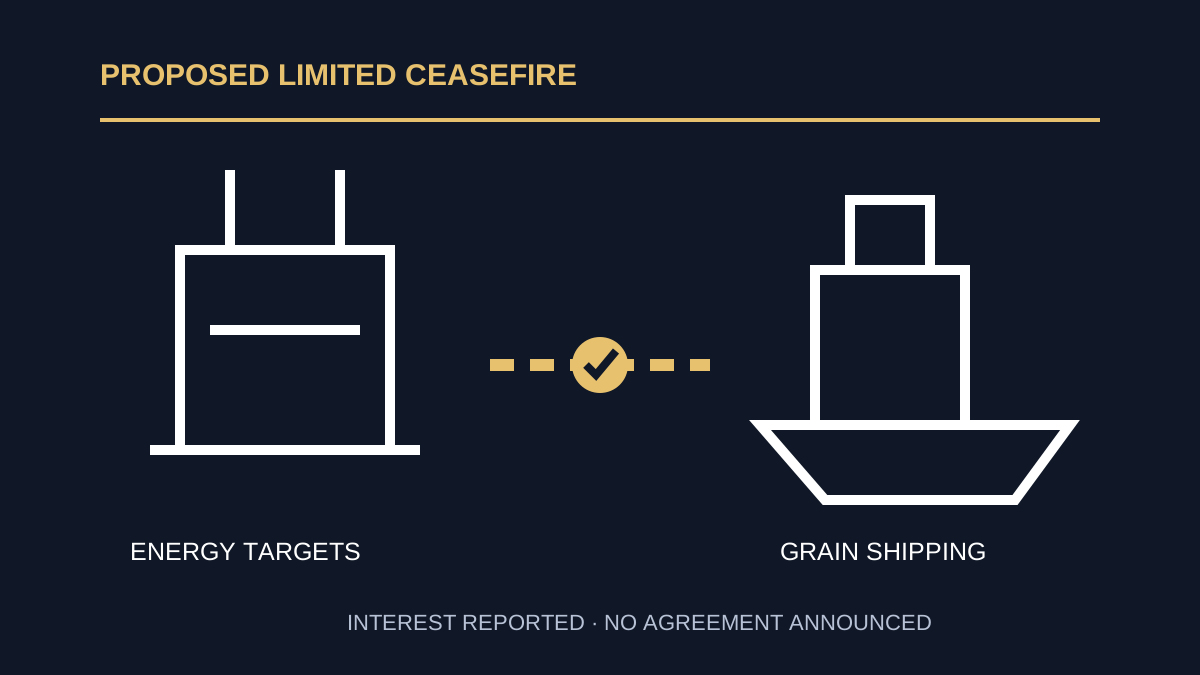
Verified Baseline
Interest was reported; an agreement was not
After meeting Russian Foreign Minister Sergei Lavrov in New York, Rubio said Russia and Ukraine had each expressed interest in a limited ceasefire involving energy and grain-related targets, according to Reuters on September 23. Ukrainian President Volodymyr Zelenskyy publicly said Kyiv was ready for a maritime truce and awaited Russia’s response.
Russia has not publicly accepted a maritime or energy truce. Lavrov told the U.N. Security Council that Moscow opposed a temporary pause that Europe could use to rearm Ukraine. Those positions mean there is no announced ceasefire, start date or enforceable text.
What It Could Cover
Energy systems and Black Sea grain routes are the proposed first steps
An energy arrangement could restrict attacks on power plants, grids, heating systems, refineries or pipelines, but negotiators would have to define exactly which facilities qualify. A maritime arrangement could reduce attacks on ports and commercial shipping and make grain exports more predictable.
Those categories overlap with military strategy. Ukraine targets Russian refining capacity and revenue; Russia has repeatedly attacked Ukrainian energy systems. Rubio acknowledged that this makes even a narrow deal difficult.
Why It Matters
A narrow truce could protect civilians without settling the war
Reduced strikes on power and heating facilities could lower winter risks for households and hospitals. Safer Black Sea shipping could help stabilize grain exports relied upon by importing countries. But a limited arrangement would not resolve territorial claims, battlefield operations or the wider political settlement.
This is analysis of possible effects, not a forecast that an agreement will be reached or honored.
What Would Make It Real
Definitions, monitoring and consequences are still missing
- A written list of protected facilities, ports, ships and cargoes.
- A start time, duration and procedure for extension or withdrawal.
- Independent monitoring capable of attributing missile, drone and maritime incidents.
- A dispute channel and agreed consequences for violations.
Earlier limited pauses have produced competing accusations. Without verification, each strike risks collapsing the arrangement.
Practical Implications
No immediate change for travelers, shippers or energy consumers
Commercial operators should continue using current government and maritime-security notices. Households and businesses should not assume energy or food prices will fall because talks are underway. Markets may react to diplomatic signals, but real supply effects depend on sustained compliance.
What Remains Unknown
Russia’s position and the scope of U.S. guarantees remain unclear
Rubio did not disclose what Russia communicated privately or whether Moscow would accept outside monitoring. Ukraine has asked for reliable, long-term guarantees. It is also unclear whether grain refers only to commercial vessels, to ports and storage sites, or to a broader Black Sea security regime.
Bias Lens: the limited-ceasefire proposal
Rubio reported mutual interest in narrow talks; Ukraine publicly endorsed maritime discussions; Russia has not publicly accepted the proposal and Lavrov rejected a temporary pause.
Framing differs over whether civilian protection, battlefield leverage or fuel costs deserve the lead. None of those emphases proves that a ceasefire exists.
Principal Sources
Evidence and reporting used
- Reuters — Rubio statement, Ukrainian position and Lavrov response
- U.S. State Department — Rubio’s earlier public discussion of an energy arrangement
- Reuters — French diplomatic proposal and energy-system context
- Associated Press — sanctions and wider negotiating pressure
No suitable directly relevant official or publisher-authorized video with clear embedding permission was available, so none is embedded.