Serbia · Elections · International politics
Serbia’s Student List Wins Parliamentary Election as Vučić Concedes
Aleksandar Vučić conceded after projections gave the student-backed list a majority. The official count and final seat allocation remain pending.
By Health Politics Daily News Desk · October 25, 2026 at 5:57 p.m. ET

Watch in this article
Pumpjack operating at the Kern River Oil Field
A short CC0 field video provides visual context for reporting on oil production and fuel supply.
Thomas Farley / Wikimedia Commons · CC0 1.0 · License and source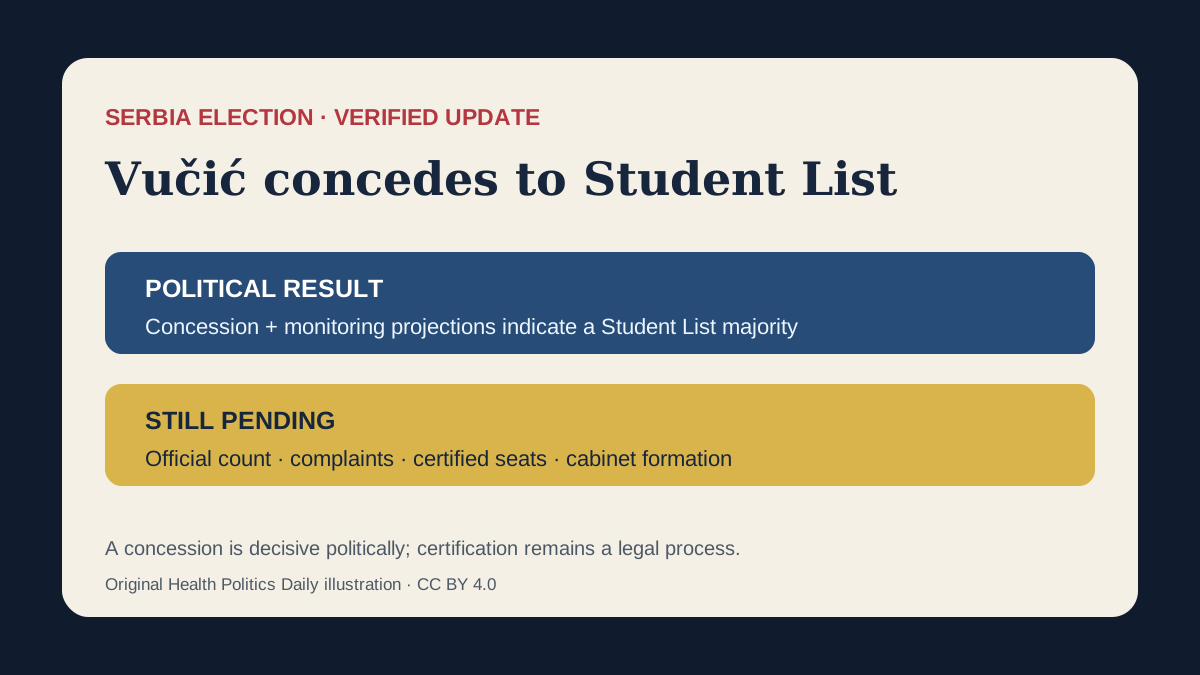
Verified baseline
Aleksandar Vučić conceded defeat Sunday in Serbia’s parliamentary election, saying a representative sample showed the student-backed Student List had won. He estimated the movement would secure 135 to 140 seats in the 250-seat National Assembly, above the 126 needed for a majority, while his bloc would receive about 105. Reuters reported the concession, and the Associated Press independently reported it.
This establishes that Vučić accepts political defeat; it is not the same as a certified result. Serbia’s Republic Electoral Commission must complete the count, adjudicate complaints and publish the final allocation. Projections can change at the margins even when the overall winner is clear.
How a protest movement reached parliament
The Student List grew out of protests following the November 2024 collapse of a railway-station canopy in Novi Sad that killed 16 people. Demonstrators linked the disaster to alleged corruption, weak oversight and a lack of accountability. The movement later fielded a nationwide list of academics, professionals and public figures selected through student assemblies.
Vučić and the Serbian Progressive Party had dominated national politics for more than a decade. The snap election therefore became a referendum on institutional control as much as a contest over individual policies. Turnout was the highest in more than 30 years, according to Reuters, increasing the political weight of the result.
What changes now
A projected majority gives the Student List a path to form a government without relying on Vučić’s bloc, but several constitutional steps remain. Final results must be certified, the assembly must convene, and a prime minister and cabinet must win parliamentary support. Minority lists may also receive protected seats under Serbia’s electoral rules.
The movement has emphasized anti-corruption enforcement and institutional independence. Its position on day-to-day governing questions—including budgets, public services, Kosovo, relations with Russia and the pace of European Union integration—will now face greater scrutiny. Winning an election does not automatically produce administrative control or rapid reform.
Election-integrity questions remain
CRTA’s election-monitoring mission reported high turnout alongside pressure on voters, procedural irregularities and violent incidents at or near some polling places. Those findings require investigation, but they do not by themselves invalidate every ballot or establish that the projected winner benefited. Complaints should be evaluated through documented evidence and the applicable legal process.
Practical implications
Serbian residents should rely on the electoral commission for certified totals and complaint deadlines. Businesses, travelers and neighboring governments should expect policy continuity in the immediate term because cabinet formation takes time. Currency or market moves are not a substitute for confirmed policy; this article provides no personalized investment advice.
Fact, analysis, forecast and opinion
Verified fact: Vučić conceded, and major monitoring projections place the Student List first with a likely majority. Analysis: the result reflects unusually broad mobilization after nearly two years of protests. Forecast: attention will shift to certification, cabinet formation and the movement’s governing program, but the timing and personnel are uncertain. Opinion: Health Politics Daily endorses no Serbian party or movement.
Bias Lens: how outlets frame Serbia’s result
Verified baseline: Vučić conceded; projections put the Student List ahead with a majority; the official count is unfinished; and election monitors documented irregularities.
Left-leaning framing: The Guardian emphasizes democratic change after protests and describes the result as a seismic shift. Center framing: Reuters leads with the concession, projected seats and the protest movement’s origins. Right-leaning framing: Fox News’s pre-election report framed the contest around Vučić’s conservative record, security relationships and the students’ lack of governing experience. These are differences in emphasis, not different vote counts.
What remains uncertain
The final vote shares, seat allocation, validity of specific complaints, composition of the next cabinet and timing of a transfer of power remain unresolved. The Student List’s ability to remain cohesive in government is also untested.
Principal sources
- Republic Electoral Commission — official counting and certification
- CRTA — independent election monitoring
- Reuters — concession, projections and turnout
- Associated Press — corroborating result coverage
No suitable directly relevant official or publisher-authorized video with clear downstream embedding permission was available, so no video was embedded.